
CHAPTER 2: THE PAPER TRAIL
The basement air of the Butler County Recorder’s Office smelled of decayed cellulose, damp limestone, and the ozone tang of an old microfiche reader humming in the corner. It was a cold, institutional smell that reminded Joel of hospital morgues—a place where human lives were boiled down to dried ink, deed numbers, and quiet tax liens.
He sat at a scratched formica table under buzzing fluorescent tubes, his fingers dusted with gray silt as he unspooled a reel of 35-millimeter microfilm. The black-and-white images flickered across the frosted glass viewer, projecting decades of forgotten property transfers, street widenings, and parcel subdivisions onto his face.
On his right lay a yellow pad with three columns of notes: Chain of Title, Zoning Exceptions, and Tax Assessments. On his left sat his cold coffee tumbler, its stainless steel wall sweating tiny beads of moisture onto the Formica.
“You’re digging deep, Carver,” the clerk said, her voice dry as static. Her name was Mrs. Gable, a woman in her late sixties with silver cat-eye glasses suspended around her neck by a beaded lanyard. She leaned over the counter, holding a heavy cardboard box labeled 1965–1970 Municipal Right-of-Way Grants. “Most folks just want their current boundary lines so they can build a cedar fence. You look like you’re hunting a murder suspect.”
“Just hunting an easement,” Joel replied, his thumb turning the chrome knob on the microfiche reader, advancing the film frame by frame. “Market Alley. Rear access to Parcel 410.”
“Ah. Market Alley,” Mrs. Gable murmured, letting out a short, knowing sigh. “Patsy Albright’s empire. She came in here four months ago with two paralegals, demanding we pull every commercial permit for the alley block back to 1990. Treated my girls like counter clerks at a fast-food drive-thru.”
Joel stopped turning the knob. “Did she pull the original right-of-way plats?”
“Didn’t bother,” Mrs. Gable said, tapping her nail against the cardboard box. “She only wanted the merchant association registrations and tax assessment maps from 2012 onward. Once she saw her association name listed as the primary administrator for street festival staging, she walked out like she owned the limestone under the courthouse.”
Joel reached into the box, lifting out a thick, leather-bound volume titled City of Fairfield Public Way Records: Volume 42 (1968). The spine creaked when he opened it, releasing a faint cloud of paper dust. He flipped past hand-drawn street maps and handwritten city council minutes, his eyes scanning for the legal description of Market Alley.
Page 142 held the document he was looking for: 1968 Municipal Ordinance 402-B: Public Loading Zone Grant.
The document was crystal clear. The city council had formally designated the entire twenty-foot-wide lane running between Market Street and Pine Alley as a dedicated municipal public right-of-way. The grant was perpetual, binding all future property owners and prohibiting any private entity, merchant board, or neighborhood committee from erecting barriers, charging access fees, or restricting commercial loading for adjoining parcels.
At the bottom of the page sat an embossed gold foil seal, crisp and raised against the parchment: City of Fairfield—Public Way Dedicated.
Joel pulled his phone from his apron pocket, taking three clean, high-resolution photographs of the page, ensuring the embossed seal and municipal volume number were razor-sharp.
“Got her,” Joel muttered softly.
“Don’t celebrate just yet,” Mrs. Gable said quietly, reaching across the counter and sliding a second, thinner folder toward him. It was a modern manila folder, bright and unweathered compared to the 1968 ledger. “While you were scrolling through the microfiche, I ran a title check on your specific parcel—Parcel 410. Something flagged in the active encumbrance index three weeks ago.”
Joel took the folder, his chest tightening slightly. He opened it to reveal a single-page document filed with the county clerk under an expedited commercial recording process.
It was a Notice of Commercial Assessment Lien & Structural Encroachment.
The claimant was listed as Highland Development Holdings LLC, with a corporate mailing address in Cincinnati. The document claimed that the rear loading ramp of Caleb’s workshop—a concrete pad poured in 1974—extended four inches past the property line into “privately administered commercial common space,” accruing daily unauthorized usage fines totaling eleven thousand four hundred dollars. Attached to the back was a temporary intent-to-foreclose notice, set to take effect in thirty days if the balance remained unpaid.
Joel read the signature line at the bottom. The document had been signed by a managing partner named Garrett Finch—Patsy Albright’s first cousin and a commercial real estate developer who owned three renovated retail spaces on Market Street.
Beneath Garrett Finch’s signature sat a faded purple ink stamp that caught Joel’s eye—a tax reconciliation mark dated September 2018. The stamp pattern was strange, using a archaic legal format that didn’t match the modern municipal stamps used elsewhere in the file.
“This lien was recorded without a court judgment,” Joel said, his eyes narrowing as he analyzed the filing structure. “It’s an administrative cloud on the title. It doesn’t give them legal ownership, but it stops me from refinancing or securing a business line of credit.”
“And if you don’t contest it within thirty days,” Mrs. Gable added, leaning closer, “it automatically triggers a tax sale notice through the county treasurer’s office. Garrett Finch buys up tax liens for a living, Carver. He buys them for fifty cents on the dollar, waits out the redemption period, and takes the deed.”
Joel stood up slowly, closing the 1968 ledger. The cold anger in his gut was no longer a flare of adrenaline; it was a cold, calculated matrix of facts, timelines, and legal leverage. Patsy wasn’t just trying to collect two hundred and fifty dollars for a flatbed lumber delivery. She was using her association to manufacture fake compliance violations, while her cousin used fraudulent commercial liens to force an administrative foreclosure on Caleb’s workshop.
“Mrs. Gable,” Joel said, pulling a twenty-dollar bill from his wallet for the copy fees. “Can you print me two certified copies of the 1968 right-of-way grant with the official county seal?”
“I can print three if you need them, son,” the old clerk replied, her eyes bright behind her cat-eye glasses. “And if you happen to need the personal home address for Mr. Garrett Finch’s registered agent in Cincinnati, it’s listed right here on page two of his corporate filing.”
Joel took the certified copies, sliding them carefully into his leather binder alongside the photos of Patsy’s Escalade. As he walked out of the courthouse basement and into the bright midday sun of High Street, his phone buzzed in his pocket.
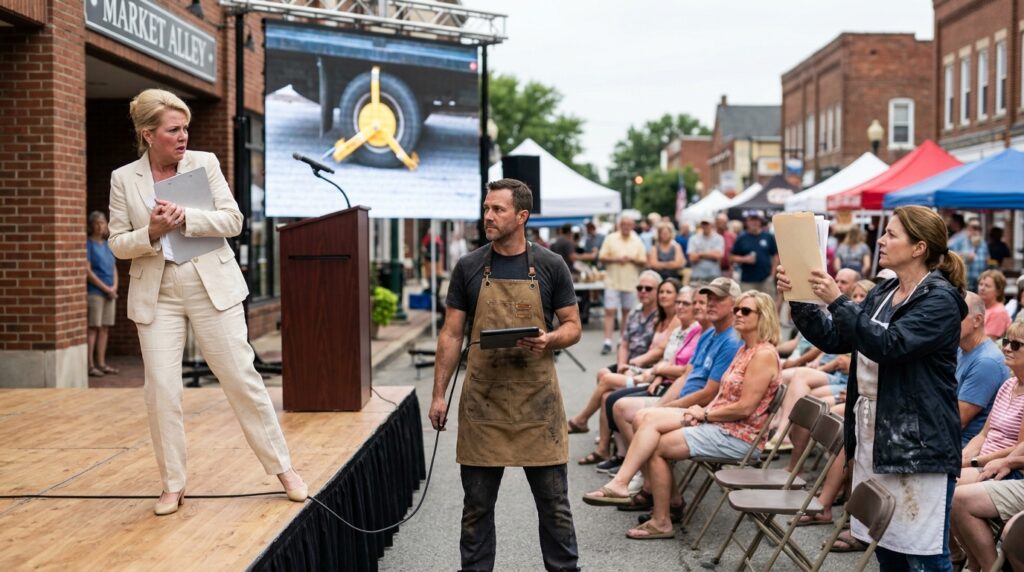
It was a text message from an unknown number: Your customer’s truck in the alley just got a yellow gift on the front tire. You have until 6:00 PM to pay the back assessments, or the wrecker takes it.
Joel didn’t hurry his pace. He walked calmly to his work truck, opened the door, and placed the binder on the passenger seat. Then he reached under the dash and tapped the cloud sync button on his security camera hub.