CHAPTER 3: THE MIDNIGHT BOOT CLOUD SURVEILLANCE
The drive from the courthouse basement to Market Alley took precisely fourteen minutes. Joel didn’t accelerate through yellow lights. He didn’t grip the steering wheel until his knuckles turned gray. He sat upright behind the wheel of his work truck, his eyes scanning the rear-view mirrors, his mind systematically processing the geometry of the trap Patsy Albright had laid.
When he turned the truck into the alley mouth, the smell hit him before the visual did—the heavy, unburned stench of gasoline fumes drifting from the open exhaust of an idling tow truck parked across the pedestrian thoroughfare.
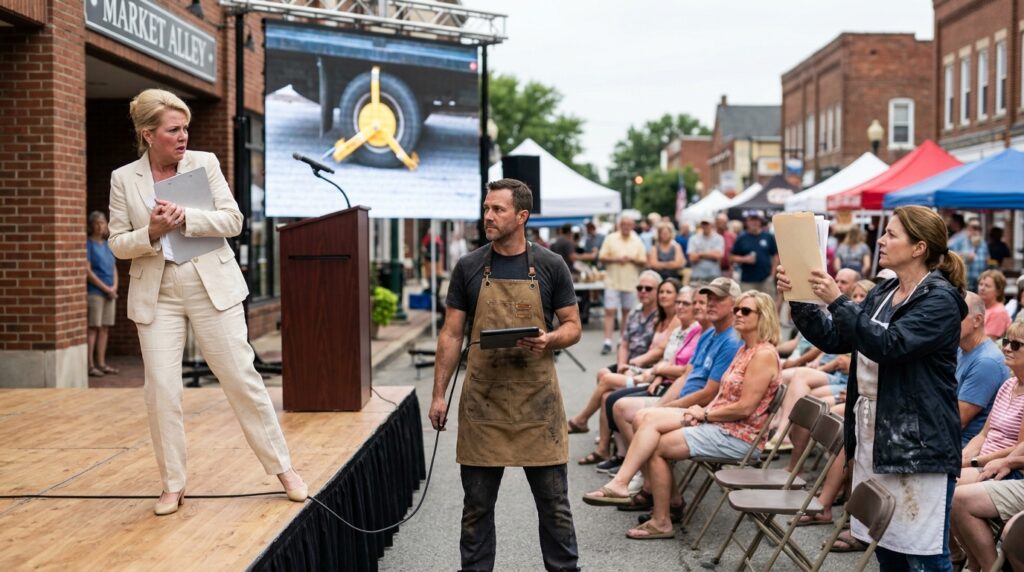
Standing beside the flatbed wrecker was a man in grease-stained blue coveralls, holding a long steel crowbar. Beside him, her arms folded tightly across her magenta floral tunic, stood Patsy Albright. On the concrete loading pad directly in front of Caleb’s workshop bay sat Dan’s heavy-duty Ford F-250—the contractor’s truck that had arrived two hours earlier to collect a restored ten-foot white oak dining table.
Secured tightly around the front driver-side wheel of Dan’s truck was a heavy, yellow powder-coated mechanical steel boot. Its hardened locking arm was jammed against the brake rotor, clamped so tightly that any attempt to roll the vehicle would instantly shear the tire valve or shatter the wheel hub.
Dan stood on the loading pad three feet from Patsy, his broad face flushed red under his dust-covered baseball cap, his hands clenched into tight, heavy fists at his sides.
“I’ve got forty workers waiting on two-by-fours at a framing site in West Chester, Patsy!” Dan roared, his voice echoing off the damp brick walls. “You can’t put a damn lock on my vehicle while I’m picking up custom furniture!”
“This vehicle is parked in an active enforcement zone without an authorized Historic Merchant loading permit,” Patsy said, her voice dropping into a cold, practiced cadence. She didn’t look at Dan. She looked at her aluminum clipboard, tapping her acrylic nail against a orange citation slip. “The release fee is three hundred dollars cash, payable to the administrative operator on site. Plus a two-hundred-dollar gate call fee for the wrecker.”
“Cash?” Dan spat the word out like gravel. “You don’t take a check? You don’t have a credit card reader?”
“The administrative release for unauthorized commercial obstructions is cash-only, sir,” Patsy replied smoothly. “If the balance isn’t settled within fifteen minutes, the wrecker hooks the rear axle and pulls it to the Cincinnati impound lot. Storage is eighty-five dollars a day.”
Joel set the truck in park, pulled the key from the ignition, and stepped down onto the asphalt. The heel of his work boot struck the pavement with a heavy, single thud. He didn’t run. He walked with measured, deliberate strides, his leather binder tucked firmly under his left arm.
“Don’t reach into your wallet, Dan,” Joel said.
Patsy’s head snapped around. Her oversized sunglasses glinted under the gray cloud cover, hiding her eyes, but the corners of her mouth twitched downward into a thin, bitter line. “Stay out of this, Carver. This vehicle is in violation of district traffic codes. The operator is executing an administrative impound.”
“The operator is committing a felony under Ohio Revised Code section 2913.02,” Joel said, stopping three feet from the tow truck driver. He didn’t look at Patsy; he looked directly at the man in the coveralls. “Unlawful restraint of personal property using an uncertified mechanical device on a municipal public right-of-way. The fine is up to five thousand dollars, plus mandatory license revocation for commercial towing operators.”
The tow truck driver hesitated, lowering his crowbar an inch. He shifted his weight on the asphalt, glinting nervously at Patsy. “Look, lady… you told me this was a private commercial court with a civil enforcement contract.”
“It is a private commercial court!” Patsy snapped, her voice cracking slightly. “My board holds administrative authority over all rear access bays!”
Joel opened his leather binder, pulled out the certified copy of the 1968 municipal right-of-way grant, and held it up directly in front of the driver’s face. The gold embossed seal of the City of Fairfield caught the pale daylight.
“Municipal Ordinance 402-B,” Joel stated coldly. “Dedicated public thoroughfare. The city owns the pavement beneath your boots. The Historic District Merchants Association is an unregistered private entity with zero traffic enforcement authority.”
Joel then turned his gaze to the small white housing mounted beneath the eaves of his workshop roof. The glass dome of his newly installed 4K cloud-connected security camera gleamed in the shadow, its infrared ring pulsing with an almost invisible red glow. He pulled his smartphone from his pocket, unlocked the screen, and tilted it toward Patsy.
The screen displayed a crystal-clear, high-definition video playback from 5:42 AM. On the screen, in razor-sharp detail, Patsy Albright was seen stepping out of her Escalade, opening her own trunk, manually lifting the yellow steel wheel boot out of her spare tire well, and carrying it across the alley to lock it onto Dan’s tire herself before the tow truck ever arrived.
“You bought that boot on Amazon, Patsy,” Joel said, his voice terrifyingly quiet. “You put it on this truck yourself three hours ago. You didn’t call a municipal enforcement officer. You staged an extortion setup on public pavement.”
Dan stared at the phone screen, his jaw dropping open. Then he turned on Patsy, his chest heaving with cold rage. “You locked my truck yourself? You tried to shake me down for three hundred bucks cash?”
Patsy took a step backward, her heels catching on the lip of the concrete drain. Her face had drained of all color, the thick layer of foundation failing to hide the sudden, stark terror in her expression. “That video… that video is an illegal invasion of privacy! You don’t have authorization to record commercial operations in this corridor!”
“This camera points at a public right-of-way,” Joel said. “The cloud server automatically synced this footage to the Butler County Prosecutor’s public evidence portal five minutes ago. Along with the dashcam footage from my flatbed delivery this morning.”
The tow truck driver didn’t wait for another word. He tossed his crowbar into the back of his flatbed, pulled a heavy steel key from his coverall pocket, knelt down beside Dan’s wheel, and frantically unlocked the yellow clamp. He threw the heavy boot into the alley grease, climbed into his cab, slammed the door, and jammed the truck into reverse, spraying gravel as he backed out onto Market Street at full speed.
Patsy stood alone on the damp asphalt, her aluminum clipboard trembling in her hand. She looked at Joel, her lips working silently for several seconds before she found her voice.
“You think you’ve won something here, don’t you, Carver?” she whispered, the composure completely stripped from her tone, leaving behind a raw, venomous spite. “You think a yellow piece of paper from 1968 protects you?”
“It protects the alley,” Joel said.
“It doesn’t protect you,” Patsy sneered, taking a step closer, her voice dropping so low Dan couldn’t hear it over the idling engine of his F-250. “Garrett filed the commercial lien on your parcel three weeks ago. Eleven thousand four hundred dollars in accrued structural encroachments. In twenty-one days, the county treasurer issues the foreclosure notice. My cousin buys your deed at the tax sale, and your brother’s precious shop gets leveled for a six-car parking garage.”
She turned and marched toward Market Street, her heels clicking furious, uneven rhythms against the brickwork.
Joel stood motionless on the loading ramp as Dan climbed into his truck, shouting his thanks before roaring out of the alley. Joel walked slowly into the cool, dark interior of his workshop. The smell of cedar sawdust and old oil wrapped around him, but the air felt heavy, charged with the lingering threat Patsy had spat at him.
He walked to Caleb’s old oak desk in the corner of the shop, pulling open the bottom drawer. He lifted out a worn leather desktop blotter, reaching into the hidden pocket at the back where Caleb kept backup receipts and property tax stubs.
Among the yellowed paper, his fingers brushed against an unfamiliar slip of heavy cardstock.
Joel pulled it out. It was an uncancelled promissory note dated September 14, 2018, made out for the sum of twelve thousand dollars. The borrower line was signed in Caleb’s looping handwriting. But the lender line at the bottom was signed by Garrett Finch—Patsy’s developer cousin.
Pinned to the back of the note was a small receipt from a cashier’s check, stamped with the exact same archaic purple tax reconciliation mark Joel had discovered earlier in the courthouse archives.
Joel stared at the purple ink, his pulse hammering in his ears. Caleb hadn’t just lost the shop to slow commercial decay. Four years before his death, Caleb had taken a secret, high-interest private loan from Garrett Finch—the very loan that Garrett had transformed into the fraudulent commercial lien now threatening the building’s title.
His phone buzzed in his hand. It was a text from Mona Higgins at the bakery across the lane: Joel, come to the back door. Eli and Sal are here. Patsy just went into Garrett’s office on Main Street, and they’re calling an emergency merchant meeting for tomorrow.
Joel folded the promissory note, placed it carefully inside his binder, and walked toward the back door of the shop.