
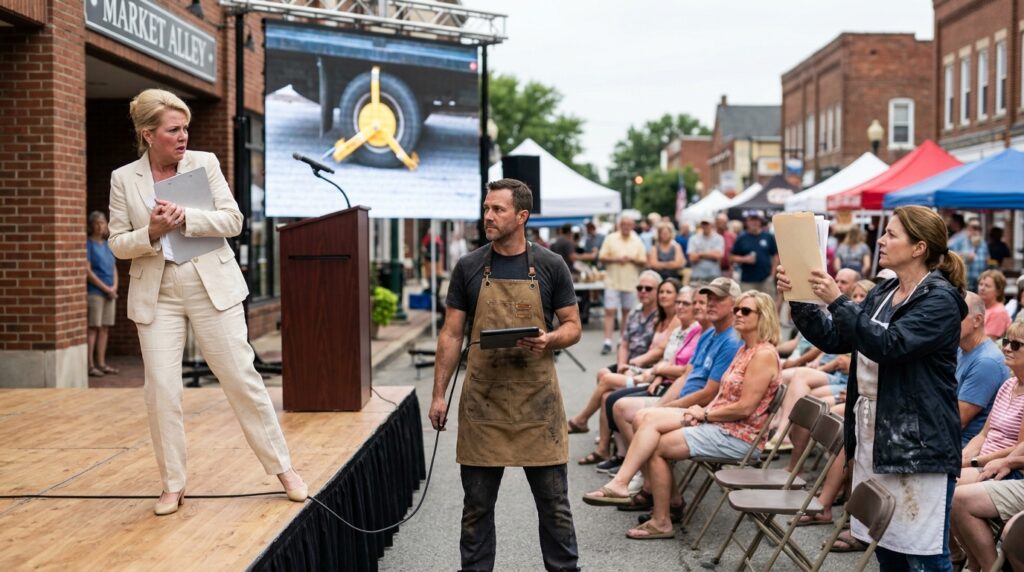
CHAPTER 1: THE LOADING BAY STANDOFF
The aluminum clipboard didn’t hit Joel’s chest hard enough to leave a bruise, but the sharp corner snagged the pocket of his canvas apron, tearing two threads of heavy-duty nylon.
“Sixty minutes, Carver,” Patsy Albright said. Her voice had the brassy, metallic rasp of a saw blade hitting a hidden knot in reclaimed pine. She stood on the damp concrete loading ramp of Caleb’s workshop, her magenta floral tunic jarring against the dark red brick of Market Alley. “Then the city hooks your flatbed and drags it to the impound lot at your personal expense.”
Joel didn’t step back. He didn’t drop his stainless steel tumbler either. Instead, he drew a slow, deliberate breath—four seconds in through his nose, hold for four, four seconds out—the exact rhythm he’d used for fifteen years while kneeling in broken glass on Interstate 75 to keep hemorrhaging drivers from slipping away. The cold morning air tasted of damp masonry, diesel exhaust, and fresh-cut cedar planks stacked on the idling truck behind her.
“The engine is off, Ms. Albright,” Joel said, keeping his tone flat, stripped of heat or hesitation. “The driver is unstrapping forty board-feet of aromatic cedar. We’ll be done in nine minutes.”
“You don’t get nine minutes!” Patsy’s acrylic nails clattered against the aluminum board as she waved a stapled four-page packet inches from his chin. Her oversized tortoiseshell sunglasses reflected the gray morning sky, masking her eyes, but the hard set of her jaw revealed the tension beneath her powder. “This alley is a designated Historic Merchant Pedestrian Corridor. Unapproved commercial unloading incurs an immediate two-hundred-and-fifty-dollar daily assessment. First check is payable to the Historic District Merchants Association by five o’clock, or your bays are red-tagged.”
Across the narrow brick lane, the wooden back door of the bakery creaked open. Mona Higgins stepped onto her flour-dusted doorstep, holding a tray of warm cinnamon rolls. She froze, her eyes widening as she recognized the magenta tunic, then quietly pulled the door half-shut, watching through the crack.
Joel adjusted his grip on his coffee tumbler, his gaze shifting past Patsy’s shoulder. Parked diagonally across the yellow painted hatch marks at the alley mouth, her pearl-white Cadillac Escalade idled, its driver-side door resting on the latch. Above the Escalade’s roofline, mounted inside the cab of the flatbed supply truck, the small blue status LED of a commercial dashcam blinked steadily, its wide-angle glass lens capturing every inch of Patsy’s stance, the idling SUV, and the forged towing authorization letter she was waving.
“My lease is recorded with Butler County, Ms. Albright,” Joel said softly, his voice dropping an octave into the quiet register he used when telling families a heart had stopped. “This building is parcel 410. It isn’t subject to private merchant covenants.”
Patsy let out a short, sharp bark of a laugh that rattled off the overhead fire escapes. “Sweetheart, every square foot of pavement between Market and Pine falls under my association’s stewardship. Your ignorance of municipal oversight doesn’t buy you a pass. Pay the assessment, or watch how fast a heavy-duty wrecker clears your bay.”
She shoved the stapled packet against his apron once more, turned on her heel, and marched toward her Escalade, her heels striking the asphalt like iron rivets.
Joel stayed motionless on the ramp, watching the white SUV back out into Market Street with a squeal of rubber. He took another slow sip of dark roast, the heat soaking into his palms. Then he pulled a small leather notebook from his back pocket, unsheathed a brass carpenter’s pencil, and wrote down the time—7:18 AM—and the Escalade’s license plate number. Beneath the entry, he noted the torn thread on his pocket, his eyes tracking a thin white envelope Patsy had dropped near the drainage grate—an envelope bearing a red stamp that hadn’t come from any city department.