
CHAPTER 4: THE ARRIVAL OF AUTHORITY
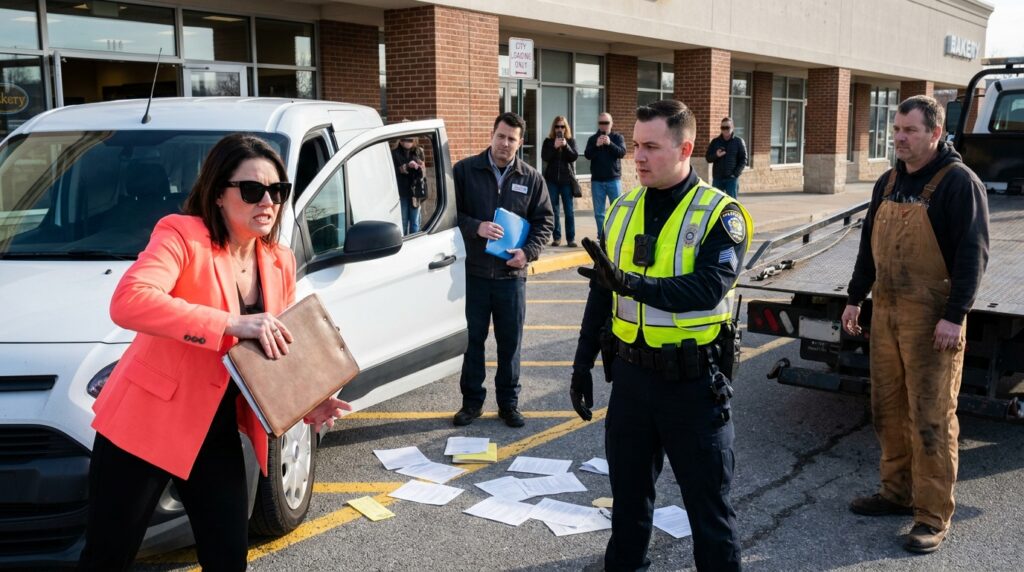
The cruiser’s door swung open with a crisp mechanical latch, and Officer Marcus Reynolds stepped out onto the sun-warmed asphalt. His high-visibility duty vest was pulled tight over a dark blue uniform shirt, the fabric worn soft at the elbows. He didn’t rush. He adjusted his duty belt with a methodical push of his thumbs, his body camera lens glinting black in the morning glare before his gaze took in the scene: the white van parked square in the yellow hatch lines, the idling tow truck behind him, the small crowd lining the sidewalk with raised phones, and Brenda standing dead center in the access lane like a toll collector at a bridge.
“Officer!” Brenda marched toward him before his boots had cleared the shadow of his vehicle door. She thrust her leather clipboard out, the silver pen trembling between her fingers. “I called dispatch fifteen minutes ago. This operator entered a restricted patron lane, refused to provide credentials, and threatened to push through when I attempted to enforce plaza access rules.”
Officer Reynolds held up one gloved hand, the motion small but absolute. “Step back to the sidewalk for a moment, ma’am. Let me get the lane clear first.”
“The tow truck is right behind you!” Brenda’s voice pitched higher, a nervous, breathless edge straining against her manufactured authority. “He’s trespassing on private merchant property. I have the signed management contract right here!”
Reynolds didn’t take the clipboard. He looked past her, his eyes settling on me where I stood by the open passenger door of my van. He took three unhurried steps forward, his boots crunching over tiny pebbles on the concrete.
“Morning,” he said. His voice was gravelly, the neutral, flattened tone of a man who spent his shifts mediating arguments over property lines and fender benders. “Driver’s license and registration, please.”
“Morning, Officer,” I said quietly. I handed him my state commercial operator’s license, the vehicle registration, and the laminated municipal loading permit from my visor. Alongside them, I laid out the city survey map and the dual-angle dashcam log display mounted on my dashboard. “The delivery is for Vasquez Bakery. Three commercial mixers and six pallets of flour. City code permits loading between six and ten AM in this bay.”
Reynolds took the documents. He flipped through the laminated permit, his eyes tracking the dark blue ink seal from the city clerk’s office, then looked up at the tall tin sign bolted to the light pole six feet away. He tapped his thumb against the edge of my registration card, his gaze shifting to the dashcam screen where the live feed showed Brenda’s coral jacket pressed tight against my front bumper.
“He’s lying!” Brenda insisted, stepping off the curb despite the officer’s instruction. She shoved the leather binder toward Reynolds’ side. “That sign is outdated! The merchant association signed an exclusive enforcement agreement. The tow driver is authorized under Section 4 of our bylaws to clear non-compliant commercial vehicles immediately!”
The tow truck driver—a burly man in grease-stained canvas overalls named Hank—had stepped down from his cab and walked over, his heavy iron winch hooks dangling from his hand. He looked at the tin sign on the pole, then at the laminated city permit Reynolds was holding, and finally at Brenda’s frantic face.
Hank scratched his jaw, leaving a smudge of grease along his cheekbone. “Officer, if that’s a municipal loading permit on the dash, I can’t hook this rig. County ordinance forbids private impounds on active municipal easements without a signed clearance order from code enforcement or traffic command. I ain’t taking a five-thousand-dollar illegal hook liability for a merchant board dispute.”
“It isn’t a dispute! It’s a violation!” Brenda shouted, her voice echoing off the brick walls. “I have the signed contract!”
In her panic to pull the contract from the binder, her hand caught the inner vinyl pocket. The loose sheets tumbled out, fluttering across the pavement toward Officer Reynolds’ boots. Among them was the expired management document with its fresh, blue-ink private stamp—and right beneath it, a pale yellow duplicate bank deposit slip.
Reynolds leaned down, picking up the papers with a slow, deliberate movement. His eyes skimmed the expired contract, then rested on the deposit slip. On the line marked ACCOUNT NAME, typed in crisp red ink, was KRAEMER BOUTIQUE – OPERATING ACCOUNT. On the line below it, hand-written in Brenda’s sharp, forward-slanting cursive, was a list of four cash payments of two hundred dollars each, labeled DOCK CLEARANCE – BAKERY / FLORIST / BISTRO.
Reynolds’ brow furrowed. He didn’t look at Brenda immediately. He looked at Elena Vasquez, who was standing on the bakery steps, her hands still wrapped in her flour-dusted apron.
“Ma’am,” Reynolds called out to Elena. “Do you pay a monthly dock fee to Ms. Kraemer?”
Elena swallowed hard, her eyes darting nervously toward Brenda’s rigid back before returning to the officer. “We… we paid two hundred dollars every first of the month. She said it went to the shared plaza maintenance fund for the loading docks.”
The silence that followed was heavy, cold, and absolute. The gathering crowd on the sidewalk went completely still, the soft whir of their phone cameras recording every inch of the space between Brenda’s pale face and the yellow paper in Officer Reynolds’ hand.
The decoy of her “enforcement contract” had shattered right there on the asphalt. But as I looked at the deposit slip in the officer’s hand, at the desperate, frantic hand-stitching on Brenda’s blazer cuff, and at the name of her boutique stamped across a personal operating account, I realized the truth was far uglier than a simple fake parking rule.
Brenda wasn’t trying to enforce order for the plaza. She was drowning.
“Ms. Kraemer,” Officer Reynolds said, his voice dropping into a dangerous, quiet register as he held up the deposit slip. “We need to talk about who authorized you to collect cash on a city easement.”