CHAPTER 3: THE GATHERING AUDIENCE
The call to dispatch hung in the air like exhaust smoke on an icy morning. Brenda lowered her smartphone, her fingers trembling slightly against the smooth glass case before she tucked it back into her blazer pocket. She stood tall, trying to project the unshakeable weight of an executive in her own courtyard, but the crack in her armor was already showing.
Elena stepped back toward the bakery entrance, her flour-dusted hands clasped tightly against her chest. “Brenda, you shouldn’t have done that. The police don’t need to be involved in a unloading bay dispute.”
“The police are being brought in to enforce order, Elena,” Brenda replied, her voice ringing out unnaturally loud, directed not just at us, but at the circle of bystanders expanding along the brick walkway. “When vendors decide they are above the rules of this plaza, the whole ecosystem falls apart.”
I didn’t answer her. I opened the heavy vinyl folder resting on the hood of my van. The sun was higher now, casting a pale, warm wash across the parking lot, glinting off the ceramic coffee mugs held by two men who had drifted over from the cafe tables. A young woman in a green barista apron stepped out onto the curb, holding her phone vertically, her screen reflecting the bright coral of Brenda’s blazer.
“You can record all you want!” Brenda called out toward the barista, turning her head just enough to catch the light. “Public accountability goes both ways! When the flatbed hauls this vehicle away, everyone will see that Oakridge Plaza protects its small businesses!”
I pulled a single sheet of paper from the left pocket of my folder—a high-resolution scan of the original 1998 municipal land deed. On the yellowed parchment, the yellow-hatched area directly beneath my boots was designated as a non-exclusive public utility easement, granted to the city in perpetuity to allow commercial access to the rear elevation of the storefronts.
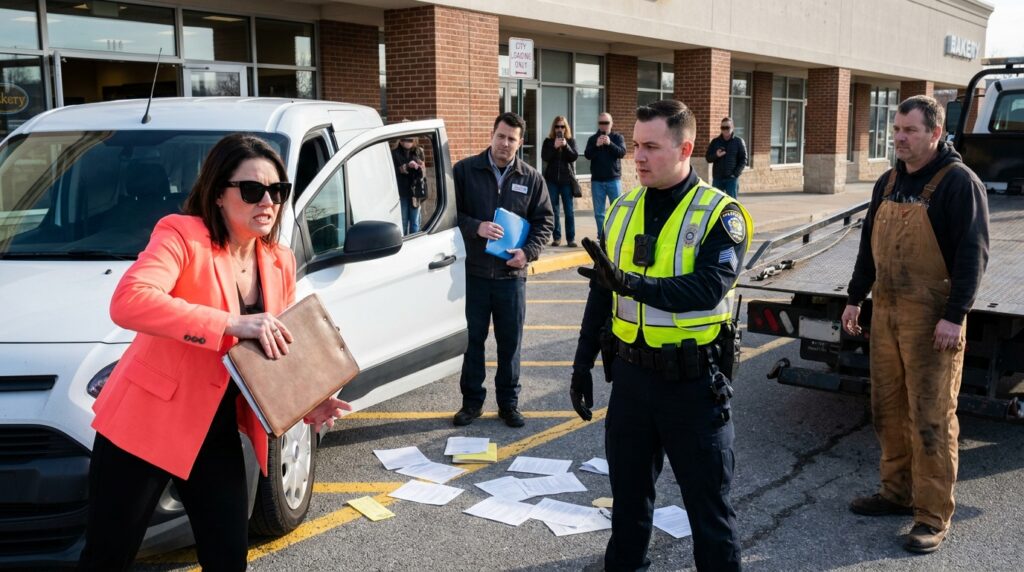
As I smoothed the paper against the cool hood, Brenda stepped forward, her leather binder swinging in her right hand. The flap slipped open for a second, and a loose sheet fluttered free, tumbling across the pavement until it caught against the toe of my work boot.
I leaned down and picked it up.
“Give me that!” Brenda snapped, reaching out with a sharp, grasping gesture.
I didn’t hand it back immediately. My eyes caught the header typed in faded black ink across the top: Oakridge Commercial Parking Rights Agreement & Exclusive Enforcement Authorization. At the bottom was a flourish of dark blue ink—a signature from the old property management group that had gone bankrupt four years ago. stamped right across it was a red oval reading CANCELED BY RECEIVERSHIP. But directly above the canceled mark, someone had stamped a fresh, blue-ink authorization seal from a local private parking company, dated six months ago.
The decoy was obvious. Brenda wasn’t just making up rules on the fly; she had gone out and acquired a dead management contract, overlaid a private enforcement stamp on it, and was using it to convince local shopkeepers like Elena that she had legal standing to charge “dock clearance fees.” She truly believed this paper gave her the right to control the curb.
“This contract expired when the management company liquidated, Brenda,” I said softly, holding the paper out toward her. “A private parking company can’t re-authorize an expired lease on a city easement.”
Brenda snatched the page from my hand, her face flushing a deep, mottled red that matched the coral of her jacket. Her eyes flashed behind her dark lenses—not with anger, but with the sudden, frantic terror of someone whose secret foundation has just taken a direct hit.
“You don’t know the first thing about property law!” she hissed, her voice dropping into a tight, desperate whisper that didn’t reach the recording phones ten feet away. “That contract was assigned to the merchant committee! Mr. Vance gave us full control over these stalls!”
“Mr. Vance owns the building, Brenda, not the street,” I replied, keeping my tone even and quiet. “And if this paper is what you’ve been using to collect two hundred dollars a month from these shop owners, you’re standing on very thin ice.”
Before she could answer, the sharp, rhythmic yelp-yelp of a police cruiser’s siren echoed off the brick walls from the main street entrance. A white-and-blue patrol car turned into the service alley, its roof lights flashing silently against the storefront windows. Right behind it, a heavy, diesel-powered flatbed tow truck rumbled into the lot, its hydraulic bed clanking loudly as it rolled over the speed bumps.
Brenda straightened her spine, smoothing down the lapels of her blazer with both hands. The terror vanished from her posture, replaced instantly by a mask of righteous indignation. She turned toward the arriving cruiser, waving her leather clipboard high in the air like a flag.
“Over here, Officer!” she shouted, stepping out toward the center of the lane. “He’s right here!”
I didn’t move. I stood by the hood of my van, my fingers resting lightly on the cold paper of the city deed, watching the patrol car roll to a stop.