CHAPTER 2: THE PAPER TRAIL AND THE PAPER THREAT
“Brenda, please—the flour is already on the pallets!”
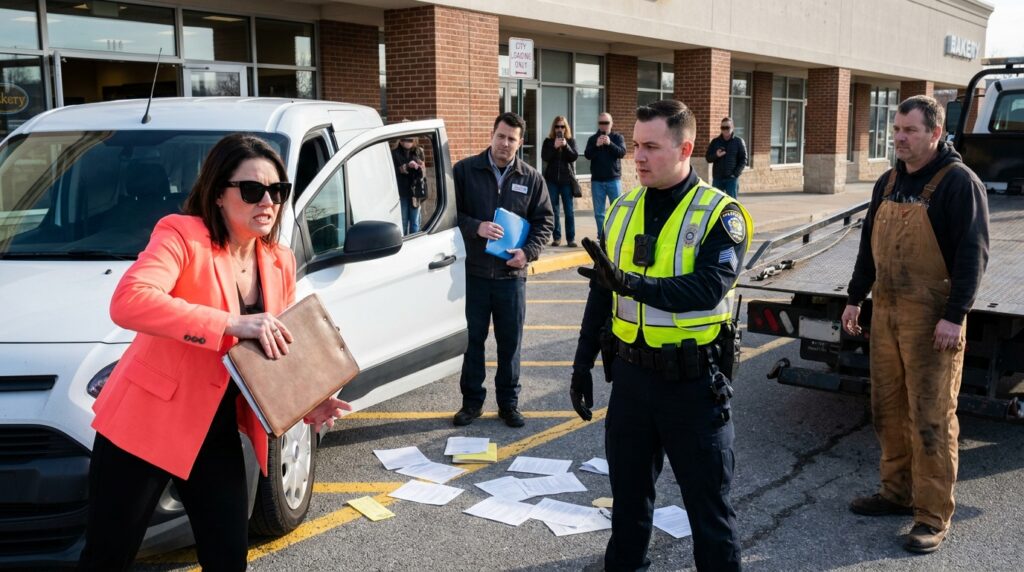
Elena Vasquez pushed through the heavy rear door of the bakery, her apron dusted in white powder that puffed into the cool morning air with every hurried step. Her hands were raw, red around the knuckles from years of handling ice water and hot sheet pans. She stopped short at the edge of the curb, looking between the neon-coral jacket blocking my front grille and the quiet stance I held inside the cab.
“He’s my delivery, Brenda,” Elena said, her voice tight, hovering in that precarious space between pleading and defiance. “The festival order starts at noon. If these mixers don’t get unloaded, I lose the deposit on the catering contract.”
Brenda didn’t turn around. She kept the phone pressed to her ear, listening to the monotonous ring of the county non-emergency dispatch, but her shoulders hitched up an inch higher.
“Your vendor is parked in a designated VIP patron space, Elena,” Brenda said, her tone dripping with the cold condescension of a bureaucrat wielding a borrowed stamp. “The merchant committee established clear dock access fees at the last quarterly board meeting. He refuses to pay the courtesy clearance. Therefore, he is obstructing private commercial access.”
I unbuckled my seatbelt and stepped down from the cab. The asphalt was firm beneath my boots, cold enough that I could feel the chill seeping through the thick soles. I didn’t crowd her space. I walked around to the passenger side, reaching through the open window to retrieve my dark vinyl clipboard folder—the one containing three years of meticulously organized routes, municipal tax receipts, and city easement filings.
“There is no merchant committee, Elena,” I said quietly, looking past Brenda to the bakery owner.
Elena blinked, her flour-dusted fingers clutching the hem of her apron. “What?”
“The Oakridge Plaza Merchant Association dissolved four years ago when the property went into receivership under Vance Management,” I continued. My voice was measured, a calm counterweight to the sharp rasp of Brenda’s pen as she suddenly stopped clicking it. “The city acquired the commercial access easement for this loading lane in 1998. It’s a public utility corridor. No private entity can charge a clearance fee on a municipal easement.”
Brenda turned then. The sunlight caught the side of her dark sunglasses, reflecting the sharp red brick of the plaza wall. For a fraction of a second, the rigid confidence slipped, revealing the tired, hollow ring of a woman running out of ground to stand on. Beneath the sharp tailored line of her blazer, I caught the micro-texture of the seam along her left cuff—it was fraying, carefully brought together with tight, hand-stitched thread that didn’t quite match the factory dye.
From the front pocket of her leather clipboard binder, a corner of yellowed carbon paper stuck out. It wasn’t an official city citation form. It was a generic receipt book you could buy at any office supply store for four dollars.
“Mr. Vance signed off on the liaison authority himself,” Brenda said, though the speed of her delivery picked up, the words tumbling out just a fraction too fast. “I have the signed parking management contract right here in this binder. It grants me full administrative control over all curb access along the northern elevation.”
She tapped the leather folder with a manicured nail, but she didn’t open it. She didn’t pull out the sheet.
I leaned against the side of my van, feeling the faint, rhythmic pulse of the diesel engine against my shoulder blades. “If you have an exclusive management contract, Brenda, then you know Mr. Vance’s lease agreements require all curb fees to be processed through the central property escrow account at First Merchants Bank on Main Street. They don’t get paid in cash on the pavement.”
Elena looked from me to Brenda, her eyes widening as the subtext settled into the quiet air. “Brenda… you told us the fifty dollars a month we were paying for ‘alley maintenance’ was going into the shared plaza lighting fund.”
Brenda’s posture went rigid as a iron rail. “That fund is administered privately for the benefit of the boutique corridor! You benefit from the foot traffic my marketing brings to this strip, Elena! Do you think those flower boxes on the sidewalk pay for themselves? Do you think the holiday lighting hangs itself?”
“The city hangs those lights,” I said softly. “It’s in the county utility ledger.”
Brenda’s jaw worked silently. The phone against her ear suddenly chirped as the dispatch operator answered.
“Oakridge Non-Emergency Dispatch, state your location and the nature of your request.”
Brenda took a deep, shuddering breath, her chest rising under the bright coral fabric. The anger returned, but it was sharper now—frantic, brittle, the kind of heat that burns up everything around it just to keep from freezing.
“I need an officer at Oakridge Plaza immediately,” she said into the receiver, her voice loud enough to carry across the parking lot toward the three shoppers now standing near the cafe. “I have an unauthorized commercial operator trespassing on private retail land, threatening local business owners, and refusing to clear a blocked fire lane.”
She looked straight at me through her dark lenses as she said it, her mouth set in a hard, uncompromising line. She was burning her bridges, betting everything on the weight of an official uniform to enforce a lie before anyone looked too closely at the yellow carbon paper in her binder.
I didn’t try to stop her. I simply opened my folder, pulled out the blue-inked city survey map, and waited.