CHAPTER 3: THE COMMUNION OF LEDGERS
The fluorescent lights in the community center hummed with a low, parasitic frequency that set teeth on edge. Outside, the dusk was turning the desert scrub into a slate of bruised purples and charcoal grays, but inside, the air smelled intensely of industrial floor wax and old, damp carpet.
B stood at the rear of the multi-purpose room, his forearms resting on the scuffed wooden back of an empty folding chair. The room was packed tighter than it had any right to be on a Tuesday evening. Retired teachers, landscapers, and homeowners who rarely looked at each other over backyard fences were now wedged shoulder-to-shoulder, their eyes fixed on the dais at the front.
Up front, behind a modular laminate table scarred by decades of cigarette burns and tape residue, A sat flanked by two men in muted grey suits who didn’t look like they lived within fifty miles of a suburban drainage ditch.
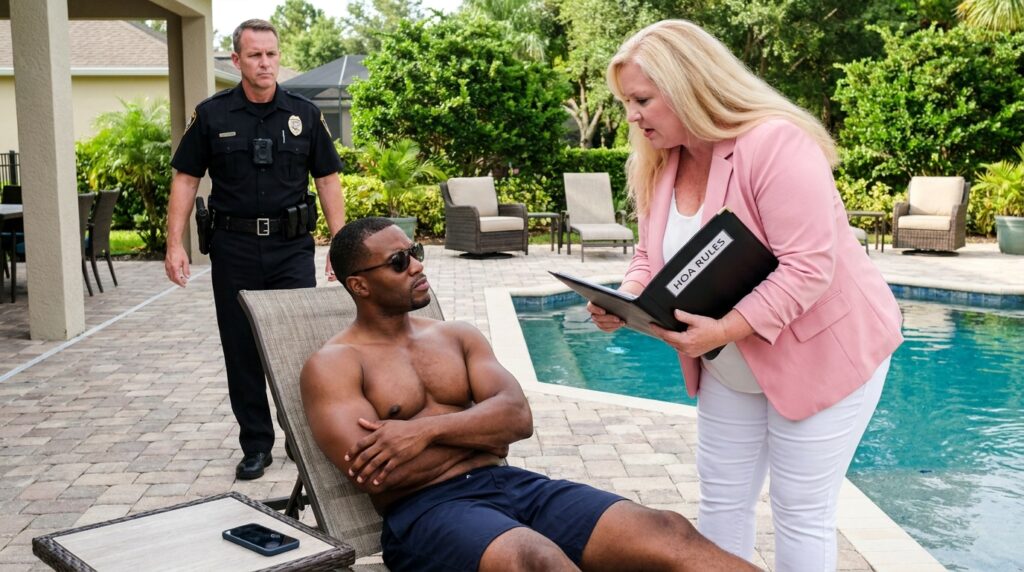
“The motion to ratify the supplemental maintenance assessment is carried by proxy vote,” A announced, her voice echoing slightly off the acoustic tile ceiling. She didn’t look up from her clipboard, her pink blazer standing out like a fresh bruise against the drab institutional backdrop. “Effective the first of next month, all non-compliant structures will be subject to immediate receivership under Section Twelve.”
A low murmur rolled through the rows of folding chairs—not a roar, but the heavy, grinding sound of a tectonic plate shifting an inch too far.
B didn’t wait for the vote to be formally closed. He stepped out from the back row, his boots striking the linoleum with a heavy, deliberate rhythm that cut through the background chatter. Every head in the three rows ahead of him turned instinctively, tracking the motion of a man who looked entirely out of place in a municipal filing dispute, yet completely anchored to the floor beneath him.
“There’s a flaw in your math, Ms. Vance,” B said, his voice carrying clearly without a microphone.
A stiffened, her hand freezing over the edge of the clipboard. She looked up, her eyes narrowing as they locked onto him through the haze of recycled air. “This is a closed executive session for property owners of record. You’re out of order, sir.”
“I am a property owner of record,” B replied, stopping five feet from the laminate table. He reached into the deep pocket of his canvas jacket and pulled out the heavy, dog-eared ledger from the pool deck, dropping it onto the center of the table with a sharp, hollow crack. The rusted brass key slid across the formica, stopping an inch from the grey suit sleeve of the man on A’s left. “And so was the man who owned my parcel before the county records were quietly scrubbed back in nineteen-ninety-six.”
The man on the left—a clean-shaven individual with silver temples and a heavy gold signet ring—glanced down at the ledger without touching it. His expression didn’t change; it was the practiced, frictionless look of someone who dealt in corporate bankruptcies and probate sales daily.
“That archive lacks state validation,” the man said smoothly, his voice sounding like dry paper sliding across a desk. “The board holds the master deed registry.”
“The board holds whatever you printed out last Thursday,” B said, leaning his weight onto his palms against the edge of the table, bringing his face level with theirs. “Which is why the county assessor’s office has a different copy stamped with the original watershed easement. The one that says this entire parcel—every square foot of this club, the pool, and the north forty lots—reverts to public utility control the moment an unvouched assessment is levied.”
A’s face drained of its professional flush, leaving her skin a tight, mottled gray under the fluorescent glare. “You don’t know what you’re talking about,” she hissed, her voice dropping below the register of the wall speakers. “You’re digging into things that have nothing to do with your lawn citations.”
“That’s where you’re wrong,” B said quietly, his gaze shifting from her face to the corporate seal embossed on the portfolio the man in the grey suit was trying to slide beneath a stack of flyers. “I thought this was about a couple of feet of unapproved concrete. But when you start filing foreclosure notices on houses whose owners have been dead for ten years, you stop being an HOA. You’re a clearinghouse for a land grab.”
The man in the suit closed his portfolio with a crisp, final snap. He looked at A, then at B, his mouth twisting into a thin, humorless line. “You have until Friday to vacate the property, Mr. Reynolds. The default notice was filed this morning, regardless of what your dusty notebook claims.”
Before B could answer, the side door of the community center banged open against the cinderblock wall. A gust of cool night air rushed into the room, carrying the flashing, silent red strobe of municipal cruiser lights painting the parking lot outside in rhythmic pulses of blood and shadow.