CHAPTER 2: THE PAPER TRAIL
The leather of the old ledger groaned as the spine shifted, releasing a faint cloud of dry paper dust that smelled faintly of a basement that had seen too many decades of closed summers. B kept his thumb pressed against the corner of page one hundred and twelve. The ink was faded iron-gall, turning a dull amber at the margins where humidity had tried to claim it years ago.
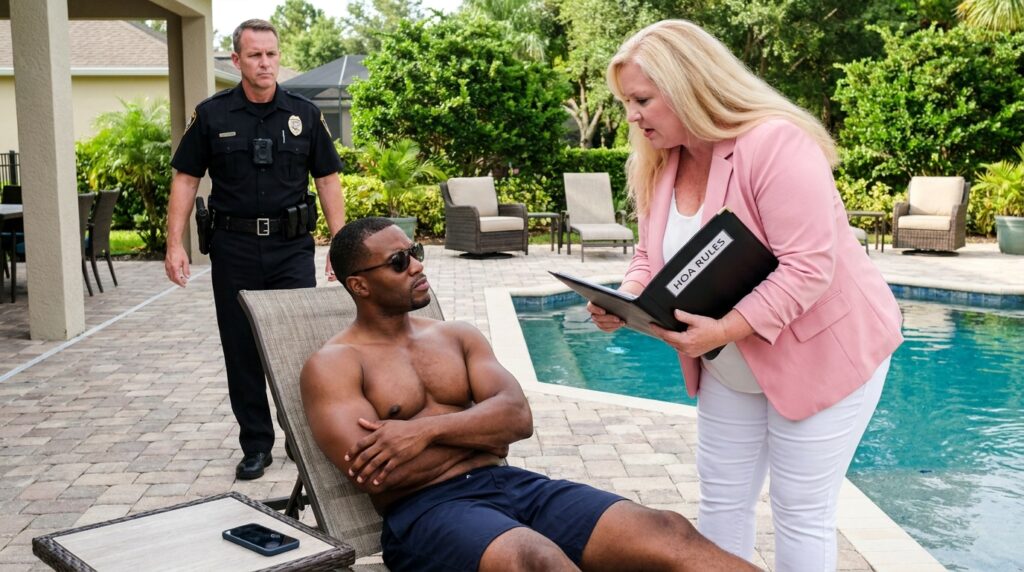
“Look at the parcel numbers, Officer,” B said, his voice dropping an octave, losing all conversational insulation. He didn’t look up from the page; he could feel the sudden rigidity in the air, the subtle shift in weight as A’s pink shoes ground slightly into the gravel.
C took a half-step forward, his boots clicking softly on the pool deck. He leaned in just enough to bring the reflective surface of his body camera within range of the open page, though his eyes stayed fixed on the rows of inked digits. “That’s municipal annex territory. That wasn’t even zoned residential when this development was platted.”
“It was zoned commercial-buffer,” B murmured, tracing a hard, calloused thumb along the margin line. “Which means the setback requirements weren’t three feet. They were twenty. Which means every single home built on this side of the drainage easement—including the one Ms. Vance is standing on right now—violates the original structural covenants filed by the county in nineteen-eighty-four.”
A’s breath hitched, a sharp, audible intake of air that rustling fabric couldn’t mask. “That document is an administrative error,” she said, her tone suddenly lacking its previous bureaucratic bounce, replaced by a thin, brittle edge. “The association superseded those filings under the emergency amendments of two thousand twelve.”
“Emergency amendments,” B repeated, finally lifting his head. His dark sunglasses caught the glare of the afternoon sun, turning his eyes into two opaque mirrors. “Filed by a three-person board that included your late husband, three months before the county reclassified the entire watershed. Funny how convenience looks when you write the rules yourself.”
C straightened up slowly, his hand drifting instinctively toward his utility belt before stopping short of the strap. The easy authority he’d walked onto the property with had turned into something heavier, something watchful. He looked from A’s pale, tightened jaw down to the exposed signatures on the yellowed paper.
“If those covenants are active,” C said carefully, addressing the space between them, “then the citation you’re trying to serve under the current bylaws isn’t just invalid. It means the association doesn’t even hold the legal easement over this drainage strip.”
“We hold what the board authorizes,” A snapped, her voice rising, losing its professional veneer entirely as she reached out a hand toward the ledger. “Give me that book. That’s stolen property from the community archive.”
B didn’t pull the book back. He simply closed it with a flat, dull thud that rattled the empty ceramic coffee mug on the side table. The sudden silence that followed was heavier than the heat.
“Archive?” B said quietly. “It was sitting in the utility box by the front gate when the lock rusted off last Tuesday. Along with three cardboard boxes of certified mail that never made it to the post office. All addressed to properties that went into sudden foreclosure right after the board raised the annual maintenance fees by four hundred percent.”
A stepped back, her pink blazer catching the light as she squared her shoulders, though the defiance in her posture looked hollowed out, like an old frame holding a torn canvas. “You’re playing a very dangerous game with people who control your property valuations, mister. You think a dusty notebook buys you immunity from municipal code enforcement?”
“No,” B said, standing up from the lounger at last, his tall, muscular frame suddenly altering the geometry of the entire poolside. He towered over the argument, the heat radiating off his skin matching the dry, unyielding fury in his voice. “I think it buys me a conversation with the county prosecutor about mail tampering and mail fraud. And I think you’re going to walk off this concrete before I finish making the call.”
C didn’t intervene. He watched the distance between them shrink and expand with the breathing of two people who had crossed a line neither could un-walk. He reached up and tapped the small black housing of his body camera, checking the steady, amber pulse of the recording light.
“Let’s keep things civil,” C said, his voice flat, offering a warning that sounded less like a command and more like an exit strategy. “Ma’am. Step back toward the drive.”
A didn’t move immediately. Her gaze locked onto B with a look of pure, concentrated venom—not the anger of a frustrated neighbor, but the cold calculation of someone whose entire architecture of control had just cracked down the middle. Without a word, she turned on her heel, the white fabric of her trousers cutting a sharp line against the green lawn as she marched toward the paved cul-de-sac.
The silence she left behind wasn’t empty. It was filled with the rhythmic, mechanical hum of the pool pump filtering water through copper pipes buried deep beneath the earth—a hidden machine that never stopped grinding, no matter who was standing above it.
B looked down at the closed black ledger, his thumb resting on the corner where a small, rusted brass key had been wedged into the binding twine, half-hidden by the fraying fibers.