
CHAPTER 4: THE FOLDED COUNTERFEIT
Brenda’s arm jerked down, crumpling the orange cardstock against her thigh like a child caught hiding a stolen test.
Her gaze flicked upward—first to the dark optical dome bolted beneath the soffit, then to the secondary wide-angle lens mounted high on the brick chimney, and finally back to me. For a second, the silence was absolute, save for the sickly drip of contaminated water leaking through the seam of her sneaker.
“You don’t have the right to record my person without consent,” she whispered, her voice tightening until it squeaked. “This is a private residential area. You’re violating state wiretapping statutes.”
“One-party consent state, Brenda. And you’re standing four yards inside my property line beside an open pool.” I took one deliberate step backward, increasing the buffer between us to a clean ten feet. Never let a desperate person close the distance. “Keep talking. The directional mic picks up every frequency.”
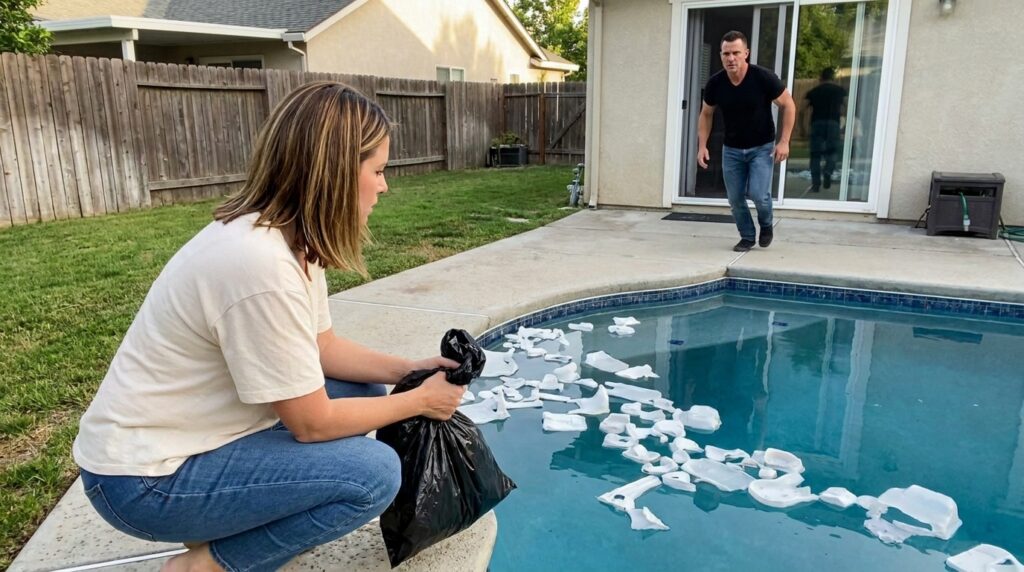
Her chest hitched. The realization that she had walked into a fortified perimeter with zero legal blind spots hit her like a cold draft, but entitlement doesn’t retreat when it’s cornered—it metastasizes. She looked down at the emptied contractor bag lying between us on the wet stone, then stepped forward, lunging to snatch the plastic by its neck.
“Leave the evidence where it is,” I said.
She grabbed the bag anyway, dragging the wet plastic across the flagstones with a sharp, scraping hiss. “This is my property. You have no right to hold my belongings.”
“Take it,” I said calmly, tapping the screen of my phone to lock the timestamped clip into cloud storage. “Tampering with evidence of a felony property crime will look fantastic on the grand jury docket.”
Her hands froze on the crumpled polyethylene.
As she lifted the bag, the motion stirred the air between us, carrying a sharp, chemical odor that cut clean through the smell of chlorine and scorched copper. It wasn’t the stale beer or cheap soda you’d expect from a backyard graduation party. It was the pungent, greasy reek of commercial degreaser and hydraulic fluid.
I narrowed my eyes. Among the floating debris of white cups and paper plates, an iridescent, violet-and-green petroleum film was blooming across the surface of the pool, spreading outward from the deep-end skimmer throat in an oily, suffocating web.
This wasn’t just household garbage thrown in a fit of neighborly spite. She hadn’t swept up after a party. The trash was a carrier—a porous, absorbent matrix soaked in chemical solvent designed to coat the pool’s vinyl lines, destroy the rubber gaskets, and permanently ruin the sand filter media underground.
“Where did you get that debris, Brenda?” I asked, keeping my voice dangerously quiet.
Her jaw clamped shut. She looked away, her eyes darting past the cedar fence line toward the driveway. Her breathing had turned ragged, her cream blouse sticking to the small of her back in dark patches of sweat.
“I told you,” she muttered, though the swagger had completely drained from her posture, replaced by a brittle, defensive tremor. “It was blown across the lot. I just gathered it up.”
“You gathered industrial solvent from a flowerbed?”
“I don’t know what you’re talking about,” she snapped, backing up toward the side gate now, clutching the dripping bag against her hip like a shield. “You’re delusional. You’re building a false narrative because you know you can’t afford this house. You overextended yourself on the mortgage, you spent thirty grand on this unnecessary luxury, and now you’re trying to pin your maintenance failures on me.”
The sentence was too specific. Too rehearsed. It wasn’t the spontaneous defense of an angry neighbor; it was the exact language of an institutional creditor justifying a foreclosure petition.
Before I could answer, a low, rising warble echoed down the street.
The two-tone wail of a township police cruiser shifted into a sharp, single-chirp siren as it turned into the mouth of the cul-de-sac.
Brenda’s head snapped toward the driveway. The panic vanished, replaced instantly by the desperate calculation of someone who still believed she could control the uniforms through seniority and social capital. She dropped the heavy bag onto the grass, spun on her heel, and bolted through the side gate, her sneakers slipping on the damp flagstone as she threw her weight against the cedar door.
“Officer!” her voice shrieked, echoing out into the front yard before the cruiser’s engine had even cut out. “Officer, thank God you’re here! I need immediate protection from this man!”
I didn’t run after her. I didn’t rush.
I walked over to the edge of the pool, looked at the black oil slick choking the blue water, tapped my phone screen to open the live split-screen feed of the front driveway, and watched her march straight toward the squad car with her hands raised in theatrical terror.