
CHAPTER 2: THE GRINDING IMPELLER
The variable-speed motor under the equipment shed screamed—a high, dry whine that vibrated through the flagstones beneath my soles.
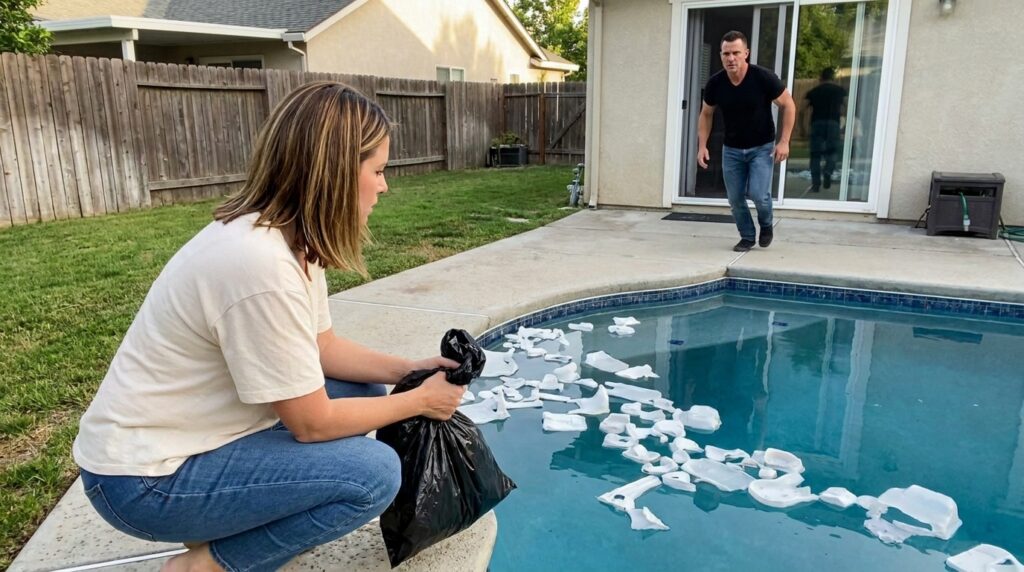
It wasn’t just plastic floating. It was heavy, shredded polycarbonate. The kind of rigid packing material that doesn’t bend when an impeller blade grabs it at three thousand revolutions per minute.
“Turn around and walk out the gate, Brenda,” I said. My voice was level, dialed back to an absolute, chilling calm. “Every second you stand on this coping is adding another line to the police report.”
She didn’t retreat. If anything, the mechanical death rattle of the pump gave her a perverse jolt of authority. She straightened her spine, pulling her cream blouse smooth with one hand while tossing the empty contractor bag onto my clean patio stones with a wet, insolent slap. Her dark sneakers squeaked against the wet concrete as she took half a step forward—not back toward the open cedar latch, but deeper into my yard, angling herself between me and the maintenance shed.
“You don’t intimidate me with threats of the police,” she sneered, her chin tilted up, catching the harsh glare of the midday sun. “Go ahead and call them. Tell them you’re running an unpermitted commercial installation that’s vibrating the bedrock under my master bedroom. Tell them you’re dumping chemical runoff into the easement.”
“There is no chemical runoff, and you know the survey line ends four feet past that fence,” I replied, keeping my eyes fixed on her hands.
Her right hand drifted toward her back pocket. Tucked halfway into the denim was a folded slip of heavy cardstock—bright neon orange, the exact shade the municipal code compliance office used for formal stop-work warnings. But the township hadn’t visited my street in four months. The paper was crisp, freshly creased, and utterly out of place for someone who claimed she had just come over on a whim to return blown yard trash.
“You think a wooden fence erases thirty years of neighborhood precedent?” she countered, her voice rising, weaponizing the quiet air of the cul-de-sac. Across the low hedge line to the north, a set of second-floor Venetian blinds twitched. She knew she was being watched, and she played directly to the unseen gallery. “This entire drainage corridor is shared land. My father helped grade this development before you were born. You bought this house at an estate auction, slapped up six-foot cedar slats, locked the access gates, and decided you owned the water table.”
“I own the parcel. I own the deed. And right now, you are committing aggravated criminal mischief.”
“It’s paper, you arrogant child!” she shouted, gesturing wildly toward the pool where a mass of crushed white cups was being sucked down into the skimmer throat with a loud, sickening slurp. The water level inside the intake dropped in an instant, starving the pump of water and filling the plumbing lines with air. “It’s biodegradable party trash! It’ll dissolve in an hour!”
“Solo cups don’t dissolve, Brenda. And neither do the acrylic shards you mixed into that bag.”
A flicker of hesitation crossed her face—a split-second crack in the facade. She hadn’t realized I could see the sharp, translucent fragments sinking toward the main drain at the eight-foot bottom. Those weren’t party cups; they were heavy industrial plastic, deliberate shrapnel meant to shatter the internal diffuser.
The pump motor gave one last violent shudder, followed by a sharp electrical pop and the bitter, acrid stench of scorched copper windings drifting across the yard. Then, dead silence settled over the patio, save for the slow, sluggish lap of contaminated water against the tile line.
“That’s forty-five hundred dollars in commercial equipment you just seized,” I said, pointing not at her, but at the charred vent of the motor housing.
“Prove it was me,” she whispered, her lips curling into a tight, toxic smirk. She took another deliberate step across the flagstone, planting her sneakers directly onto the clean edge of my lawn. “A bag blew over in the wind. I came over to retrieve it, and you assaulted me. Let’s see whose side the board takes when I show them the petition.”
She reached back, tapping the neon orange slip in her pocket as if it were a shield, completely unaware that twenty feet above her right shoulder, the optical zoom of the 4K exterior array had already focused on the serial number printed on the contractor bag at her feet.
I didn’t argue. I didn’t raise my voice. I took out my phone, unlocked the screen with my thumb, and pressed the three-digit shortcut for emergency dispatch.
“Stay right where you are,” I said softly. “Let’s see what the county prosecutor thinks of your petition.”