CHAPTER 5: THE RETREAT THROUGH THE GLASS DOORS
Brenda didn’t say another word.
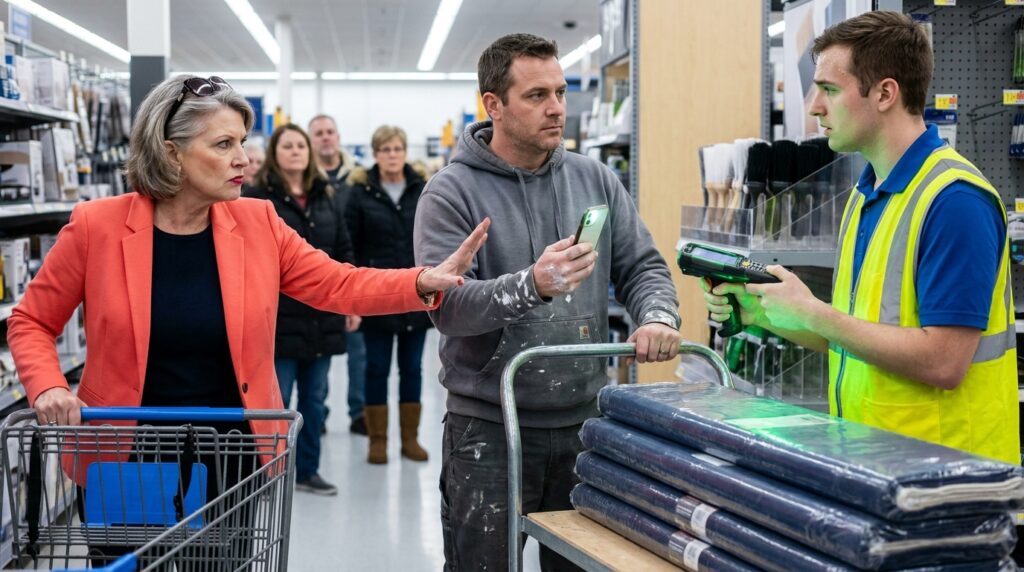
The silence that settled over aisle four was absolute, heavy with the cold, unyielding weight of twenty people watching a delusion disintegrate in real time. Her hand, stiff and trembling, yanked hard on the rubberized grip of her metal cart.
The front caster caught on the corner of the cardboard brush display with a violent, screeching crunch. A rack of hog-bristle brushes wobbled, spilling three plastic packages onto the linoleum at her feet. She didn’t stoop to pick them up. She didn’t look at Todd, she didn’t look at the teenager whose phone lens was still tracking her every gesture, and she didn’t look at me.
Her shoulder clipped the edge of the display shelf as she hauled the cart backward into the main arterial walkway. In her haste, the frayed brass buckle of her leather handbag caught on a metal pegboard hook. A sharp snap echoed down the aisle as the tiny, faded yellow clearance tag—the old mark she had used as her silent talisman of store expertise—tore free from the leather strap, fluttering down onto the polished floor like a discarded scrap of paper.
She spun on her heel, her coral blazer flaring behind her, her dark sunglasses slipping slightly down the bridge of her nose. The rubber wheels of her empty cart squealed in frantic, uneven bursts as she pushed it at a rapid clip down the central corridor, heading directly past the registers toward the automated sliding glass doors of the garden center exit.
The man in the John Deere cap let out a short, dry chuckle, stepping back to give her a wide berth. “Have a nice weekend, Mrs. Sallow,” he called out, his voice laced with unvarnished, small-town irony.
Brenda didn’t turn around. The double glass doors opened with a soft pneumatic hiss, swallowing her silhouette as she pushed out into the glaring midday heat of the parking lot.
Todd Carver let out a long, ragged breath, his shoulders dropping three inches as the tension left his frame. He looked down at the floor, noticed the fallen brush packages, and knelt slowly to collect them, his hands still slightly unsteady.
“I’m sorry about that, Marcus,” Todd said, standing back up and placing the brushes neatly back onto the pegboard. He adjusted his high-visibility vest, avoiding direct eye contact for a moment out of sheer residual embarrassment. “Mrs. Sallow… she spends a lot of time in here during inventory weeks. She always acts like she’s on the payroll.”
“It’s fine, Todd,” I said quietly. “You were just checking the system.”
“Yeah,” Todd muttered, taking his scanner back out and tapping a final confirmation code on the screen to archive the transaction. “Well, the system says you’re good. Ten bolts, fully cleared, paid via municipal grant account. You’re set to go.”
“Thanks.”
I tightened my grip on the galvanized steel handlebar of the flatbed cart. The ten heavy bolts of navy duck canvas rested securely in two neat, parallel stacks, the clear industrial shrink-wrap glinting under the store’s high-overhead lights. The cardboard cores were plain, unadorned, and complete—a raw foundation for sixty feet of outdoor youth mural that would sit on the brick facade of the downtown library annex by next Tuesday.
I pushed the flatbed forward, the rubber wheels rolling smoothly over the spot where Brenda’s cart had blocked the way three minutes prior. My boot heel stepped right over the tiny scrap of yellow paper lying on the floor. I didn’t stop to kick it aside.
As I approached the main front exit, the automatic motion sensors clicked above the threshold. The heavy glass doors slid open with a smooth, cool rush of air, exposing the wide, sun-drenched concrete apron of the loading zone. Out in the parking lot, fifty yards away, the bright coral splash of Brenda’s blazer was already vanishing into the driver’s side of a dark luxury sedan, her cart left abandoned in the middle of a painted pedestrian hatch.
I wheeled the heavy flatbed out onto the pavement. The summer air was warm, smelling of asphalt, dry pine needle mulch, and hot exhaust. I leaned my weight into the cart, guiding the heavy load toward the rusted tailgate of my pickup truck parked in the bay.
The paint-stained cuff of my left hoodie sleeve rubbed against the cold steel handle as I lifted the first bolt of canvas onto the truck bed. The canvas was heavy, dense, and real. It didn’t care about municipal committee fees, private grudges, or the loud, fragile authority of a woman who thought she owned the aisle.
It was bought, paid for, and ready for work.