
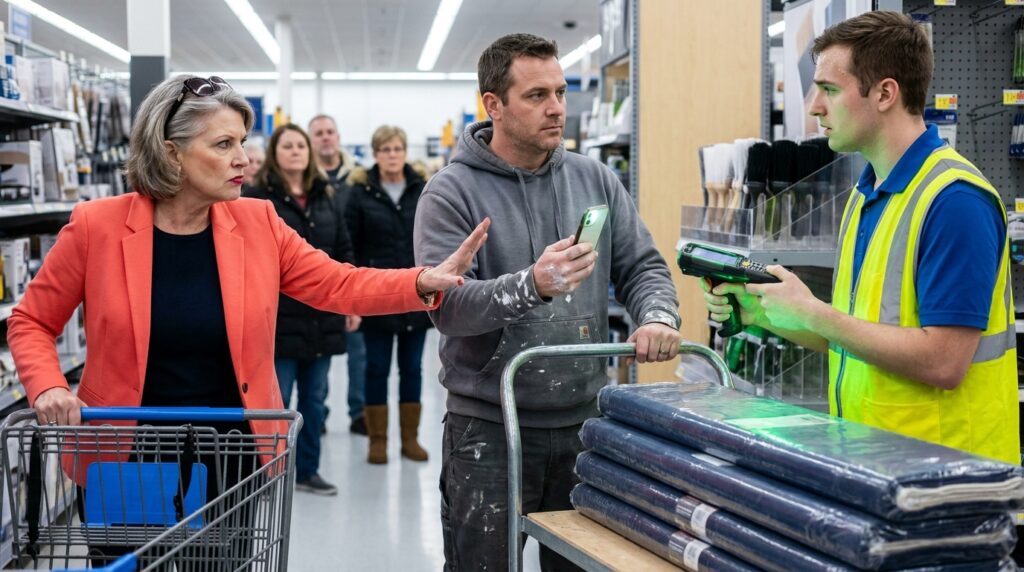
CHAPTER 2: THE ECHOES OF THE LIBRARY BOARD
“Call them,” I said again, my voice flat against the hum of the overhead fluorescents.
I didn’t move my boots on the polished linoleum. I kept my left hand anchored on the cold, galvanized handlebar of the flatbed cart, feeling the slight vibration of the store’s air handlers overhead. The paint on my hoodie cuffs was dry and brittle, tiny flakes of white titanium primer catching the harsh lighting like dust.
Brenda’s jaw tightened, a tiny twitch forming at the corner of her crimson lip liner. She didn’t press the record button on her screen. Instead, her fingers shifted, her grip tightening on the heavy leather handbag wedged against her ribs. Taped near the strap’s brass buckle was a tiny, faded yellow price-override tag—the kind Apex used three seasons ago for clearance items, frayed at the edges and rewrapped around the leather.
“You think you’re clever, Marcus,” she purred, lowering her phone just an inch, though the lens remained angled toward my chest. She stepped closer, her cart’s metal bumper grinding another half-inch into the display rack. “You think because you talk softly at city meetings that people don’t see what you are. A failed business owner trying to cut corners on the public dime.”
A murmur rippled through the small semicircle of shoppers now anchored at the mouth of aisle four. The mother with the stroller had backed off two paces, but her eyes were fixed on the flatbed. Down the main aisle, a man in a grease-stained john-deere cap leaned over his cart handle, watching with the quiet, practiced attention of a neighbor waiting for a fender bender to escalate.
I watched the yellow tag on her bag. It was an old mark. Brenda knew every inch of this store’s back-end logistics because her husband’s firm had handled the regional HVAC service contracts until the corporate buyout last autumn. She knew where the blind spots in the security dome coverage used to be. She was banking on old geometry.
“This canvas isn’t public property, Brenda,” I said quietly, keeping my gaze locked on the bridge of her sunglasses. “And this isn’t the Oakridge Public Library annex.”
Her eyes narrowed behind the dark lenses. The memory hung between us, heavy and unspoken: two months ago, room 2B of the library annex, forty-seven residents sitting on folding chairs in ninety-degree heat. Brenda at the microphone in this exact coral blazer, arguing that open-access community workshops brought “unvetted elements” into the downtown core. She had wanted a two-hundred-dollar annual entry fee. I had voted no. My vote was the fourth one. The one that killed her motion.
“The library committee was about community standards,” Brenda hissed, dropping her voice so only I and the mother three feet away could hear. “This is about basic honesty. You brought ten bolts of heavy-grade navy duck canvas out of the back staging bay without an associate escort. That stock is listed on the seasonal manifest as restricted staging until Monday’s floor revision.”
“You checked the seasonal manifest?” I asked.
“I know how restricted inventory works!” her voice spiked again, rebounding off the metal shelving units. “I spoke to the shift manager on duty last Tuesday when the freight truck arrived. You don’t get to bypass the cutting counter just because you’re running a little mural project for the mayor’s office.”
She took a breath, expanding her chest under the structured blazer, feeling the crowd’s weight shifting toward her louder frequency. She raised her left hand, pointing a sharp, manicured fingernail at the stacked bolts.
“Look at those labels,” she announced to the gathering audience, turning her shoulders forty-five degrees to address the man in the John Deere hat. “No floor price tags. No associate initials. He picked them straight off the intake pallet in the back corridor before the inventory team could catalog them for the sidewalk clearance sale. He’s taking hundred-dollar bolts for twenty bucks a piece.”
The man in the cap frowned, his eyes dropping to the raw cardboard cores of the canvas rolls stacked on my flatbed. They were bare, wrapped only in clear industrial shrink-wrap with a single black thermal barcode sticker affixed to the plastic. To anyone who bought paint or lumber by the piece, it looked like raw, uncataloged stock straight off a delivery truck.
Brenda saw the man’s frown and fed on it. She took half a step forward, her coral sleeve brushing against the edge of my cart’s handle.
“Put your hands off the cart, Marcus,” she commanded, her tone dropping into that smooth, rehearsed cadence she used when calling municipal meetings to order. “We’ll wait right here until Todd comes down from the service desk. If you have a legitimate invoice, you can show it to him. But we both know you don’t.”
I didn’t take my hands off the bar. I felt the rough grit of dried primer under my thumb. The trap was set, laid out cleanly on the linoleum between us. Brenda believed she had caught me in a procedural grey zone—a technical violation of store staging policy that she could frame as outright theft in front of twelve local witnesses.
“Todd is already coming,” I said.
Down the main aisle, the quick, uneven squeak of rubber-soled work boots approached. Todd Carver, the twenty-eight-year-old shift supervisor, was walking fast, his high-visibility yellow vest pulled tight over his blue polo shirt. His forehead was slick under the fluorescent lights, his hand resting nervously on the heavy plastic holster of his handheld inventory terminal.
“What’s the issue here?” Todd asked, his voice cracking slightly before he caught his breath. He looked between Brenda’s rigid posture and my motionless stance, his eyes lingering on the metal cart wedged into the display column. “Mrs. Sallow? Marcus?”
“Todd,” Brenda said, her voice instantly transforming into a smooth, authoritative purr as she turned to face him. “Thank goodness. I’ve caught this man wheeling unpriced restricted stock out of the back corridor. He bypassed the floor associates and the cutting desk entirely.”
Todd blinked, his eyes darting down to the black barcodes on the shrink-wrapped canvas, then back to my face. “Marcus… did someone in textiles cut these for you?”
I didn’t answer right away. I let the silence stretch for three full seconds, feeling the crowd leaning in, waiting for the defense to break.
“He doesn’t have an associate slip, Todd,” Brenda declared, stepping between Todd and my flatbed, her phone raised like a drawn weapon. “Check your terminal. That navy duck canvas is tagged for Monday’s clearance manifest. He’s taking unpriced store property.”
I reached into my pocket, my fingers wrapping around my smartphone, and brought it into the light between us.