
CHAPTER 3: THE SHIFT SUPERVISORS DILEMMA
The glass screen illuminated the blue-and-white interface of the Apex mobile application. I held the device steady, my wrist locked, the casing cool against my palm.
Todd Carver didn’t look at the screen first. He looked at Brenda.
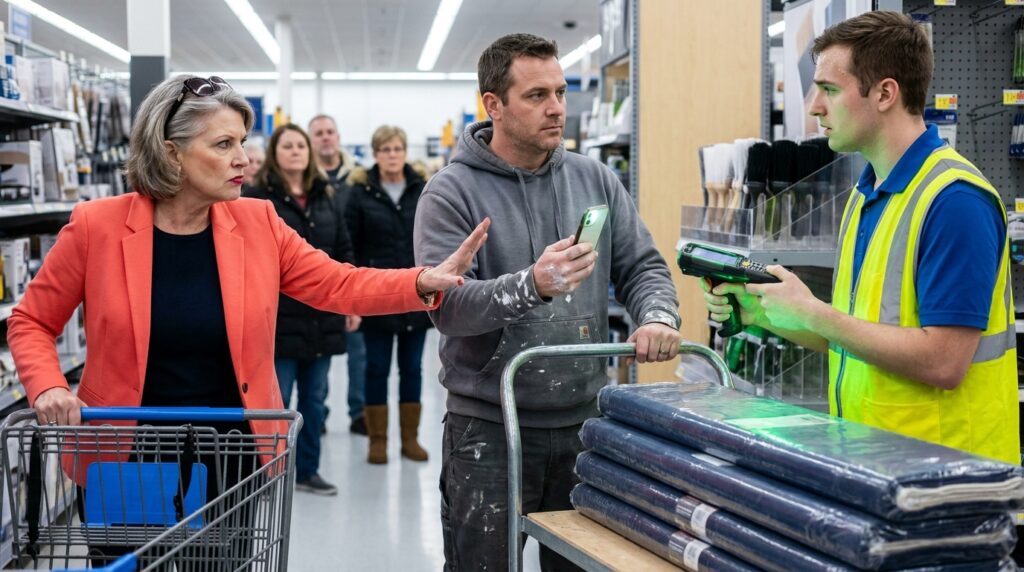
Brenda stood motionless, her chin tilted at an angle that forced Todd to look up at her despite his six-foot frame. Her coral blazer caught the hard overhead fluorescent light, casting a sharp shadow across the rack of acrylic brushes behind her. Tucked inside Todd’s high-visibility vest pocket, a folded piece of paper—a printed internal store memo with an orange highlighter mark along the top edge—flopped forward as he leaned down.
“Todd,” Brenda said, her tone dropping into a smooth, maternal register that cut under the hum of the store air handlers. “You know how the regional office views shrinkage during the clearance transition. The store manager specifically sent out an internal advisory on Monday regarding uncataloged staging inventory in the rear corridors. I have a copy of that corporate notice in my email.”
Todd swallowed hard, his throat moving against his stiff blue collar. His eyes darted to the orange-highlighted paper in his own pocket, then to Brenda’s face. He knew the memo she meant. Every supervisor had received it: an urgent alert about unaccounted bulk inventory disappearing from staging bays prior to public clearance events. It was the exact decoy Brenda had laid—a real corporate paranoia that she was weaponizing to turn a standard pickup into an apparent crime.
“Mrs. Sallow,” Todd began, his voice raspy before he cleared his throat. “We… we do have strict protocol for back-corridor staging right now. Any stock moving out of the staging bay needs an associate override slip attached to the flatbed.”
“Which he doesn’t have,” Brenda interjected smoothly, taking a half-step sideways to narrow the gap between her cart and Todd’s shoulder. She turned her head slightly toward the crowd of six shoppers now standing at the end of aisle three. “Look at the cart, Todd. No yellow paper tag. No associate signature on the shrink-wrap. He walked into a restricted staging corridor, loaded ten bolts of unpriced navy duck canvas, and attempted to bypass the cutting counter entirely.”
The man in the John Deere cap crossed his arms, his eyes shifting from the bare cardboard cores of the canvas to Todd’s pale face. A woman holding a basket of yarn muttered something under her breath to her teenage daughter, who immediately tilted her phone camera higher to capture Todd’s response.
Todd shifted his weight, his work boots squeaking against the waxed floor. He reached for the plastic holster on his hip, his thumb nervously flicking the retention strap of his handheld terminal. He was trapped in the corporate middle: a twenty-eight-year-old hourly supervisor caught between a high-spending regional rewards member who spoke like an auditor and a quiet customer refusing to raise his voice.
“Marcus,” Todd said, looking at me with a strained, guarded focus. “Did an associate in textiles hand these off to you, or did you go into the secondary staging corridor yourself?”
“I went into the secondary staging corridor,” I said.
Brenda let out a short, sharp breath—a sound that was half-gasp, half-triumph. “He admits it,” she told the man in the John Deere hat, her voice ringing clearly across aisles three, four, and five. “He admits he entered a employee-only staging area without an escort.”
“It’s a designated pickup bay,” I said, keeping my gaze locked on Todd’s eyes, ignoring Brenda entirely. “For pre-paid corporate inventory orders.”
“The corporate order system doesn’t apply to seasonal clearance staging!” Brenda snapped, her voice rising an octave, hard and metallic. She turned back to Todd, her manicured finger tapping firmly against the plastic casing of his handheld terminal. “Todd, check your staging manifest right now. The navy canvas in bay four was flagged for the Monday morning sidewalk markdown. If he takes those ten bolts out of this building, the department is down twelve hundred dollars in accounted clearance assets.”
Todd pulled the heavy black scanner from his holster. His fingers were stiff as he tapped the rubberized keypad, bringing up the store’s internal inventory portal. The glare from the overhead LED strips reflected brightly off the scanner’s glass screen.
“I need to see an associate authorization code, Marcus,” Todd said, his voice tightening under the weight of the audience watching him. “If this was pulled from the secondary staging corridor without a paper transfer ticket, the system logs it as an unverified floor movement. Mrs. Sallow is right about the corporate advisory—we can’t clear unpriced bulk items through the registers without an active system override.”
Brenda smiled—a microscopic lift at the corner of her crimson lips, subtle enough that only someone standing three feet away could see it. She adjusted her leather handbag, her fingers brushing against the old yellow clearance tag taped to the strap. She believed she had boxed me in using the store’s own rigid bureaucratic anxiety. She had taken a real corporate memo about missing clearance stock and mapped it directly onto my flatbed.
“Show him the screen, Marcus,” Brenda said softly, her tone dripping with fake sympathy. “Show him the paper slip you don’t have.”
I didn’t argue. I didn’t mention the library board vote, and I didn’t mention her husband’s canceled HVAC contract. I took one step forward, bringing my phone screen within four inches of the red laser lens resting in Todd’s right hand.
“Scan the digital collection token, Todd,” I said. “Not the barcode on the canvas. Scan the app.”