Chapter 2: The Five Minutes That Changed Everything
Margaret had lived in the townhouse community for eleven years.
She knew which porch boards creaked in winter, which neighbor watered flowers before breakfast, and which children rode bicycles too fast through the parking lot.
She also knew that the porch outside her unit was technically shared.
That distinction had always seemed harmless.
Until Karen moved into the neighboring unit six months earlier.
Karen believed shared meant everyone was responsible for maintaining the space.
Margaret believed shared meant everyone was responsible for respecting it.
Those ideas had collided before.
There had been arguments about potted plants, lawn chairs, packages left near the door, and a small wind chime Margaret’s late husband had given her.
But the bird’s nest was different.
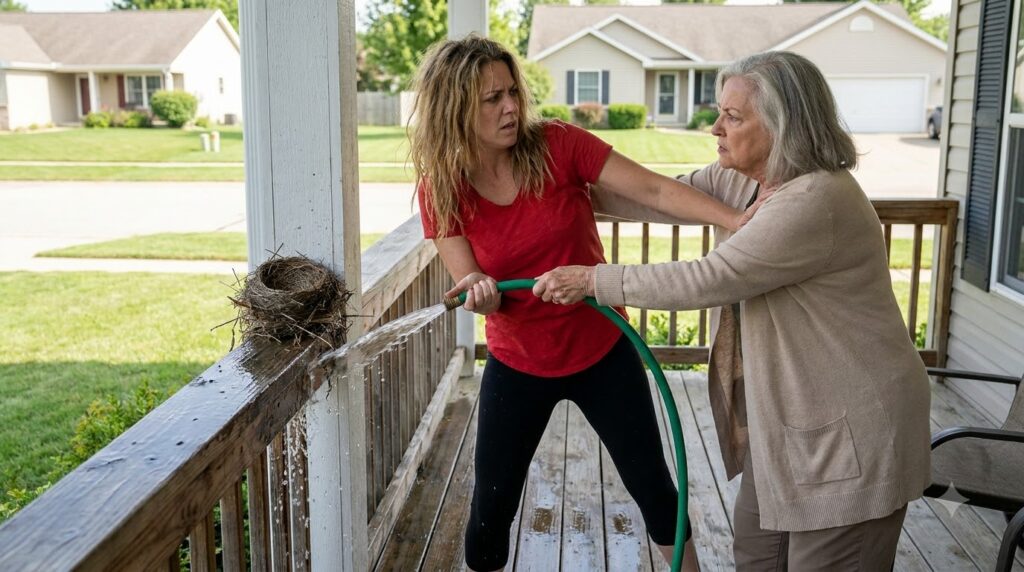
It had appeared in early spring, tucked beneath the roof beam above the porch.
Margaret had noticed the adult birds carrying pieces of grass and twigs there.
She had watched them from her kitchen window.
Later, she discovered the eggs.
When they hatched, she began leaving the area alone.
She even moved her chair.
Karen saw none of that.
To Karen, the nest was simply another nuisance.
A few minutes after the branch cracked, Margaret called the community’s maintenance number.
She explained what had happened and asked whether someone could come immediately.
While they waited, she found a cardboard box and an old towel.
She did not touch the nest.
She knew enough not to improvise with baby wildlife.
Karen stood near the porch railing with her arms folded.
“You know,” she said, “if people maintained things properly, this wouldn’t happen.”
Margaret looked at her.
“Things?”
“The porch.”
Margaret glanced at the broken branch.
“You were spraying a live nest with a pressure hose.”
“I wasn’t trying to hurt anything.”
“Intent doesn’t change what happened.”
Karen’s jaw tightened.
For once, she had no immediate answer.
A neighbor named Tom Alvarez came over from across the courtyard. He was seventy-two and had been a volunteer with the community’s safety committee for years.
He took one look at the nest and called the local wildlife rehabilitation center.
The advice was simple: keep people away, avoid handling the birds unless instructed, and let a trained person assess the nest.
The waiting was harder than anyone expected.
The mother bird appeared twice.
Each time, she landed on the roof, chirped anxiously, and flew away when the people below moved.
Margaret watched her from behind the screen door.
Karen watched too.
Neither woman spoke.
Then a small bird fell from the edge of the nest.
Margaret gasped.
Tom caught sight of it before it reached the floor.
He carefully followed the rehabilitation center’s instructions and placed it in a temporary container until a specialist arrived.
Karen stared at the tiny creature.
Her face had lost its usual certainty.
“What happens now?” she asked.
Margaret didn’t answer immediately.
“Now,” she said, “we find out how much damage was done.”
That sentence stayed with Karen long after the wildlife specialist arrived.
Because for the first time, there was a consequence she could not argue away.