
CHAPTER 4: MASONRY ANCHORS AND THE FALSE TOW NOTICE
The hammer drill shuddered through Derek Callahan’s wrists, sending a fine cloud of damp red brick dust cascading down over his safety glasses and into his beard. The drill bit bit deep into the mortar joint four feet above the concrete apron, screaming against the quartz aggregate embedded in the historic masonry.
Rain fell in heavy, vertical sheets now, running in cold rivulets down the back of Derek’s neck and soaking through the heavy canvas shoulders of his work coat.
He didn’t slow his rhythm. He backed the drill out, cleared the hole with a short burst of compressed air, and shoved a thick, zinc-plated anchor sleeve flush into the brick. He set the heavy gauge steel sign—PRIVATE COMMERCIAL DOCK. NO ASSOCIATION JURISDICTION. AUTHORIZED VEHICLES ONLY—against the wall, aligned the pre-drilled mounting flange, and drove the hex-head lag bolt home with a three-pound sledge.
Clang. Clang. Clang.
The sound rang through the narrow brick corridor like an anvil strike, echoing off the high, wet walls of the arcade. Across the alley, the rear display window of Patsy Albright’s floral boutique remained dark, but behind the rain-streaked glass, a shadow shifted—a sharp, rigid silhouette standing beside an unlit display case, watching every strike of the mallet.
Derek finished the fourth lag bolt on the final corner, grabbed the bottom lip of the thick steel plate, and pulled down with his full body weight—two hundred and ten pounds of dense muscle and bone. The brick held firm. The sign didn’t yield a fraction of a millimeter.
“They’re not coming down with a pry bar,” Derek muttered to himself, wiping a paste of brick dust and rainwater from his cheek with his wet sleeve.
He turned toward his bay door, his boots crunching on the wet gravel. Above the roll-up threshold, the small green status lights of his three surveillance cameras glowed steadily through waterproof acrylic housings. All three lenses were clear, capturing a three-hundred-and-sixty-degree wide-angle view of the yellow curb line, the concrete pad, and the alley approach.
Inside his apron pocket, his fingers brushed against the notched brass key he’d recovered from the mahogany speaker cabinet. Beneath the key lay a new discovery—a small, water-damaged scrap of yellowed carbon paper he’d found tucked behind the alley utility meter box while running the camera cables. It was a receipt for a master lock replacement issued in 1994, bearing the name of the arcade’s former maintenance trustee and a single handwritten note in red ink: Key copy held in unit 104 speaker housing for emergency access to vault drain.
The puzzle pieces were grinding together, but the main gears had yet to turn.
A sudden, wet crunch of rubber on gravel made Derek snap his head toward the western mouth of the alley.
A commercial van—not a freight delivery truck, but a faded white utility vehicle with no magnetic door logos—coasted slowly through the rain, its headlights casting long, pale beams through the downpour. It stopped directly in front of Derek’s freshly bolted steel sign.
The driver’s side door swung open, and a man in a grease-stained yellow rain slicker stepped out into the mud. He held a pair of heavy, neon-orange plastic traffic cones in one hand and a stack of laminated placards in the other.
Without looking at Derek, the man walked straight to the center of Derek’s loading pad, dropped the two cones directly across the double-yellow hash marks, and reached into his coat for a heavy staple gun.
“Step off the pad,” Derek said. His voice wasn’t loud, but it cut through the rush of falling rain with the absolute clarity of a steel blade sliding from a scabbard.
The man in the slicker stopped, his staple gun hovering two inches from the timber frame of Derek’s bay door. He turned his head slowly, revealing a weathered, square face with a thick mustache dripping with gray rainwater.
“I’m contracted by the Oak Street Merchant Board, pal,” the worker said, his tone flat, bureaucratic, utterly devoid of personal malice. “Emergency lane clearance order. I’m tagging this pad as an active tow zone for seven-thirty AM.”
“You’re on private leased property,” Derek said, taking two slow, deliberate steps forward until he stood on the yellow curb line, blocking the man’s path to the bay door. “That sign behind you was installed under municipal code section 4513.60. The board has no jurisdiction here.”
The worker looked at the heavy steel sign, then down at the yellowed brass surveyor’s disk embedded in the concrete between his boots. He spat a dark stream of tobacco juice onto the wet asphalt, his eyes narrowing slightly.
“Look, mister,” the worker said, pulling a laminated sheet from his stack. “I don’t read survey maps. I get a work order signed by Mrs. Albright, I put up the cones, and I post the notice. If there’s a vehicle on this pad at eight AM tomorrow, Central Towing hooks it. You got a problem with the order, take it up with her attorney husband.”
The worker raised the staple gun, aiming for the wooden jamb above Derek’s shoulder.
Before the mechanical trigger could click, Derek’s hand shot out. His calloused fingers didn’t touch the man; instead, he gripped the cold metal nose of the staple gun, locking the firing mechanism against the heel of his hand with a sharp, immovable lever action.
“You staple that notice to this jamb,” Derek said, his eyes locking onto the worker’s with cold, unyielding pressure, “and you become a named co-defendant in a civil suit for property damage and fraudulent trespass. The camera above your head is streaming this live to the First Precinct code enforcement unit.”
The worker stared at Derek’s hand. He felt the immovable strength in the woodworker’s grip—a grip built from twenty years of hauling iron timber and wrestling heavy machinery. He looked up at the small green camera lens pulsing under the awning, then back at the bold, reflective lettering on the newly mounted steel sign.
The worker slowly relaxed his pressure on the trigger. He pulled the staple gun back, slipping it into his slicker pocket.
“You’re crazy if you think you’re gonna win against the board, pal,” the worker grunted, though his voice had lost its bureaucratic edge. “They’ve been running this alley since before you had a business.”
“They were running a bluff,” Derek said, stepping back to let the man move. “Clear your cones off my pad.”
The worker hesitated for a second, then kicked the two orange cones toward the alley gutter with the toe of his boot. He turned, climbed back into his unmarked van, slammed the door, and reversed out of the alley, his tires spraying gray slush against the brick walls.
Derek stood alone on the apron, the rain pouring down around him.
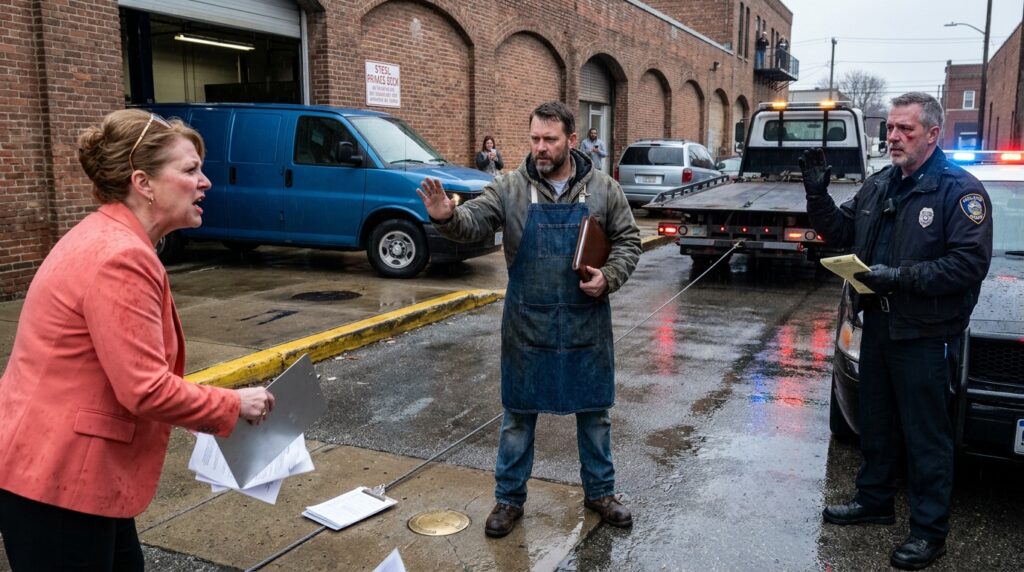
He reached up, wiped the wet brick dust from the mounting flange of his new sign, and verified the solid iron anchor beneath. The decoy paper from 1994 had given Patsy her cover for thirty years, but tomorrow morning, when the heavy flatbed tow truck rolled onto this pad, the false paper would collide directly with cold steel, certified land deeds, and the unyielding truth of the law.
He turned and walked into his workshop, pulling the heavy steel door shut behind him, locking out the storm.