CHAPTER 2: THE DAMAGE LOG AND THE UNMARKED KEY
“Hold the corner, Derek. Don’t let it shift again.”
The freight truck driver’s voice rattled against the high joists of the workshop, flat and exhausted. Outside, the rain had started—a thin, freezing Ohio drizzle that turned the soot on the alley brick into black grease. Inside, the air smelled of cure-accelerator, damp pine, and the sharp, metallic tang of iron filings from the lathe.
Derek Callahan braced his forearm against the mahogany corner trim of the forty-thousand-dollar custom enclosure. His boots slipped two inches on the oil-slicked concrete before his heel caught the raised iron lip of the floor drain. A sharp, cracking sound—like a dry branch snapping underfoot—echoed through the bay as the crate settled onto the workbench.
The left structural pillar was split clean through the grain. A three-inch void gaped near the lower joinery where the sudden brake lockup in the alley had thrown the secondary internal brace against the transit frame.
“Five thousand in cabinet work alone,” Derek muttered, his thumb tracing the jagged edge of the splintered hardwood. The varnish was still tacky near the seam, leaving a dark, sticky residue across his callus. “Dr. Patterson’s going to take one look at this joinery and write the whole casing off as compromised.”
“She wasn’t even going five miles an hour when she cut us off,” the driver said, wiping his wet brow with the sleeve of his flannel shirt. He pulled a carbon-copy bill of lading from his pocket, the paper damp and limp in his trembling fingers. “Just pulled that silver boat right across the apron. Didn’t look. Didn’t care. Said we were blocking her egress.”
“She knew what she was doing,” Derek said. He didn’t look up from the split wood. His heart was beating with the dull, heavy rhythm of an engine running low on oil. “She wanted you to hit her. She wanted a police report with an industrial freight company named as the primary obstruction.”
He reached for his digital caliper on the magnetic strip above the bench. As he turned, his hip brushed against the open drawer where his legal folder lay flat. The crisp, white 11×17 city survey maps peeked out from beneath the string tie, their bright neon highlighter marking the exact two-foot boundary line extending past the yellow curb.
Three months ago, when he’d walked away from the logistics terminal in Marion—after twenty years of watching regional directors alter shipping manifests to dodge OSHA fines—he’d swore he would never again let another person’s manufactured crisis dictate his pulse. He had built this shop with clean money, clean deeds, and a five-year lease that explicitly separated his bay from the Oak Street Merchant Association’s private covenants.
Yet here was the grease on his floor. Here was the split mahogany.
“You need me to sign the damage rider?” the driver asked, holding out a stubby ballpoint pen.
“Leave the carbon on the bench,” Derek said. “I’ll file the claim directly with the carrier’s adjuster. Tell them Dr. Patterson will have the structural appraisal ready by four.”
The driver nodded once, pulled his cap down against the drizzle, and retreated out the side door into the alley. The heavy steel door clicked shut behind him, sealing the workshop in a heavy, muffled silence broken only by the rhythmic drip-drip-drip of rainwater hitting the corrugated iron awning above the loading pad.
Derek picked up a flashlight and leaned deep into the hollow cavity of the damaged speaker cabinet. He needed to inspect the internal bracing near the crossover network—the delicate, hand-wound copper inductors that gave the vintage system its distinct warmth.
The beam of light swept past the damp mahogany ribs, illuminating the dark interior.
Something glinted near the rear port—a dull, brass reflection that shouldn’t have been there.
Derek reached his arm in up to the elbow, his knuckles scraping against the rough, unvarnished cedar lining. His fingers closed over a small, stiff object wedged between the lower acoustic dampening pad and the frame wall.
He pulled it out into the harsh LED work light.
It was a grease-spotted manila envelope, no larger than a playing card, sealed with a strip of yellowed masking tape. On the front, written in faded blue ballpoint ink, were three numbers: 1994.
Inside the envelope lay a single, notched brass key. It bore no manufacturer mark, no serial number, only a deep, file-carved groove along the spine—a key cut by hand for a pin-tumbler lock that had long outlived its factory specs.
Derek turned the key over in his palm. The brass was cold, heavy, smelling faintly of old machine oil and stale paper.
This cabinet hadn’t come from a factory line. It was a custom restoration unit shipped from a private estate in Upper Arlington—a property whose original owner had been a founding trustee of the Oak Street Arcade back when the building was first partitioned in the mid-nineties.
A horn blared outside in the alley. Two short, sharp blasts that vibrated right through the glass panes of the roll-up door.
Derek didn’t jump. He dropped the key back into his apron pocket, letting it rest beside his sandpaper and caliper, and walked steadily toward the front bay window.
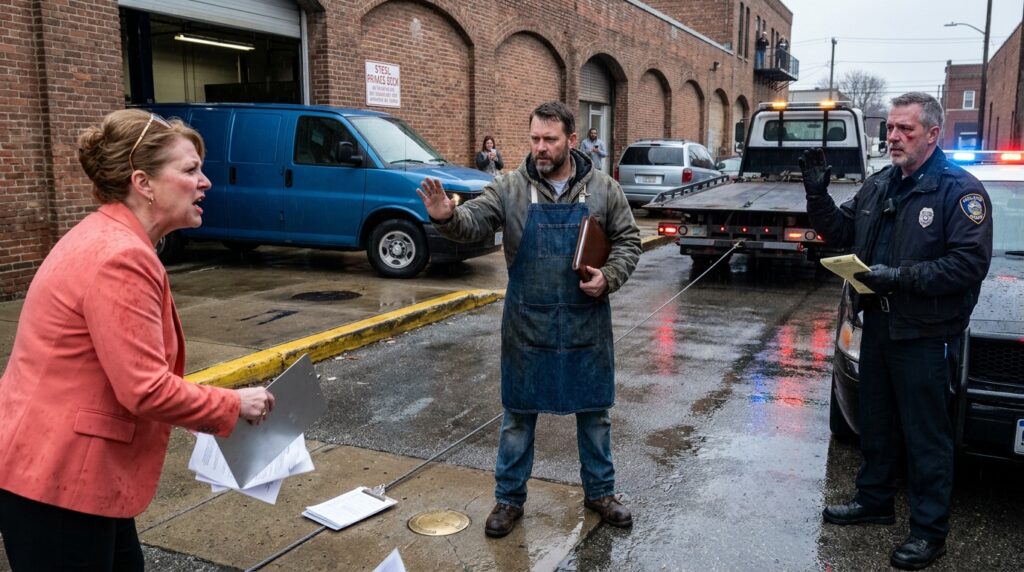
Through the rain-streaked glass, he saw the silver SUV idling three feet from his threshold. Patricia Albright sat behind the wheel, her gold-rimmed sunglasses pushed up onto her coiffed hair. Her driver’s side window rolled down an inch—just far enough for her to slide a bright orange paper slip out into the rain.
She didn’t look at his window. She simply let go.
The orange slip fluttered down into the wet gravel of Derek’s designated pad, face up.
In bold, block lettering printed from a desktop template, it read: FINAL NOTICE OF UNAUTHORIZED OBSTRUCTION – OAK STREET MERCHANT BOARD – ASSESSMENT: $150.00.
Below the printed line, written in the same precise, looping script he’d seen on three previous fake tickets, was a hand-lettered note: EAGLE EASEMENT RECORD #1994-B ATTACHED TO MUNICIPAL FILE. TOWING WILL PROCEED WITHOUT FURTHER WARNING.
Derek stood behind the glass, his thumb tracing the deep, notched groove of the brass key inside his pocket.
The easement didn’t exist in the city registry. He knew that. He had the certified township parcel maps sitting on his desk to prove it. So why was she citing a specific nineteen-ninety-four file number to a tenant who had never signed an association charter?
He turned back toward his workbench, the flashlight beam still burning bright against the ruined mahogany cabinet.