
CHAPTER 3: THE PRECINCT LOBBY AND THE SIGNED DEED
Rainwater dripped from the brim of Derek’s canvas cap, pooling in dark, greasy droplets on the scuffed linoleum floor of the First Precinct lobby. The air inside smelled of damp wool, industrial floor wax, and the metallic sourness of an ancient radiator knocking against the radiator pipe near the front desk.
Derek didn’t shake the water from his jacket. He stood motionless before the high acrylic partition, his heavy leather folder tucked flat against his ribs. Beside the folder, his thumb rested inside his coat pocket, pressing against the sharp, notched spine of the brass key he had pulled from the speaker cabinet an hour earlier.
Behind the scratched plastic barrier, Officer Thomas Ruiz looked up from his terminal. His high-visibility municipal vest was unzipped at the collar, revealing the faded blue weave of his uniform shirt. Ruiz’s eyes were bloodshot from a double shift, his jaw stiff with the gray stubble of a man who spent more time mediating alleyway disputes than walking beats.
“You’re back early, Callahan,” Ruiz said, his voice gravelly, muffled by the speaker grate. “Don’t tell me she parked across your bay again.”
“She didn’t just park,” Derek said. His voice was calm, steady, dropping into that flat, unhurried cadence he used when an inventory discrepancy crossed three state lines. “She cut off a specialized freight driver. Split a structural pillar on a forty-thousand-dollar custom enclosure. Then she dropped this on my apron.”
Derek reached into his folder, pulled out the damp orange citation, and pressed it flat against the document pass-through slot.
Ruiz didn’t pick it up immediately. He leaned forward, squinting at the precise, looping script written across the bottom margin. When his eyes caught the handwritten file reference, his eyebrows twitched upward by a fraction of a millimeter.
“Record nineteen-ninety-four B,” Ruiz read aloud. He reached down, dragged the orange slip through the slot, and turned it over in his calloused fingers. “She’s still throwing Richard’s old paperwork around.”
“Her husband?” Derek asked.
“Richard Albright,” Ruiz said, leaning back in his swivel chair, making the springs groan under his weight. “He was the chief legal counsel for the downtown restoration zone back when the city re-zoned the Oak Street corridor in ninety-four. Before he took early retirement, he drafted the original condo association charter for the arcade.”
Derek laid the string-tied folder on the counter, unlooping the cord with deliberate, even motions. He pulled out the 11×17 city survey map, unfolding the heavy white paper until the neon highlighter line lay exposed under the buzzing fluorescent light.
“My landlord bought the bay outright in ninety-six,” Derek said, pointing his finger at the yellowed brass surveyor’s mark printed on the lower left quadrant. “The county recorder stamped this title clean. No encumbrances. No access easements. The loading pad belongs to unit 104.”
Ruiz looked down at the map, then reached for a thick, gray plastic binder sitting on the shelf behind his desk. He flipped through the tabbed dividers until he reached a section labeled Oak Street Corridor – Municipal Right of Way (Historic).
He pulled out a single sheet of heavy cardstock, yellowed at the edges and smelling faintly of moldy basement archives. He laid it side-by-side with Derek’s survey map.
At the top of the cardstock, stamped in faded blue ink, was an official-looking header: EASEMENT & COMMON ACCESS AGREEMENT – OAK STREET COMMERCIAL ARCADE (1994). Below the text sat two signatures: one belonging to the original arcade developer, and the other written in bold, dark ink—Richard A. Albright, Esq.
Beside the signatures rested a red wax notary seal and a municipal filing stamp.
Derek leaned closer, his eyes scanning the dense legal verbiage. The document explicitly granted the Oak Street Merchant Board the legal authority to manage, regulate, and clear all vehicular traffic in the rear service alley, including the concrete aprons serving the ground-floor bays.
“There it is,” Ruiz said softly, tapping the red wax seal with the back of his thumb. “Signed, sealed, and stamped in ninety-four. According to this copy, Richard set up a master easement that binds the entire alley to the association board. Patsy isn’t just making up numbers, Callahan. She’s executing a recorded covenant.”
The room went still, save for the rhythmic, metallic clank-clank-clank of the steam radiator in the corner.
Derek stared at the red wax seal. On the surface, the trap was complete. The authority wasn’t a bluff; it was a thirty-year-old legal anchor embedded in the very foundation of the arcade. If this document held, every fine Patsy had issued, every tow she had threatened, and every obstruction she had caused was legally protected under commercial easement rights. His clean lease was subordinate to a master covenant signed two years before his landlord ever touched the property.
Derek didn’t blink. He didn’t raise his voice. He reached out and touched the bottom corner of the yellowed cardstock.
“Look at the filing stamp, Officer,” Derek said quietly.
Ruiz frowned, pulling a small magnifying glass from his drawer and lowering it over the blue ink.
The stamp bore the words: RECEIVED – FRANKLIN COUNTY MUNICIPAL PLANNING COMMISSION – OCT 12 1994. But right beneath the word RECEIVED, where the official county clerk’s volume and page number should have been hand-lettered in black ink, the space was blank.
Stapled to the very back of the cardstock was a small, square slip of pink carbon paper—a formal rejection notice from the county recorder’s office, dated three weeks later. The reason cited in crisp typewriter font read: REJECTED – NON-UNANIMOUS PARCEL OWNER CONSENT. FILE RETURNED TO APPLICANT.
Ruiz went motionless. He stared at the pink slip, then turned the page over to look at the blue ink stamp again. The easement had been submitted, stamped as received by the planning commission, and then formally rejected and returned to Richard Albright because two original property owners refused to sign away their private dock rights.
Richard Albright had kept the stamped, rejected draft in his personal files. And for thirty years, his wife had been using that unrecorded, voided document to claim legal dominion over eighty yards of private asphalt.
“She’s been enforcing a voided petition,” Ruiz muttered, his voice dropping an octave as the realization settled into the room. “She knows the county rejected it.”
“She has the original draft in her shop,” Derek said, his hand closing around the brass key inside his apron pocket. The notched groove felt cold against his skin—a key cut to fit a private lock, hidden inside a speaker cabinet that had once belonged to an estate tied directly to the original 1994 arcade board. “And she’s been using it to bully every tenant who doesn’t know how to read a county land ledger.”
Ruiz slowly closed the gray binder. He looked up at Derek, his jaw setting hard into a sharp, rigid line. The bloodshot exhaustion in his eyes had cleared, replaced by the sharp, tactical focus of an officer who had just watched a local authority figure step completely off the legal ledge.
“This copy here in my book is just a reference file Richard dropped off to the precinct back in nineties as a courtesy,” Ruiz said, his fingers tapping the cover of the binder. “We never verified the recorder’s volume page because nobody ever disputed it.”
“They disputed it today,” Derek said.
“If I go down to that alley right now on a civil call, she’ll pull her husband’s legal weight and claim it’s an administrative dispute,” Ruiz said, leaning over the grate. “I need more than a thirty-year-old pink slip, Callahan. I need her actively attempting an illegal seizure on camera, with the property boundary clearly marked, while refusing a direct order from code enforcement.”
Derek gathered his 11×17 map, folding it with precise, sharp creases along the original grid lines. He tucked the paper back into his string-tied folder and snapped the legal cord tight.
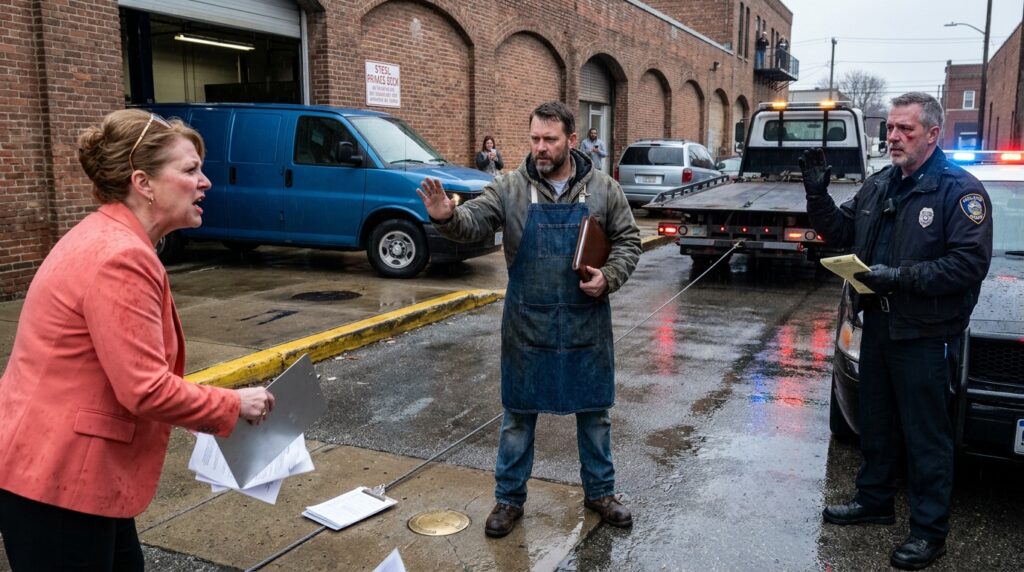
“She called a heavy flatbed towing rig twenty minutes ago,” Derek said, meeting Ruiz’s eyes through the scratched plastic. “They’re dispatching out of the south yard. They’ll be in the alley by eight-thirty tomorrow morning.”
Ruiz picked up his radio mic from the desk, his thumb resting on the talk button.
“I’ll have Inspector Ruiz from code enforcement sitting in my cruiser at the corner of Oak and Fourth,” the officer said quietly. “Make sure your signs are up, Callahan. And make sure your cameras are recording every inch of that pad.”
Derek turned toward the heavy glass doors of the precinct, the rain outside still drumming relentlessly against the pavement. He pushed the door open, stepping out into the cold damp air, the brass key heavy in his pocket, ready for the morning.