
CHAPTER 3: THE BRIDGE AND THE LEDGER
The aluminum service bridge rattled under the hard strike of E1’s sneaker, a sharp, metallic clatter that broke the humid stillness of the courtyard.
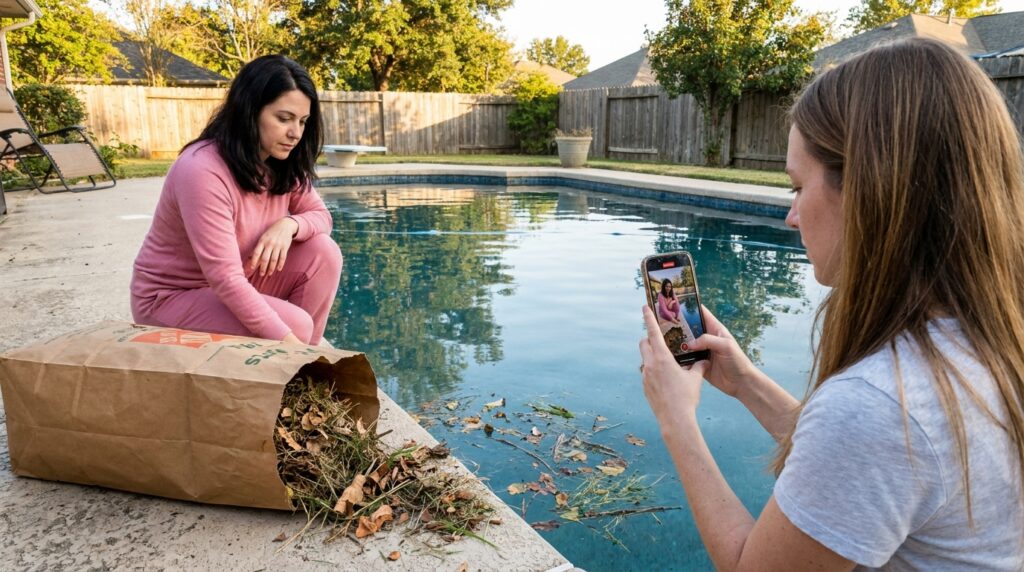
E2 didn’t flinch, nor did she retreat a single inch. Her right hand remained locked in place, the black casing of the smartphone acting as an unyielding pivot point against the air. As E1 closed the distance, her face contorted by a sudden, desperate surge of raw fury, the air between them grew tight with the static friction of a collision that both women knew would leave permanent scars on the neighborhood record.
“Delete it,” E1 hissed, her hand shooting out in a sharp, clawing arc toward the device. Her fingernails missed the lens by less than two inches, grazing only the cold plastic edge of the phone case. “You have no legal right. I’m a board officer. That’s private property you’re recording.”
“The lens is pointing at public concrete, Elena, and the debris is sitting on shared amenities,” E2 said, her voice dropping into a register so chillingly calm that it stopped E1 dead in her tracks at the midpoint of the span. “And that utility notice tucked into your mulch isn’t private property either. It’s public municipal record, fluttering right where everyone on the block can trace it.”
E1’s hand hovered in the air, trembling violently. The pink fabric of her sleeve pulled taut across her shoulder blades as she fought to maintain an aura of absolute command, but the veneer was cracking. Beneath the elected title and the aggressive rule-policing lay a hollow, frantic core. For months, the neighborhood had whispered about the unpaid contractor bills, the second mortgages, and the sudden disappearance of the landscaping crew that used to maintain her lawn. The yard waste she had just hauled across the asphalt wasn’t routine seasonal clearing; it was the overflow of a property she could no longer afford to manage legally, dumped deliberately to manufacture code violations against the adjacent units, shifting the board’s punitive gaze away from her own failing perimeter.
“You think a piece of paper proves something?” E1 snarled, her voice dropping to a venomous whisper as she leaned closer, her breath smelling faintly of stale coffee and panic. “I write the violation logs for this district. I sign off on the architectural exceptions. You think the management company cares about a stray envelope? They care about who keeps property values from dropping into the dirt. And if I go down for a stray bag of leaves, I promise you, every unpermitted alteration on your property line goes down with me.”
E2’s eyes narrowed slightly—the only physical tell that the threat had hit its mark. The micro-mystery of the hand-written marginalia glimpsed on the back of that utility notice—a series of parcel numbers that didn’t match the standard HOA plat map—pulsed in the back of her mind like a hidden tripwire. Elena wasn’t just hiding debt; she was shielding an encroachment. But before E2 could press the advantage, the sharp, hollow pop of a screen door slamming shut echoed from the northern courtyard.
Mrs. Vance’s voice cut across the water, thin and carrying the weight of a decade’s worth of pent-up grievances.
“Elena Vance, you leave that girl alone and pick up your garbage off this deck right now, or I’m calling the county marshal myself.”
E1 whipped her head around toward the balcony, her face flushing a dark, mottled crimson. When she turned back to face the phone lens, the calculation in her eyes had shifted from rage to pure, venomous survival. She didn’t lunge again. Instead, she stepped backward off the aluminum bridge, her heels clicking a staccato retreat against the hot asphalt.