
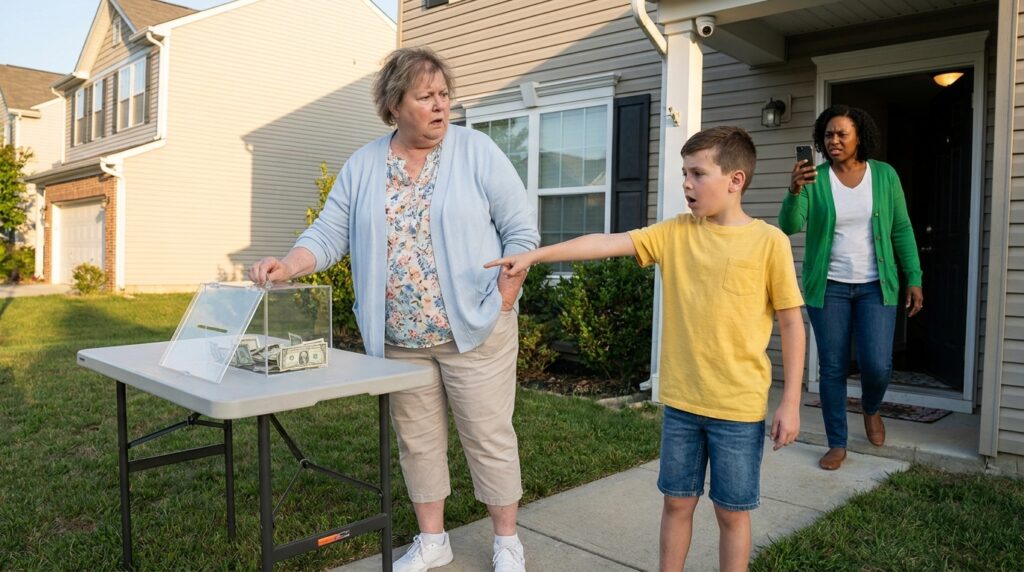
Chapter 7: More Than Eighty-Six Dollars
Three weeks later, Noah set up another lemonade table.
This time, the committee president came.
So did Margaret.
So did the treasurer.
Frank brought a folding chair and sat beneath the shade of the maple tree.
Even several neighbors who had never attended the first fundraiser stopped by.
The donation box was larger.
It was also locked.
A printed sheet beside it explained exactly where the money would go.
Noah had learned something from the experience.
So had the adults.
Trust was not the absence of rules.
Trust was knowing the rules applied to everyone.
By late afternoon, the box held more than four hundred dollars.
Noah counted the bills carefully.
Then he looked up.
Karen was standing across the street.
She had not approached the table.
She simply watched.
Denise saw her.
For a moment, she wondered whether the old argument would begin again.
It didn’t.
Karen crossed the street slowly.
She stopped several feet from the table.
“I heard you were doing another fundraiser.”
Noah nodded.
Karen looked at the locked donation box.
Then she reached into her purse.
She took out an envelope.
“I owe the pantry more than a dollar.”
She placed the envelope on the table.
Noah looked at his mother.
Denise did not tell him what to do.
He picked up the envelope.
“Thank you.”
Karen nodded.
Then she turned away.
It wasn’t a dramatic reconciliation.
There was no sudden embrace.
No one pretended the past hadn’t happened.
Some damage could not be erased by one envelope.
But something had changed.
The neighborhood no longer depended on one person’s version of the rules.
The committee had new safeguards.
The residents had learned to ask questions.
And Noah had learned that standing up for something small could matter when the thing being protected was bigger than money.
That evening, Denise deposited the day’s donations.
The receipt showed $412.75.
She gave Noah the copy.
He smiled.
On the refrigerator, beside the receipt, Denise placed another piece of paper.
The original fundraiser total.
$86.40.
She kept it there because she wanted to remember what the number had really represented.
Not the amount of money.
Not the argument.
Not Karen.
It represented the moment a child discovered that fairness sometimes required courage.
And the moment a neighborhood discovered that dignity was not something a committee could hand out—or take away.
It belonged to the people who lived there.
Months later, the little lemonade table was gone.
But on Saturday mornings, neighbors began leaving food pantry donations on Denise’s porch.
Someone brought canned soup.
Someone else brought cereal.
Margaret started collecting blankets.
Frank helped organize deliveries.
Noah kept the donation box.
He never left it unattended.
He didn’t need to.
The box now carried a small handwritten note:
Every dollar helps someone feel less alone.
And this time, everyone in the neighborhood understood exactly what it meant.