Chapter 2: The Missing Footage
By seven that evening, the lemonade table was gone.
The cups had been washed. The donation box sat empty on Denise’s kitchen counter.
Noah had gone upstairs without eating dinner.
Denise replayed the security footage again.
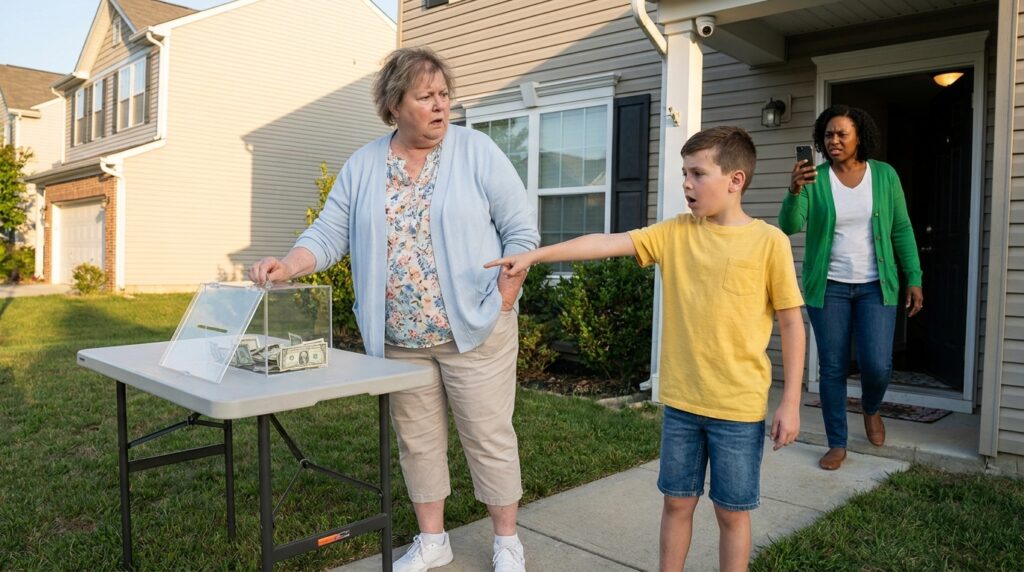
The recording showed Karen approaching the table.
It showed her looking toward the house.
It showed her glance directly at the security camera.
Then the screen froze.
The next available footage began twelve minutes later.
Karen was already walking away.
Denise sat back.
The gap bothered her more than the theft.
She called the security company.
The technician explained that the camera itself appeared to be working, but the recording had been interrupted because the system had temporarily lost its internet connection.
It could have been a technical failure.
But Denise remembered Karen looking directly at the camera.
That detail stayed with her.
The next morning, Denise went to the neighborhood association office.
The community was an older suburban development where people had lived for decades. Retirees walked every morning. Families knew which houses had grandchildren visiting on weekends. Small disputes were usually settled over coffee before they became official complaints.
Karen had served on the neighborhood committee for years.
She knew the rules.
She also knew people trusted her.
At the office, Denise found a copy of the community guidelines.
There was no rule prohibiting small charitable collections on private property.
There was a rule requiring permits for commercial sales conducted on common property.
Noah’s table had been in Denise’s front yard.
It wasn’t common property.
Denise photographed the relevant page.
Then she found another detail.
Karen had submitted a complaint about the fundraiser two days earlier.
The complaint stated that an “unapproved financial solicitation” would be taking place at the Bennett residence.
Denise stared at the date.
Karen had known about the fundraiser before she came over.
She hadn’t suddenly decided to “protect the neighborhood.”
She had already decided it was a violation.
That afternoon, Denise received an email from the committee requesting a meeting.
The subject line read:
Fundraiser Compliance Review.
Not theft.
Not missing money.
Compliance.
Denise understood immediately.
Karen wasn’t planning to defend herself.
She was planning to make the fundraiser the problem.
When Denise told Noah, he looked frightened.
“Are they going to take the money?”
“No.”
“What if they say I did something wrong?”
Denise sat beside him.
“You didn’t.”
Noah looked toward the empty donation box.
“But she took a dollar.”
Denise nodded.
“I know.”
“And everybody saw her.”
“Noah,” Denise said gently, “sometimes people don’t believe what they see until there’s proof they can’t explain away.”
That night, Denise received a message from an elderly neighbor named Margaret Ellis.
Margaret had seen Karen leaving the house.
She had also seen something Denise hadn’t.
Karen wasn’t carrying only her purse.
She had been holding a small black device in one hand.
Margaret didn’t know what it was.
But she remembered Karen stopping beside the Bennett driveway before walking away.
And Margaret had heard her say one sentence to herself:
“I’ll make sure that camera never becomes a problem.”