
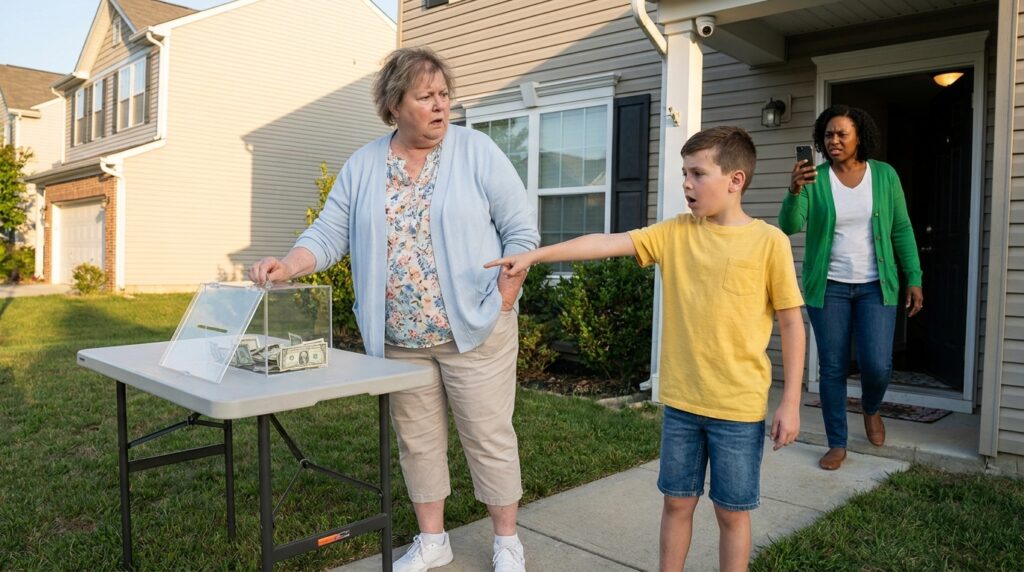
Chapter 3: The Woman Everyone Trusted
The committee meeting filled the community room.
Karen arrived early.
She wore a neat cardigan, carried a folder and greeted everyone by name.
She looked nothing like the woman who had been arguing with Noah.
That was part of what made Denise uneasy.
Karen spoke calmly.
She said she had been concerned about neighborhood regulations.
She said she had only moved the donation box because she believed it was unauthorized.
She denied taking money.
Then she opened her folder.
Inside was a printed copy of the community guidelines.
Several residents nodded.
Denise felt the room shifting.
Karen had come prepared.
When Denise showed the same guidelines, including the section that permitted charitable activity on private property, Karen immediately changed her argument.
She said the rule was “open to interpretation.”
Then she claimed Noah had been collecting money without adult supervision.
Denise looked at her.
“You took the box from a ten-year-old.”
Karen didn’t answer.
Instead, she turned toward the committee.
“I was trying to protect the neighborhood from becoming a place where anyone can put a money box outside and ask residents for cash.”
The sentence sounded reasonable.
That was the problem.
Then Margaret Ellis raised her hand.
Everyone knew Margaret.
She was seventy-three, lived alone and rarely involved herself in neighborhood disagreements.
“I saw Karen leave,” Margaret said.
Karen’s smile disappeared.
Margaret continued.
“She had something black in her hand.”
Karen interrupted.
“You don’t know what you saw.”
Margaret remained seated.
“No. I don’t.”
That simple admission made her testimony stronger.
“But I know what I heard.”
The room became quiet.
Margaret described hearing Karen say she would make sure the camera wouldn’t become a problem.
Karen immediately denied it.
Then Denise’s phone vibrated.
A message had arrived from the security company.
They had recovered a partial cloud recording.
The local system had stopped recording.
But the camera had uploaded several seconds of footage before the interruption.
Denise opened the file.
The room watched.
The video showed Karen approaching the table.
She looked around.
Then she reached into the donation box.
She pulled out a small stack of bills.
She pushed them into her cardigan pocket.
The room went silent.
Karen stared at the screen.
For the first time, she had no explanation ready.
Then she noticed the timestamp.
The footage didn’t show what happened after she took the money.
It didn’t show whether she returned it.
It didn’t show the confrontation.
It didn’t prove exactly how much she had taken.
Karen seized on that weakness.
“You’re showing an incomplete clip,” she said.
Denise nodded.
“Yes.”
Karen straightened.
“Then you don’t have the whole story.”
Denise looked at Noah.
He was sitting beside his grandfather, Frank, who had come to support him.
Frank leaned forward.
His voice was quiet.
“We don’t need the whole story to know you put your hand in that box.”
Karen looked around the room.
Nobody spoke.
But nobody was looking at Denise anymore.
They were looking at Karen.
And for the first time, Karen seemed to realize that the neighborhood’s trust was no longer automatically hers.