CHAPTER 5: THE UNBROKEN BOUNDARY
The air on the upper pad tasted of raw pitch, cold iron, and old exhaust.
Dave had already swung the flatbed’s hydraulic crane arm out over the wooden bed, the steel cables humming under tension as they took the strain of the first timber cluster. Four heavy Douglas fir posts—sixteen-inch squares, hand-planed and notched for mortise-and-tenon framing—hung suspended two feet above the bed, dripping clear meltwater onto the crushed stone.
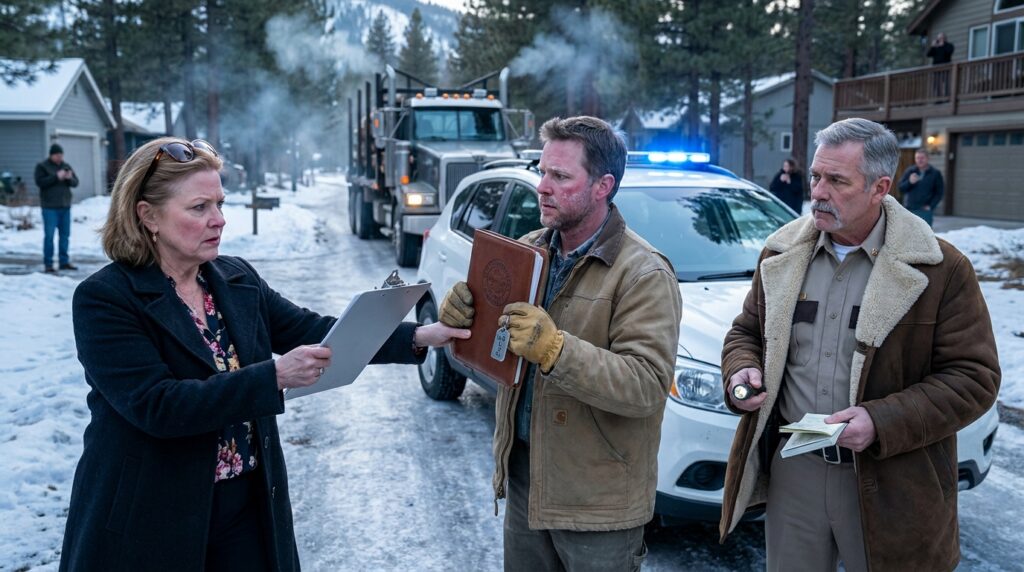
I walked up the slope slowly, my work boots sinking through the crust into the dirt below. Behind me, down at the choke point where the lane narrowed between the stone pillars, the roof of Callahan’s patrol car sat quiet under the pine canopy, its single alley light throwing a steady beam across the gravel apron. Beyond his rear bumper, the white crossover remained parked in Evelyn’s paved turn, its headlights dark, its interior silent.
Dave pulled the hydraulic lever, lowering the first bundle onto my timber bunks with a dull, heavy thud that rattled the frost off the nearest pine branches.
“She’s sitting in her kitchen watching through the blinds,” Dave said, stepping off the truck’s side rail and rubbing his gloved hands together over the warm exhaust stack. “I saw the curtain twitch when the crane hydraulic hissed.”
“Let her watch,” I said, setting the leather binder down on a stack of rough-sawn cedar boards near the building pad.
The binder lay open to the 1974 county grant. The raised silver seal caught the pale amber light of the setting sun breaking under the cloud deck to the west. Beside it, the notched steel key tag E-47 rested flat against the yellowed parchment, its stamped numbers filled with dark soil from the ditch.
For three years, every time I turned a saw onto this parcel, I’d felt the weight of their perimeter. The Ridge Crest gates sat half a mile down the mountain, but their rules had crept up the draw like frost under a door frame—measuring the height of my stack, timing my generator runs, counting the days my trailer sat parked beside the foundation. I’d spent forty thousand dollars on legal retainers after my partner cleaned out the business account, trying to prove I had the right to stand on land my family had cleared before the county paved the main road.
And all the while, the answer hadn’t been in a court filing or a lawyer’s retainer agreement. It had been sitting in an oiled leather binder on my grandfather’s shop shelf, written in dark black ink on four pages of forty-pound parchment.
“Where do you want the second bundle, Marcus?” Dave asked, leaning his shoulder against the crane’s control housing.
“Set it right along the south setback line,” I said, pointing toward the line of iron surveyor pins marking the boundary between my four acres and the manicured lawn of the adjacent estate. “Two feet inside the pin. Leave room for the staging trailer.”
Dave nodded, swinging the crane arm back over the truck bed. The steel cables creaked as the motor revved, the sound carrying across the ravine and echoing off the granite bluff behind the subdivision.
I walked to the edge of the pad, where the ground sloped down toward the culvert. From here, you could see the entire sweep of Mercer Lane—the gray ribbon of packed gravel winding down through the timber, crossing the invisible boundary between the county right-of-way and the paved estate drives, then vanishing through the open wrought-iron gates at the bottom of the hill.
The gates were wide open.
Callahan hadn’t moved his car, but he’d stepped out onto the shoulder, his hands resting on his belt as he watched a third delivery truck—the flatbed carrying the roof trusses—turn off County Road 14 and begin its slow climb up the grade. The driver didn’t pause at the crossover. He didn’t check for laminated notices or look for a clipboard at the gate post. He simply shifted into low gear, his engine roaring as he took the incline, his tires throwing up a spray of clean gravel over the old ruts.
I reached down and picked up a handful of dirt from the edge of the pad, squeezing it until the frozen crust broke apart between my fingers, leaving only the dark, damp soil beneath.
The road hadn’t changed. The easement hadn’t expanded, and the county line hadn’t moved an inch. The covenants, the board votes, the ninety-day moratoriums, and the threats of impoundment had all been noise built over a foundation of paper that didn’t exist.
Dave swung the last bundle of timbers off the bed, setting them square on the cedar bunks with a heavy, final thud. He cut the crane motor, and the sudden silence that settled over the mountain was absolute—no wind in the pines, no hydraulic whine, no idling engines. Just the cold, clean air settling into the draw as the sun dipped behind the ridge.
Dave stepped down from the rig, unhooking the rigging straps and tossing them onto the truck floor. He looked down the hill toward Callahan’s cruiser, then at the timber stack sitting six feet high on my pad.
“That’s the last of the frame, Marcus,” Dave said, wiping his brow with the back of his sleeve. “You’re set to build.”
I looked at the timber stack, then at the leather binder resting on the cedar boards. The parchment pages didn’t flutter in the still air. The raised silver seal sat dark against the paper, permanent and unyielding.
“Yeah, Dave,” I said, closing the binder and sliding the steel key tag back into its pocket inside the leather cover. “We’re set.”
I picked up my framing square from the workbench, turned my back to the gate down the hill, and walked toward the foundation.