CHAPTER 3: THE COVENANT SHADOW
The word misdemeanor hung in the frozen air between the crossover’s front bumper and my work boots, flat and cold as a sheet of galvanized tin.
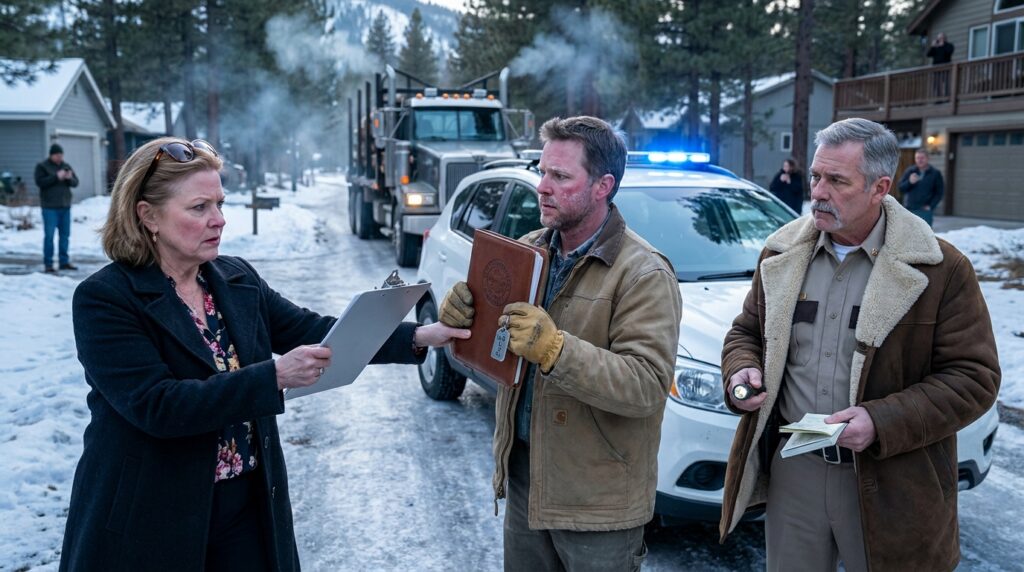
Evelyn didn’t flinch, but her grip on the silver clipboard tightened until the knuckles inside her leather glove turned white as bone. The flashlight beam in Callahan’s hand reflected off the glass face of her watch, painting a small circle of white light across her cheekbone.
“Don’t talk to me about criminal statutes, Jim,” she said, her voice dropping into a razor-thin whisper that barely cleared the rumble of Dave’s idling engine. “You know as well as I do that the county signed off on the Ridge Crest master plan in ninety-eight. If this corridor is classified under fire protection, it’s subject to municipal emergency access rules—which means the board holds concurrent enforcement power.”
She reached into the outer pocket of her coat and pulled out a second document—a stapled, folded thick sheet printed on heavy linen bond. She didn’t hand it to Callahan. She held it flat against her chest, the top margin clearly visible under the flashlight beam.
Across the top ran a bold header: RIDGE CREST MUNICIPAL CONSOLIDATION AGREEMENT & ROADWAY RESTRICTION COVENANT (1998).
On the reverse side of the last sheet, peeking out past her cuff, sat a square ink stamp—not the raised silver seal of the county clerk, but a faded blue-and-yellow municipal tax-lien stamp from the lower district water authority.
“Look at the recording number, Marcus,” Evelyn said, turning her head slightly toward me. The oversized sunglasses hid her eyes, but the hard line of her jaw didn’t move an inch. “When your grandfather took the water hookup extension from the lower reservoir in ninety-eight, he signed the district consolidation rider. That rider explicitly brought this entire four-acre parcel under the administrative umbrella of the Ridge Crest infrastructure covenant. He didn’t tell you about that, did he?”
I looked at the blue-and-yellow ink stamp. My palm tightened around the leather binder, the cold brass rings biting into my fingers through the thin work gloves.
My grandfather had never mentioned a district rider. After the partner in my building firm wiped out our operating account three years ago and left me with four hundred thousand dollars in unfulfilled timber contracts, I’d spent six months going through every ledger in his shop. I knew his grain receipts from 1982. I knew what he paid for the red pine siding on the shop in ninety-one. But I had never seen a municipal water consolidation sheet with his signature at the bottom.
“He took the water hookup,” Evelyn repeated, her tone regaining that smooth, unyielding edge. “And in exchange, he agreed that any commercial transport exceeding ten thousand pounds would require prior written authorization from the road committee to protect the shared water lines running beneath the gravel apron. That covenant was recorded. It runs with the land.”
Dave leaned further out of the flatbed cab, spitting a dark drop of tobacco juice into the frozen mud beside his front wheel. “Marcus… my front axle is sitting right over those line markings. If she’s holding a recorded district covenant that covers the water main under this apron, the transport company’s liability insurance won’t let me roll another six inches. If I crack a main under a municipal restriction, the township hangs the repair bill on my rig.”
Callahan didn’t answer right away. He shifted his weight, his heavy boots crunching through the crusted snow down to the hard packed clay beneath. He reached out and took the folded linen paper from Evelyn’s hand.
He unfolded it slowly, the heavy paper crackling like dry bark in the sub-zero wind. The flashlight beam swept down the text, stopping at the blue-and-yellow stamp on the back page.
“It’s recorded, Jim,” Evelyn said softly, stepping closer to Callahan’s elbow. “It’s a valid municipal rider. The board passed the ninety-day commercial moratorium based strictly on Section B of that agreement to prevent main ruptures during freeze-thaw cycles. Mr. Bennett’s grandfather traded commercial transit autonomy for municipal water access twenty-eight years ago. He took the benefit; now Mr. Bennett has to live with the burden.”
I looked at the paper in Callahan’s hands. The decoy was clean, sharp, and structured like a trap. For three years, I’d assumed the board’s harassment was just the vanity of a gated community trying to clean up its sightlines before the spring real estate market opened. But the rider in Callahan’s hands wasn’t about curb appeal or quiet hours. It was a paper lock built nearly three decades ago, designed to make my parcel unusable for any real construction unless I bowed to the board’s terms and signed over the property rights piece by piece.
If that rider held up under Callahan’s review, Dave’s truck turned around right now. The timber went back to the valley staging yard at three hundred dollars a day in storage fees, my construction timeline collapsed before the spring melt, and the four acres my grandfather cleared by hand became nothing more than an unbuildable landlocked lot trapped inside their luxury perimeter.
“Jim,” I said, my voice steady despite the cold settling deep into my chest. “Look at the notary date on that rider.”
Callahan froze. His thumb paused over the bottom margin of the page.
Evelyn’s head snapped toward me, her hand rising slightly as if to reclaim the paper. “The date is irrelevant. The stamp is certified by the district clerk.”
“Look at the date, Jim,” I repeated, stepping directly up to the edge of her bumper, where my boots met hers in the narrow rut. “Check the month and the year on that notary seal.”
Callahan raised his reading glasses, bringing the flashlight beam down until it was three inches from the blue-and-yellow ink.
“October fourteenth, nineteen ninety-eight,” Callahan read aloud. He paused, his brow furrowing beneath the brim of his hat. “October fourteenth…”
“My grandfather was in the regional veterans hospital in Spokane from August through November of ninety-eight, Evelyn,” I said, looking straight into the black reflection of her lenses. “He had a double hip replacement. He wasn’t signing water consolidation riders at the county clerk’s desk in October.”
The silence that followed was different from the silence before. It wasn’t the quiet of a frozen road; it was the heavy, suspended stillness of a timber beam taking more load than its grain was grown to bear.
Callahan looked up from the paper, his eyes dropping from the document to Evelyn’s face. He didn’t speak. He just held the paper out in the cold air between them, waiting.
Evelyn didn’t reach for it. Her lips compressed into a line so thin it almost disappeared against her skin. “The district records are official public filings, Marcus. If there is a clerical discrepancy regarding the notary execution, that is a matter for the circuit court to adjudicate during regular business hours.”
“Which means it isn’t an enforceable road closure today,” Callahan said. His tone didn’t rise, but the softness was completely gone. He folded the linen agreement once, twice, and handed it back to her without looking at her fingers as she took it. “You’re asking me to execute an impound order based on a contested district rider while blocking a primary fire corridor with a civilian vehicle.”
“I am protecting the infrastructure of this community!” she snapped, her voice finally breaking into a sharp, brittle pitch that echoed off the rock face across the draw.
“You’re parked in the middle of a county right-of-way, Evelyn,” Callahan said, pulling his leather ticket book out from under his arm. “And right now, I’m ordering you to move this crossover into your own drive. If that key isn’t in the ignition in ten seconds, I’m calling the county wrecker out of Townsend, and I’m signing the obstruction citation on your hood.”
Evelyn stood motionless for two full seconds, her coat stiff against the wind. The neighbors on the upper balcony didn’t move either; three phones were held high now, their screens glowing white against the dark timber of the deck.
She didn’t apologize. She didn’t look at me, and she didn’t look at Dave. She turned on her heel, her leather soles slipping slightly on the frozen granite before she caught her balance, opened the crossover’s door, and slid into the leather driver’s seat.
The engine turned over with a sharp, metallic whine before catching. She slammed the transmission into reverse, the tires spinning once against the ice before the vehicle backed hard up the slope, clearing the narrow choke point and pulling twenty yards back into her paved driveway.
Dave didn’t waste a second. The air brakes released with a loud, violent PST-HSSSH, and the twelve-ton flatbed lurched forward, its heavy drive tires grinding through the crust and gripping the dirt beneath.
As the truck’s rear wheels passed Callahan’s cruiser, the deputy stepped up beside my door, his hand resting on the top frame of my open window.
“She’s not going to leave this at the driveway, Marcus,” Callahan said softly, his breath fogging his glasses as he took them off. “That district rider… even if the date is bad, somebody filed it in ninety-eight. Somebody wanted that water main tied to your parcel line.”
I looked down at the notched steel key tag stamped E-47 hanging from my binder’s ring—the metal cold enough to freeze sweat to iron.
“They didn’t want the water main, Jim,” I said, watching the flatbed’s tail lights disappear up the climb toward my construction site. “They wanted the vault at the end of it.”