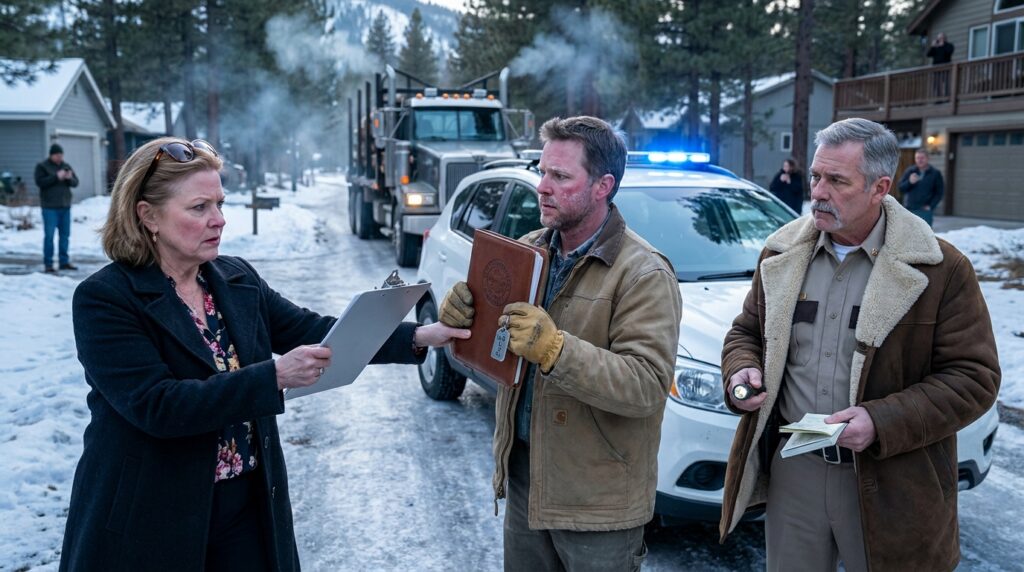
CHAPTER 2: THE PAPERWORK IN THE DUST
The blue strobe didn’t flash twice before the diesel engine under Dave’s feet gave a low, shuddering cough, its radiator fan cycling against the frozen air. The noise rattled the hood of the flatbed, sending a skin of gray rime flaking off the steel bumper onto the gravel.
Evelyn didn’t turn around to look at the approaching cruiser. Her eyes stayed locked on the plastic sleeve between my hands, her pupils tiny behind the dark gradient of her lenses. Her thumb was still tapping that silver clipboard—clack, clack, clack—a frantic, dry cadence that sounded like a grasshopper caught in a dry well.
“Put that away, Marcus,” she said. Her voice had dropped half an octave, losing the public-address chime she used for the Ridge Crest quarterly meetings. “You think showing me a piece of paper from the seventies makes a bit of difference? This road was dedicated to private residential maintenance in ninety-eight when the developer paved the lower apron. The township signed off on the covenants. The board holds exclusive authority over commercial transit.”
“The township paved sixty feet of apron to keep your crossover from slinging mud onto County Road 14,” I said. My breath formed a narrow, gray plume between us, dissipating against the front grill of her vehicle. “They didn’t buy the dirt beneath it.”
I turned the page inside the binder. Beneath the yellowed land grant lay a smaller, handwritten sheet, its edges dark with oil stains from my grandfather’s workbench. Clipped to the top ring was a notched steel key tag stamped with E-47—the metal cold enough to draw moisture out of the air. I let the metal ring dangle against the plastic sheath, just long enough for her to see the dark iron notch worn smooth by sixty years of handling.
She didn’t glance at the key. She looked at the blue light reflected in the white paint of her hood.
The sheriff’s cruiser stopped ten yards down the incline, its front tires wedged tightly into the drainage swale to leave room on the narrow shelf. The driver’s door creaked as it swung open, the rubber seal groaning against frozen metal. Deputy Jim Callahan stepped out, his broad frame taking up half the space between the embankment and the timber. He wore his shearling-lined winter coat over his khaki uniform, his hat pulled low enough to shade his brow. He didn’t have his hand on his belt, but he held a heavy leather-bound ticket book tucked under his arm.
“Morning, Evelyn,” Callahan said, his boots grinding into the crushed granite with a measured, heavy step. He didn’t look at me first; he looked at the white crossover sitting sideways across the double rut. “Got a call about a commercial obstruction blocking the mountain turnoff.”
“I made the call, Jim,” Evelyn said quickly, turning half a shoulder toward him while keeping her arm rigid in front of my chest. “This transport rig is attempting to haul heavy industrial material up Mercer Lane in direct violation of the Ridge Crest winter access restrictions. We voted on a ninety-day commercial moratorium on Monday. The driver refused to clear the right-of-way.”
Callahan stopped at the rear quarter-panel of her SUV. He looked at the flatbed’s front tires—twelve inches of tread sitting square on the gravel—then at the white bumper three inches from the steel hub.
“You’re across both ruts, Evelyn,” Callahan noted softly.
“I am securing the property boundary until private security arrives to issue the impound notice,” she snapped. Her composure was fraying at the edges, her voice rising just enough to reach the three neighbors who had stepped out onto the upper deck of the estate overlooking the turn. “The HOA covenants explicitly state that any unapproved vehicle exceeding ten thousand pounds gross weight constitutes an active hazard.”
“The board passed a quiet-hours covenant,” I said, looking at Callahan over her head. “They passed it forty-eight hours ago in a closed executive session because they knew Dave’s truck was scheduled for this morning. She’s trying to call it municipal law.”
Evelyn turned on her heel, her coat flaring against the cold wind rising up the draw. “It is law within the boundaries of the Ridge Crest development, Marcus! Every parcel owner signed the master deed restrictions when they took title. You don’t get an exemption just because you choose to live in a temporary shelter while you drag out a construction project for three years.”
Dave leaned out the driver’s window of the flatbed, his arm resting on the cold door frame. “Hey, Deputy! I got four more hauls behind this one waiting down at the staging yard. Engine’s idling away eighty dollars an hour in fuel. Either we clear this road or I’m billing the party holding the clipboard.”
Callahan didn’t answer Dave. He shifted his weight, his eyes dropping to the leather binder I was holding at my waist. He knew the land. He’d worked this beat since the old mill closed down in ninety-six, back when the only thing on this ridge was scrub pine, deer trails, and my grandfather’s timber shop.
“What do you have there, Marcus?” Callahan asked, stepping around Evelyn’s bumper.
Evelyn stepped directly into his path, her hand coming up again with the laminated paper. “He has an obsolete survey, Jim. My legal counsel reviewed the entire developer packet before we issued the winter moratorium. The master association holds total administrative authority over all ingress and egress corridors connected to the lower gate. If you don’t enforce the vehicle clearance now, the board will file an immediate injunction against the sheriff’s department for failure to protect private property rights.”
Callahan stopped. He looked at the laminated paper she was holding inches from his chest, then down at his own boots. A low, dry sound came out of his throat—not a laugh, just the sound of a man who had read too many county code books in the dark of a patrol car.
“Evelyn,” Callahan said, his voice flat as frozen slate. “You can file whatever you like with the county commissioners on Monday morning. But right now, you’re parked sideways on a road that doesn’t have a turnaround for half a mile.”
“It’s a private drive,” she insisted, her tone hardening into iron. “We hold the maintenance bond.”
“You hold the gravel contract,” I corrected, stepping past her shoulder so the binder lay directly in Callahan’s line of sight. I flipped the clear sleeve over, exposing the second document—the one bearing the red-ink boundary lines and the stamped clerk’s certification. “Look at the easement dedication, Jim. Paragraph three. The 1974 grant didn’t just give my grandfather access. It dedicated Mercer Lane as a public utility and right-of-way corridor tied to the lower drainage basin and the county fire protection network.”
Callahan took a pair of thin reading glasses from his coat pocket, hooking them over his ears with one hand while holding the binder open with the other.
Evelyn reached out, her fingers hovering an inch from the yellowed paper as if she intended to pull the sleeve right out of the ring harness. “That document is fifty years old, Jim! It was written before the subdivision existed. It has no legal standing against a modern municipal covenant!”
Callahan didn’t look up from the page. His thumb moved slowly over the raised silver seal, feeling the sharp, embossed edges of the metal impression that had survived half a century in an oiled drawer.
“It says here,” Callahan read aloud, his voice low and deliberate, “that the right-of-way is unalterable by any subsequent owner, assignee, or private association without a unanimous vote of the county board of commissioners and the explicit written consent of the underlying parcel holder.” He paused, looking over the top of his wire-rimmed glasses straight into Evelyn’s dark lenses. “Did the county commissioners vote on your winter moratorium on Monday, Evelyn?”
The wind dropped for a second, leaving only the deep, rhythmic thrum of the flatbed’s diesel exhaust filling the gap between the trees. On the upper deck across the lane, one of the neighbors leaned over the timber railing, pulling his phone out of his parka pocket.
Evelyn’s chin came up an inch, her mouth settling into a tight, pale line. “The board’s attorney verified the scope of our authority. We are well within our rights to protect the structural integrity of the pavement.”
“Then your attorney needs to read the bottom of page two,” Callahan said, handing the binder back to me. He unbuttoned the flap of his holster, not to draw his sidearm, but to pull a small steel flashlight from his utility belt. He clicked it on, shining the bright white beam directly onto the rusted steel key tag resting against my knuckles. “Because if this lane is a dedicated fire corridor, Evelyn… blocking it with a private motor vehicle isn’t a civil dispute. It’s a class-two misdemeanor.”