
CHAPTER 1: THE GRAVEL APRON
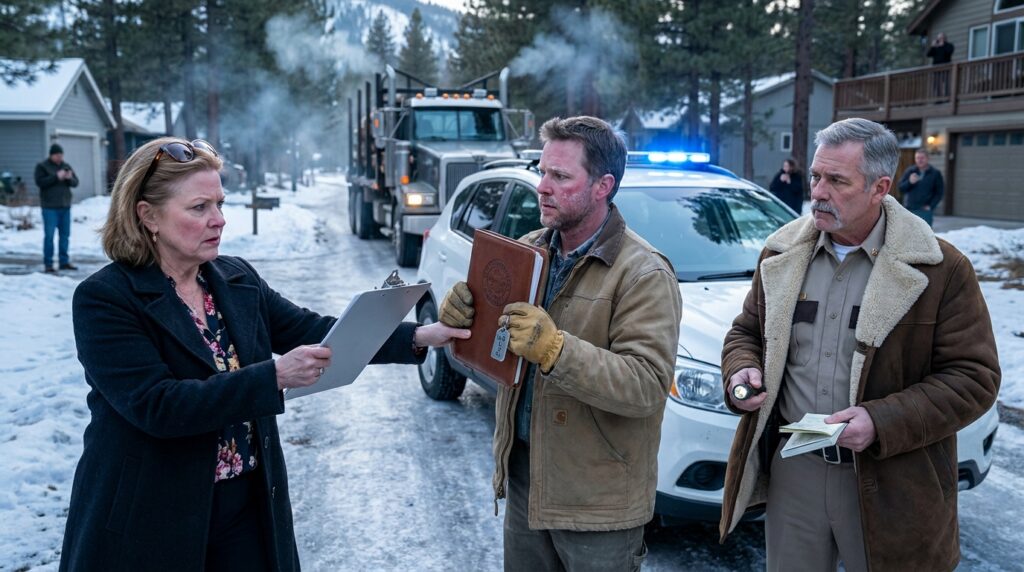
The air brake hiss of a twelve-ton flatbed transport truck bit through the sub-zero quiet of Mercer Lane, cutting off mid-roar as a white crossover vehicle swerved hard across the frozen gravel to block the incline.
Marcus Bennett didn’t jump. He stayed seated in the passenger cab of Dave’s transport rig, watching diesel exhaust curl gray and thick against the pine canopy. Through the windshield, the white SUV sat tilted across both ruts, its back wheels kicking up a small cloud of crushed granite before coming to a dead stop.
The door of the crossover opened. Evelyn Pryor stepped out into the biting air, her dark wool coat unbuttoned just far enough to display a crisp floral blouse underneath. She held a silver clipboard like a shield, her oversized sunglasses reflecting the pale winter sun.
“Hold it right there, Dave,” Marcus said quietly, his voice low over the rumble of the engine. “Don’t back down an inch.”
Dave wiped a calloused palm across the steering wheel, his jaw set hard. “She’s blocking the whole choke point, Marcus. One slip on this ice and I’m sliding into her fender.”
“She knows it,” Marcus replied. He unbuckled his seatbelt, pulled his work gloves tight over his knuckles, and grabbed the thick leather binder resting on the dash.
When Marcus stepped down from the cab, the crunch of frozen needles beneath his work boots was the only sound in the lane. Across the driveways of the Ridge Crest subdivision, three separate garage doors had rolled up halfway. Neighbors stood in the shadows of their heated bays, watching.
Evelyn didn’t wait for Marcus to reach the front bumper. She marched to the edge of the gravel apron, raising one gloved hand in a sharp halt gesture.
“You need to turn this commercial rig around immediately, Marcus,” she announced. Her voice carried the practiced weight of someone who spent her Tuesdays chairing committee meetings. “Mercer Lane is under seasonal quiet-hours governance and strict weight limits by vote of the Ridge Crest Board. This delivery is an unsanctioned nuisance.”
Marcus stopped two feet from her front bumper. The cold air burned the back of his throat, smelling of pine sap and unburnt diesel. He didn’t raise his hands, nor did he look at the clipboard she shoved forward.
“The county marked this right-of-way forty years before your sanctuary built its first gate, Evelyn,” he said, his posture unyielding against the frost.
“Current covenants supersede historical assumptions,” Evelyn shot back, her index finger tapping the metal edge of her clipboard with a sharp, metallic click. “I’ve already dispatched private security, and county transit has been notified. You haul commercial timber up this lane, and I will have the vehicle impounded before your crew lays a single joist.”
Marcus looked past her shoulder to the narrow throat of the road. On the passenger seat of her idling SUV sat a second, identical red notice—freshly laminated, ready to tape to his gate post. He didn’t argue. He slowly unzipped the binder, revealing a yellowed parchment map protected by heavy plastic. In the center, stamped deep into the paper, sat a raised silver seal from the county clerk dated November 1974.
“Read section four, Evelyn,” Marcus said softly, holding the binder flat between them. “Stamped by the clerk. Witnessed forty years ago.”
Down at the turn of the main road, the flash of a single blue strobe light reflected off the ice on the timber line.