CHAPTER 5: THE CLEAR LINE AND THE FINAL TORQUE
“You don’t bring any vehicles here anymore, Patricia,” Greg repeated, his voice carrying the immovable density of reinforced concrete. He pulled a yellow pre-printed form from the rack behind the register, smooth paper tearing sharp against the metal edge of the dispenser. “Your appointment for twelve-thirty is officially canceled. Your commercial account with Northern Fleet & Auto is terminated as of right now.”
Patricia’s mouth worked silently for two seconds, her designer sunglasses sliding down the bridge of her nose as her head jerked back. “You can’t cancel a corporate account over a misunderstanding!”
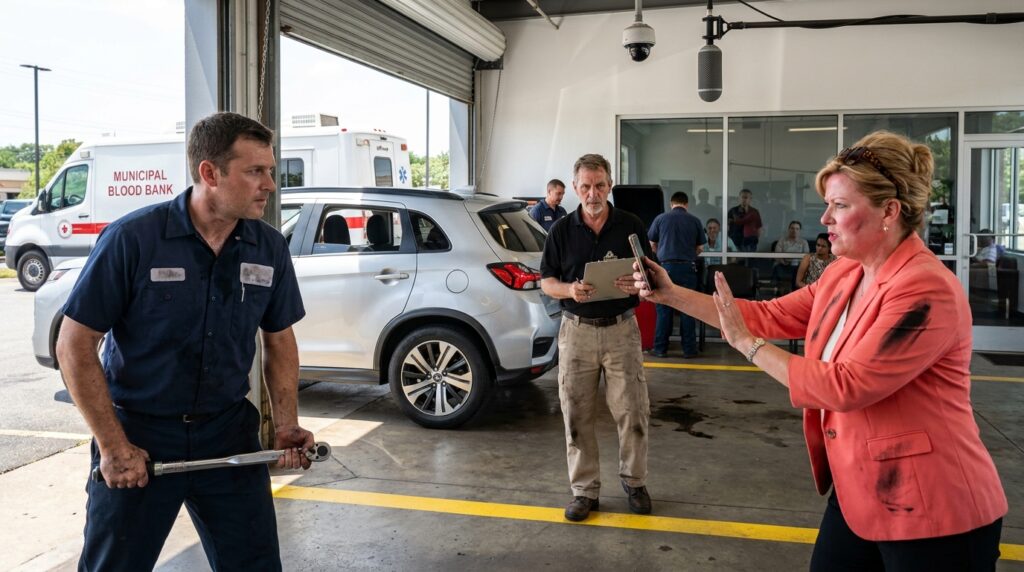
“This wasn’t a misunderstanding,” Greg said. He pressed his thumb against the terminal keyboard, sending the exported camera clip and audio file directly to the regional compliance portal and the municipal police non-emergency dispatch line. “You backed into an active, restricted service bay. You created a physical obstruction for an emergency medical transport. And you attempted to fabricate an assault claim against my lead technician.”
He slid the yellow carbon-copy paper across the laminate counter, stopping it right at the edge of her manicured hand.
“That is a formal notice of commercial trespass,” Greg said, pointing toward the double glass doors. “You have three minutes to step out to your vehicle, put it in drive, and clear our apron. If that silver crossover is still sitting across the Bay 2 threshold at ten-twenty-one AM, the county deputy stationed two blocks down will handle the removal.”
Patricia looked at the paper, then at Greg, then slowly turned her head to face the lobby.
Not a single person looked away. The man in the utility jacket had his phone raised, the glass lens catching the glare of the ceiling lights as he recorded her posture. Beside him, two other waiting drivers sat with arms folded, their expressions hard, unforgiving, and completely devoid of sympathy.
She didn’t grab the yellow form. She pulled her coral blazer tight around her waist—her arm brushing against the thick, dark streak of gear grease running down her right side—and turned on her heel. The glass doors hissed open as she shoved through them, her heels clicking against the concrete outside in a frantic, ungraceful cadence.
“Miller,” Greg called over the shop intercom mic on his desk, his voice echoing out through the external bay speakers. “Clear the apron.”
Through the double-paned window, we watched Patricia throw herself into the driver’s seat of her crossover. The engine roared as she slammed the transmission into drive, the tires screeching against the painted yellow line as she yanked the steering wheel hard to the left, cutting a jagged arc across the gravel lot before accelerating onto the main county road.
The low, heavy rumble of the shop floor returned the second the crossover cleared the driveway threshold.
I turned away from the counter and walked back through the double glass doors onto the concrete apron of Bay 2. The air hit me like a physical weight—hot, thick with hydraulic oil, and smelling of fresh rubber. But the knot that had lived between my shoulder blades for four years—the cold, ghost-like dread of an unverified accusation ruining a man’s livelihood—was gone.
I picked up the calibrated torque wrench from the rolling tool cart. The heavy steel handle felt solid, cold, and familiar against my calloused palm.
“Marcus,” Miller called down from the operator console of Bay 2, his hand hovering over the hydraulic release lever. “We good to lower?”
“Lower her down,” I said.
The hydraulic valves hissed, releasing compressed fluid back into the reservoir as the two-post hoist descended in measured, rhythmic increments. The heavy steel frame of the blood bank van settled onto the concrete floor with a solid, echoing thrum.
I knelt beside the rear passenger tire, set the socket against the final lug nut, and leaned my body weight into the lever arm. The internal mechanism clicked sharply at ninety foot-pounds—exact, measured, and verified.
Behind me, the shop doors stayed wide open to the summer heat, the bright yellow line on the floor marking the boundary between the work we did and the noise of the world outside. I stood up, wiped the grease from my hands onto my blue canvas work trousers, and signaled the delivery driver that his rig was clear for dispatch.