CHAPTER 2: THE THREAT ON THE LINE
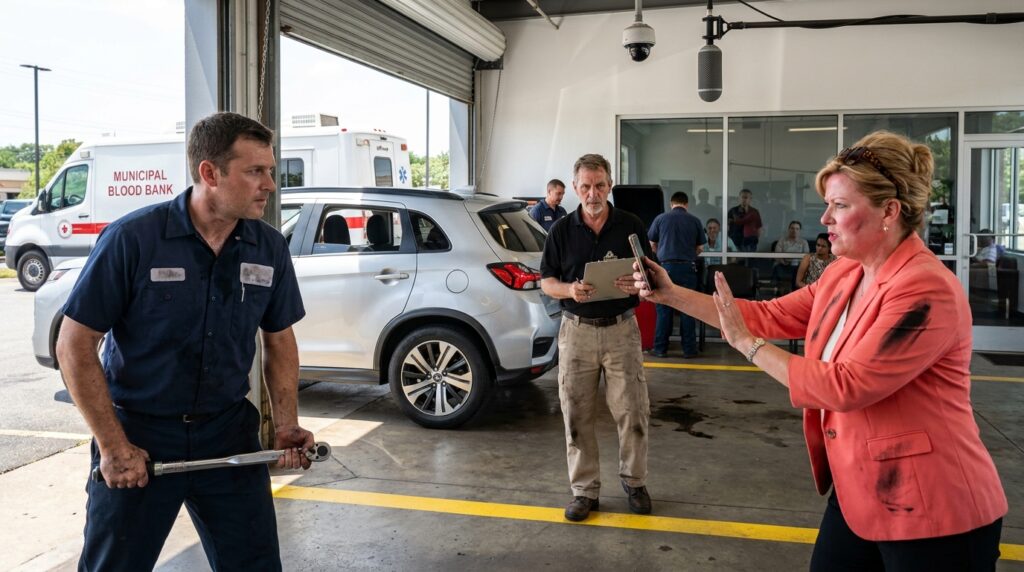
Patricia Delancey took half a step closer to the yellow paint, her smartphone extending until the camera lens hovered less than two feet from my chest. The glass screen reflected the yellow overhead lights of Bay 2, a tiny red recording dot pulsing in the upper corner.
“Look at him,” she said to the phone, her voice dropping into a theatrical, trembling cadence that cut clean through the idling rumble of her crossover. “He’s cornering me. Standing over me with a forty-inch steel wrench while I’m completely defenseless.”
I didn’t shift my feet. The concrete beneath my boots was rough, stained with decades of dark transmission oil and ground-in gravel. I kept my breathing slow, filling my lungs with the heavy, metallic tang of the shop air—hot rubber, brake dust, and the sharp bite of solvent from the parts washer in the corner.
“Ma’am,” I said, my voice barely louder than the hum of the hoist pump behind me. “You are standing inside an active workspace. You crossed the safety perimeter while a three-ton vehicle is raised on hydraulic locks. My hands are on my tool because I was torquing the lug nuts on a blood transport van that needs to clear this bay in six minutes.”
“He’s making excuses!” Patricia shouted toward the glass wall of the waiting room. A man in a flannel shirt holding a clipboard stood up inside the lobby, his palm resting against the double-paned window to get a better view. “He threatened me before I even stepped out of the vehicle! He told me if I didn’t get out of his way, he’d use this tool on my bumper!”
The lie was clean, delivered with the practiced sharpness of someone who knew exactly how corporate liability claims worked. Over her shoulder, through the open driver-side door of her SUV, the dashboard display glowed. A digital audio recorder icon was active on her media console, a thin blue wave line moving steadily across the dark screen.
“I have it right here,” Patricia declared, tapping the back of her phone casing with a manicured fingernail. Her gold bracelets clinked against the hard plastic with a sound like small coins hitting iron. “I hit record the second I pulled onto your gravel. I have his voice on tape telling me he’d smash my headlights if I didn’t back out.”
My left hand tightened slightly on the cold steel shaft of the torque wrench. The claim was impossible. I hadn’t spoken a word until she opened her door and stepped onto the apron. But in a corporate retail setup like Northern Fleet & Auto, a recorded verbal threat of destruction—even a fabricated one—triggered an immediate suspension protocol. If a manager heard the word ‘threat’ paired with an active audio file, the employee was escorted off the floor before the footage was even pulled.
“You have audio of me?” I asked, keeping my eyes fixed on the bridge of her sunglasses.
“Every single word, supervisor,” she hissed, taking another deliberate quarter-step forward. The hem of her coral blazer brushed the greasy vertical guide rail of the bay door. A black streak of grease and heavy gear lubricant transferred onto the bright fabric—a mark exactly five feet, two inches off the ground. “And when Greg hears it, you won’t just be off this shift. I’ll make sure the regional director revokes your master tech certification for assault.”
Behind her, the door to the office corridor clicked open. Greg Harrison stepped onto the concrete apron. He moved with the slow, deliberate stride of a man who had spent twenty years managing mechanics and knew that rushing onto a shop floor only invited accidents. He wore his standard black polo shirt, crisp and tucked into heavy khaki trousers, a aluminum clipboard tucked under his left arm.
His eyes swept the bay in three seconds flat: the crossover idling across the yellow lines, the blood bank van sitting at chest height on the lift posts, the waiting room patrons pressed against the glass, and Patricia standing two inches past the painted safety boundary with her arm raised.
“Patricia,” Greg said. His voice was raspy, worn down by thirty years of diesel smoke and customer disputes. He didn’t look at me first. He looked at the rear tires of her SUV, which were sitting directly over the drainage grate. “You’re parked over the oil interceptor line. Turn off your engine.”
“Greg! Thank God,” Patricia turned instantly, her posture collapsing into an exaggerated display of distress. She lowered her phone just enough to point it at Greg’s chest. “This man just threatened to destroy my vehicle with that iron bar! He told me to get out or he’d smash my front end!”
Greg didn’t blink. He stopped at the edge of the yellow line, his work shoes lined up perfectly parallel to the paint. “Marcus. Is the Ford van torqued?”
“Three wheels complete,” I said, my voice steady. “Right rear needs the final ninety foot-pounds. Vehicle is ready to lower as soon as the apron is clear.”
“He’s lying!” Patricia raised her voice to a near-shriek, turning back toward the lobby window so the waiting customers could hear every syllable. “I have the recording right here on my phone! He threatened me in the alley before I even backed in! Ask him why he’s hiding behind his yellow lines now!”
Greg looked at Patricia’s phone, then glanced up at the ceiling of Bay 2. Suspended twelve feet above the concrete, mounted directly to the steel I-beam that held the hoist motor, was a black dome camera housing. A thin green status LED blinked steadily on its underside. Right beside it hung a omnidirectional boundary microphone, its black foam cover gray with settled shop dust.
“You say you have an audio recording of Marcus making a verbal threat in the alleyway?” Greg asked, his voice flat, completely devoid of emotion.
“I have the file open right now,” Patricia said, holding her phone out toward Greg’s face. “I want him suspended immediately, and I want my tire serviced while I file the corporate report.”
Greg tapped his thumb against his aluminum clipboard. “We don’t do suspensions on the shop floor, Patricia. And we don’t review customer audio on an active bay apron.” He stepped back three feet, gesturing toward the double doors leading into the air-conditioned customer lobby. “Bring your phone inside. Marcus, hand the torque wrench to Miller, leave the van on the safety locks, and come into the office.”
Patricia smiled—a small, sharp curve of her lips that didn’t reach her eyes behind the dark lenses. She straightened her blazer, oblivious to the thick black smudge of commercial gear grease running along her right ribs, and marched toward the glass doors with her heels clicking loudly against the concrete.
I set the torque wrench down on the rolling tool cart, looked Miller in the eye, and gave him a brief nod. “Keep the lift locks engaged,” I told him quietly. “Don’t touch the lowering valve until Greg gives the word.”
I wiped my palms on a red shop rag, tossed it into the fireproof bin by the post, and followed Greg through the double doors into the cool, silent air of the lobby.