CHAPTER 5: PUBLIC COLLAPSE AND RESTORED BOUNDARY
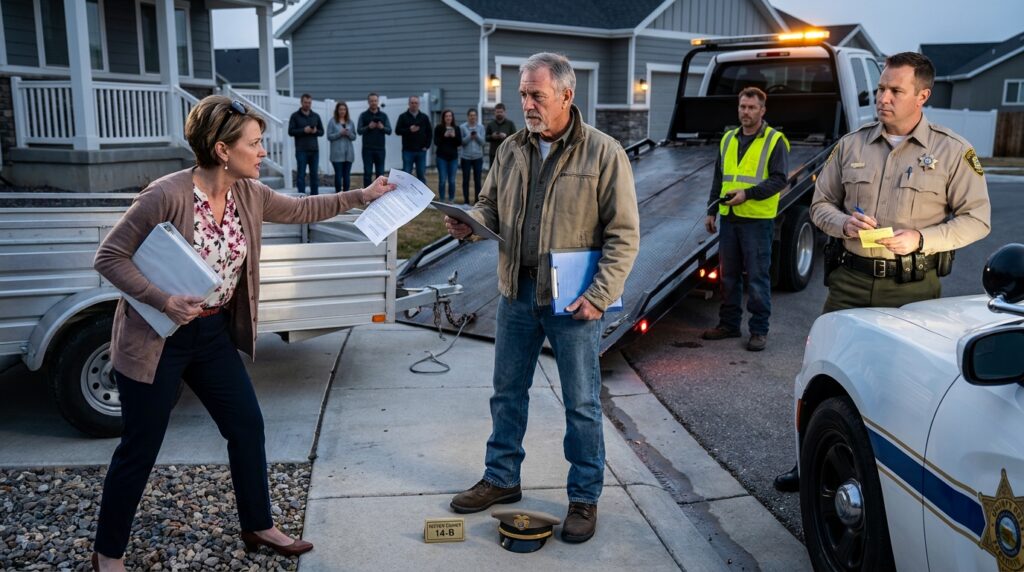
The vinyl binder hit the hood of the patrol cruiser with a dull, heavy thud, sliding two inches across the cold white paint before wedging against the base of the driver’s windshield wiper.
Brenda’s fingers didn’t leave the plastic cover immediately. Her hands trembled against the vinyl, her acrylic nails making a sharp, frantic clicking sound as Deputy Vance stepped directly into her path, his pen hovering above the yellow paper of his official report book.
“Step back from the cruiser, Mrs. Lawson,” Vance said. The words were low, clipped, carrying the unyielding weight of a deputy executing a roadside citation. He didn’t look at her face; his eyes remained fixed on the document pages as he flicked open the binder’s metal rings. “You called county dispatch requesting an emergency dispatch for a criminal obstruction on a public right-of-way. You gave the operator a sworn statement that the vehicle was parked on community land.”
“It is community land!” Brenda’s voice cracked, the pitch thinning into a desperate, hollow rasp that echoed off the garage doors down the cul-de-sac. “The 2018 resolution—”
“The 2018 resolution relies on a 1994 tract map,” Vance interrupted, pointing his pen at the fine print at the bottom of the board document. He turned his head toward Arthur, his expression hard, unreadable. “Arthur, you certified the ’98 realignment yourself when you were with the county, didn’t you?”
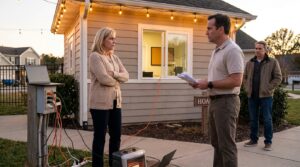
Arthur took two slow steps forward. The soles of his work boots crunched through the gravel apron, bringing him to the edge of the asphalt turnout where the brass cap sat embedded in the curb. He reached into his canvas jacket, pulled a small brass wire brush from his tool pocket, and knelt on one knee over Section Corner 14-B.
“I certified the ’98 survey because the 1994 map was voided for fraud,” Arthur said quietly. He scrubbed the wire bristles across the face of the brass cap, clearing away the accumulated road grit and dried pine needles until the stamped metal gleamed under the cruiser’s white spotlight. “The former chief engineer drew that ’94 boundary to hide a six-foot right-of-way encroachment for his own driveway. The board in 2018 pulled an invalidated, superseded map out of the county archives to manufacture this easement.”
He stood up, brushing the dirt from his knee, and looked past the deputy straight into Brenda’s eyes.
“You didn’t check the county recorder’s index, Brenda,” Arthur continued, his voice steady, devoid of anger or triumph. “You took a dead map, moved my boundary cones at two in the morning, and called a tow truck to haul off private property that sits on deeded ground my wife and I paid taxes on for twenty-two years.”
A cold wind swept down from the ridge, rattling the dry aspen leaves along the fence line. Across the street, Mrs. Gable slowly lowered her phone to her side, her face pale under the streetlight. The remaining neighbors turned away, walking back toward their front doors in total silence, leaving the asphalt apron completely empty.
Frank’s flatbed truck let out a heavy chug of exhaust as he shifted into gear, the tires spraying loose gravel as the rig pulled away down Oak Crossing Drive, its amber strobes fading into the dark.
Vance tore the yellow carbon copy from his ticket book with a sharp, crisp rip that sounded like a dry branch snapping. He held the slip out toward Brenda.
“This is a formal citation for misuse of the emergency 911 system, Mrs. Lawson,” Vance said, his voice flat and final. “In addition, I am filing an incident report for civil harassment and attempted unlawful impoundment. If you or any member of the board set foot past Section Corner 14-B without a certified court order signed by a district judge, you will be taken into custody for criminal trespass.”
Brenda stared at the yellow paper in Vance’s hand. Her fingers shook so violently she could barely grasp the slip. She didn’t look at Arthur. She didn’t look at the vinyl binder remaining on the hood. She turned on her heel, her heels clicking jaggedly against the street as she retreated toward her crossover SUV, her silhouette shrinking under the cold suburban streetlights.
Vance handed the blue folder back to Arthur and closed his notepad. “She won’t be back on your turnout, Arthur.”
“Appreciate it, Marcus,” Arthur said.
The deputy nodded, climbed into his cruiser, and backed slowly out into the lane, leaving the cul-de-sac in quiet darkness.
Arthur walked back to the trailer. He ran his hand over the cold, brushed aluminum frame, checking the hitch lock and the firm pressure of the tires. The turnout was silent now. He picked up the two orange traffic cones Brenda had placed three nights before, tossed them into the back bed of his truck, and stood alone at the edge of his property.
Beneath his boot, the brass cap of Section Corner 14-B remained flush, immovable, and exact—a permanent line etched into the earth that no transient authority could ever erase.