CHAPTER 3: THE VERIFICATION PHASE
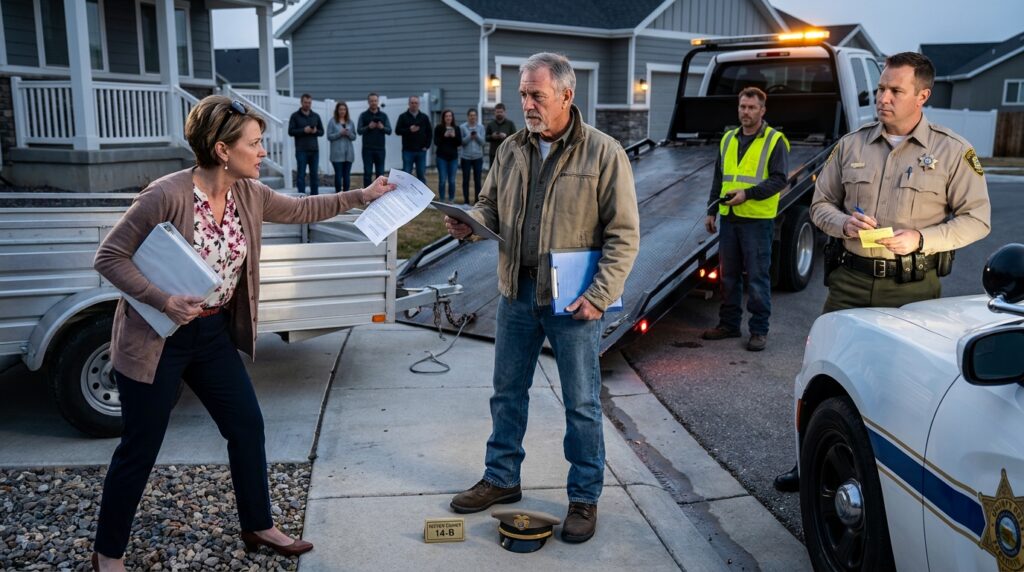
The driver’s door of the cruiser opened with a dry, mechanical latch-click. Deputy Vance swung his boots onto the shoulder gravel, his left hand settling instinctively over the base of his radio holster as he stood up. His uniform shirt was crisp against the dimming orange twilight, the silver star on his breast pocket catching the intermittent flash of the flatbed’s amber strobe.
“Evening,” Vance said, taking in the scene with a slow, practiced sweep of his eyes. He didn’t look at Arthur or Brenda first; he looked at the steel winch cable hooked to the bed frame, then at the rear tires of the flatbed sitting on the apron. “Got a dispatch call for an obstruction and a civil dispute over a private vehicle.”
“It’s an illegal obstruction, Deputy,” Brenda said, stepping out from behind the tow truck’s rear bumper. She pulled the vinyl binder from under her arm and opened it flat against her chest, her acrylic nails tapping against a sheet protected in heavy clear plastic. “I’m Brenda Lawson, HOA Board President. We are executing a lawful removal under Section 4-B of the subdivision covenants and the 2018 municipal easement variance recorded with Douglas County.”
Vance didn’t take the binder immediately. He walked to the edge of the turnout, his soles crunching over the loose gravel, and stopped two feet from where Arthur stood over the brass cap.
“Arthur,” Vance said, offering a curt, familiar nod.
“Deputy,” Arthur replied. He didn’t shift his boots off Section Corner 14-B. “Hope the hip’s holding up in this cold.”
“It manages.” Vance looked down at the brass monument, then at the blue laminated folder tucked under Arthur’s arm. “You want to clear this up before Frank starts racking up hourly standby fees?”
“The 2018 variance Mrs. Lawson is referencing isn’t a deed modification,” Arthur said. He unclasped the blue folder, the heavy plastic snapping open in the quiet evening air. “It was an administrative permission slip granted to the county water district to access the culvert during the spring flood mitigation. It relies on a 2018 easement variance executed by the previous board.”
Arthur pulled the top sheet from his folder—a crisp, high-resolution copy of the 2018 filing—and held it out.
Brenda’s posture stiffened. She stepped forward, her voice rising half an octave. “That variance gives the association an explicit twenty-foot right-of-way from the road centerline for community access and utility infrastructure! It was drafted by legal counsel, signed by the board president, and recorded in book 412 of the county land entries!”
Vance took Arthur’s sheet first, holding it up into the white glare of the cruiser’s spotlight. He squinted slightly, his thumb tracing the bold header at the top of the page. “It’s a recorded municipal variance, Arthur. It carries a clerk’s stamp.”
Frank leaned against the side of his flatbed, crossing his arms. Across the street, Mrs. Gable lowered her phone an inch, her eyes darting between the deputy and the paper in his hand.
“Read section three, Deputy,” Arthur said quietly. “The variance grants an easement across Tract C as mapped in the 2018 board resolution. But look at the legal description attached as Schedule A.”
Vance flipped to the second page of Arthur’s copy. His brow furrowed as he read the fine print printed beneath the notary seal.
Brenda stepped closer, her binder held like a shield. “The schedule references the subdivision plat! It’s completely standard!”
“The schedule references the 1994 master tract map,” Arthur said, his tone as flat and unyielding as the concrete beneath them. “The 1994 map was superseded four years later when the county realigned Oak Crossing Drive to install the storm drains. The board in 2018 used a dead map to draw their easement.”
A cold stillness settled over the driveway.
Brenda stared at Arthur, her mouth opening slightly before her jaw snapped shut. She reached into her binder, her fingers frantically shuffling through a rubber-banded stack of index cards stamped with faded red county seals, trying to locate her copy of Schedule A.
“The variance is real, Arthur,” Brenda whispered, her confidence wavering into a razor-thin edge of panic. “It’s on file. It’s signed.”
“It’s a valid variance for a piece of land that hasn’t legally existed since 1998,” Arthur said. He didn’t look at Brenda; he looked at Vance. “And even if that variance applied to this dirt, it wouldn’t account for what happened on my driveway at two o’clock on Friday morning.”
Arthur reached into his canvas jacket, pulled out his tablet, and tapped the glass screen three times.