CHAPTER 4: THE LAW ENFORCEMENT TURN
The glare of the tablet screen threw a harsh, bluish rectangle across Deputy Vance’s uniform chest. Arthur didn’t hand the glass over immediately. He held it at waist height, angled slightly toward the hood of the cruiser where the white spotlight cut through the dusk, and let the infrared playback loop.
“Timestamp is 02:14 AM, Friday the seventeenth,” Arthur said, his thumb holding the slider over the progress bar. “Infrared camera mounted on the soffit above the garage door. Resolution is 1080p.”
Vance stepped closer, his boots heavy on the gravel. He leaned down, his eyes narrowing as the black-and-white footage played across the screen.
On the display, the high-contrast night-vision playback showed the turnout bathed in stark monochrome. A figure in a dark parka and floral scarf walked onto the edge of Arthur’s driveway, carrying two plastic traffic cones in her left hand and a retractable metal measuring tape in her right. She stopped over the brass survey cap—the exact point where Arthur now stood—and knelt down. She pulled the tape out toward the road, set the base of a cone four feet inside the concrete apron, and hammered a wooden stake into the sod to hold it.
Then, the figure on the screen turned her face directly toward the soffit lens, adjusting her glasses as the camera caught her facial structure with absolute clarity.
Vance watched the six-second loop repeat three times. The silence on the driveway grew heavy, stretched so tight that the rhythmic ticking of the patrol car’s cooling manifold sounded like iron strikes against stone.
“Mrs. Lawson,” Vance said, his voice dropping into a low, measured register. He didn’t look at the tablet anymore. He turned his head slowly to face Brenda. “That looks like your parka.”
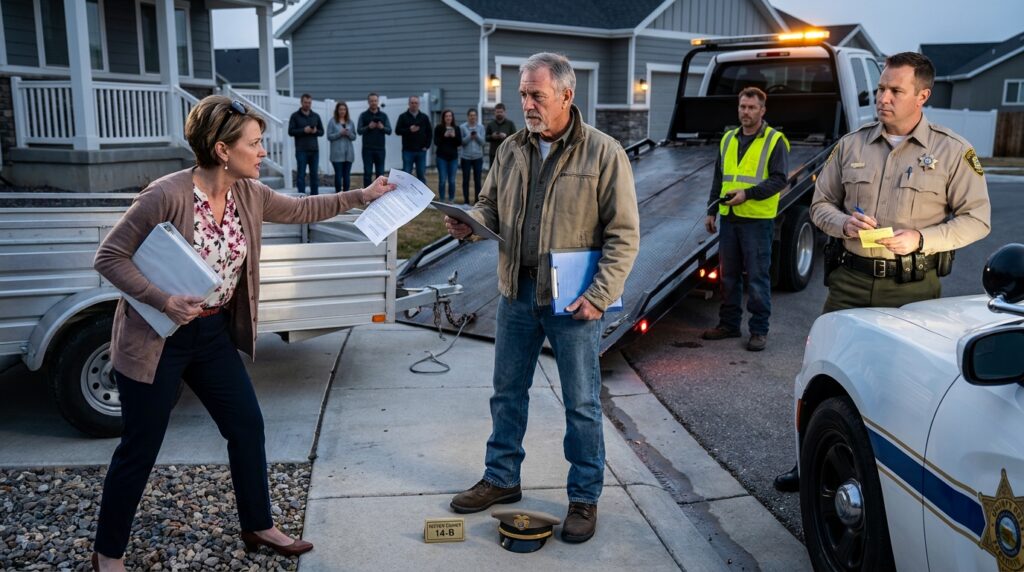
Brenda’s breath hitched, a thin, whistling sound in her throat. Her hands tightened around the vinyl binder until the plastic cover bowed outward, the white rings inside clicking as the spring tension gave way. She took half a step backward, her heels catching on the grass lip of the shoulder.
“I was verifying the easement boundary,” Brenda said, her voice rising in a thin, desperate pitch that carried straight across to the sidewalk crowd. “The board authorized an on-site physical check before the towing contract was finalized! It was administrative work!”
“You moved the temporary cones four feet onto deeded private concrete,” Arthur said. He tapped the tablet screen, freezing the frame on the moment the measuring tape extended from the brass cap. “And then you used those modified positions to calculate six thousand dollars in daily non-compliance fines while I was out of state.”
Across the street, Mrs. Gable lowered her phone completely, her jaw slack. The two younger men beside her exchanged a brief, sharp look and quietly stepped back toward their porch, leaving Brenda isolated on the shoulder.
Frank, the tow driver, let out a sharp, breathy whistle. He reached down, unclipped the winch control cable from the flatbed’s side box, and tossed the heavy rubber remote onto the steel deck with a loud, metallic clatter.
“I’m unhooking,” Frank said, shaking his head as he stepped toward his rig’s tailboard. “I’m not pulling a rig off private concrete on a altered boundary claim. You can bill my office for the roll-out fee, lady, but my cable isn’t touching that tongue again.”
“Frank, wait!” Brenda took a step toward the truck, her binder slipping three inches out from under her arm. “We have an indemnification agreement! The board will cover—”
“The board can cover whatever it wants with a judge,” Frank snapped, climbing up into his cab. “I’m not getting caught in the middle of a civil fraud complaint.”
Vance stepped between Brenda and the truck’s cab door, his posture shifting into a rigid, commanding line. He pulled a small leather-bound notepad from his breast pocket and clicked his pen.
“Mrs. Lawson, set the binder on the hood of my cruiser,” Vance said. The tone wasn’t a request; it carried the flat, institutional weight of a formal order. “We’re going to go over these municipal variance dates right now. And then we’re going to discuss the official report for filing a false emergency dispatch.”
Brenda stood frozen on the edge of the turnout, her eyes darting from the deputy’s notebook to the blue folder in Arthur’s hands, her authority dissolving into the cold mountain air. But as Vance flipped his notepad open, Arthur looked down at the paper in his own folder—at the 1994 tract map reference. A sudden, cold realization settled in his chest. The 1994 map wasn’t just a simple filing error by an incompetent board; it carried a specific county engineering index number that had only been sealed by one man—a man who had been the chief county engineer prior to Arthur’s own tenure twenty years ago.
Arthur looked up at Brenda’s trembling hands, realizing that the false variance wasn’t just her creation—it was a legacy trap laid decades before, and the final truth behind who originally altered the subdivision boundary remained locked deep inside the county records.