
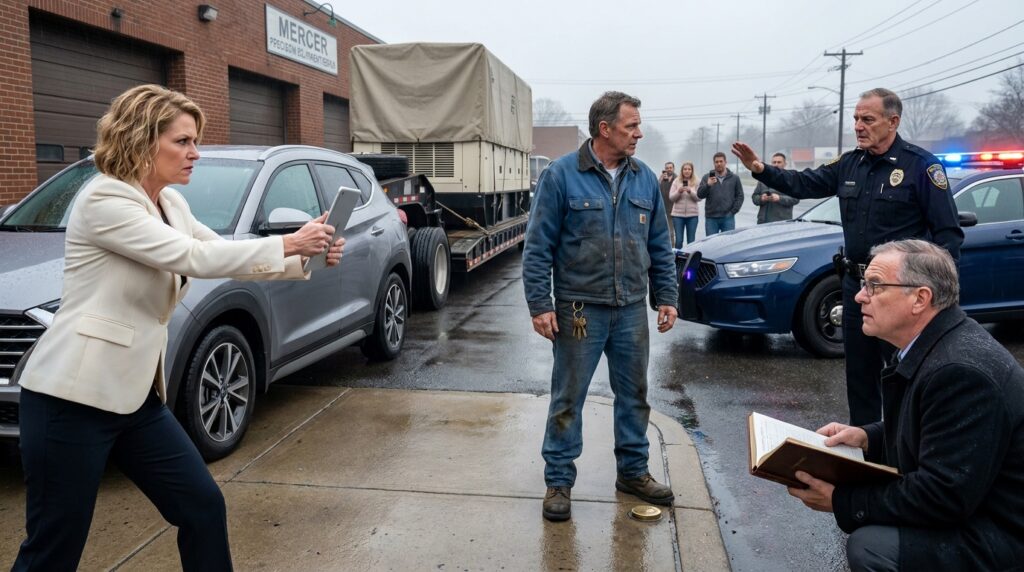
CHAPTER 4: TARGETED SABOTAGE
The silent vibration against Derrick’s chest woke him at 2:14 a.m.
He didn’t turn on the loft lamp. He swung his boots off the side of the cot, the cold floorboards pressing through his wool socks as he reached for the black monitor screen resting on the timber nightstand. The infrared camera feed from the overhang showed a pale figure moving along the side of Bay 2.
Rain fell in heavy, diagonal streaks through the frame, glowing like silver needlework against the darkness. Evelyn Pryce stood on the wet gravel beneath the shop’s main electrical drop, her ivory blazer covered by a dark, clear plastic rain poncho. In her right hand, she held a long-handled pair of insulated wire cutters; in her left, a heavy yellow clipboard.
Derrick didn’t grab a flashlight or a heavy wrench. He pulled on his dark blue canvas jacket, picked up his smartphone—its lens set to continuous local recording—and eased open the rear loft door that led down the iron fire escape into the dark service yard.
The wet gravel didn’t crunch under his boots. Thirty years of moving through high-voltage switchyards taught a man how to shift his weight to the heel, stepping silent and flat. The damp midnight air smelled of wet cedar, ozone, and the bitter, chemical stench of a cigarette left burning in an outdoor tray across the road.
As he reached the shadow of the main service bay, a loud, sharp SNAP echoed through the rain, followed by a shower of blue sparks that lit up the gravel for a fraction of a second.
The shop’s external solar inverter groaned, its cooling fan dying with a high-pitched whine as the primary copper feed wire dropped limp into the mud.
Evelyn didn’t run. She stepped over the severed cable, her designer rain boots squelching in the wet earth as she reached into her poncho pocket and pulled out a heavy steel padlock and a set of plastic yellow traffic cones. She dropped the cones right in front of the bay door threshold, then reached for the heavy safety chain securing Derrick’s outdoor parts bin—a steel locker containing five thousand dollars in reconditioned hydraulic valves.
Derrick stepped out from the shadow of the overhang. The rain hit his face cold and sharp, plastering his graying hair to his forehead.
“The main breaker carries two hundred and forty volts, Evelyn,” Derrick said. His voice didn’t carry anger; it was flat, heavy, and resonant against the wet metal siding. “You cut the neutral leg first, you would’ve taken thirty amps through that steel handle.”
Evelyn flinched, her body spinning around so fast her heel skidded in the mud. The yellow clipboard slipped from her wet fingers, smacking flat against the gravel near Derrick’s boots. The silver flashlight she held panned across his chest, blinding him for a half-second before settling on his face.
“You’re operating an unpermitted, hazardous electrical installation,” she said, her breath coming in fast, ragged plumes of white steam. Her voice lacked its polished, daytime cadence—it was sharp, brittle, strained at the edges. “This property is a public nuisance. I’m placing an emergency environmental quarantine tag on this bay.”
“You’re cutting private secondary feeds on deeded ground at two in the morning,” Derrick said. He didn’t step toward her. He stood six feet away, holding his phone steady at chest height, the tiny green recording light glowing softly behind his hand. “That’s felony destruction of commercial utility infrastructure.”
Evelyn’s eyes narrowed behind her rain-streaked glasses. She didn’t look at his phone; she looked at the dark bay doors behind him, her expression twisting into something cold and desperate. “You think you can hold out with a county plat map from nineteen-seventy-four, Mercer? You think a piece of paper stops a regional redevelopment overlay? Your shop is an eye-sore on a five-million-dollar corridor project. You’ll be locked out by the end of the week.”
“The money in your beautification fund LLC isn’t yours, Evelyn,” Derrick said, testing the line. “And those citations aren’t municipal orders.”
A dry, harsh laugh broke from her throat. “The fines? You still think this is about seven hundred dollars in association dues? You really are just a grease-monkey like your old man.” She stepped forward, her umbrella tip pointing straight at his chest. “The board doesn’t want your money, Derrick. The board wants your default.”
She turned, grabbing her plastic cones and retreating toward the curb where her pearl-gray crossover sat idling in the dark, its hazard lights cut, its engine humming with a low, mechanical purr.
Derrick didn’t chase her. He let the red tail lights disappear into the sheeting rain down Old Post Road before he bent down to pick up the item she had dropped in the mud.
It wasn’t just a yellow clipboard cover. Tucked inside the clear plastic sleeve on the back was a clipped corporate business card, its edges soaked in rainwater. The card wasn’t printed with the crest of the Crestview Commercial Association or her private beautification LLC. It was heavy black cardstock stamped with a raised gold leaf emblem: a stylized oak leaf inside a geometric diamond.
Oakridge Regional Development Holdings — Acquisition Division.
Beneath the logo, written in Evelyn’s sharp, slanted handwriting in red ballpoint ink, was a single line of notes: Lot 14 (Mercer) — Final obstruction before block assembly. Force emergency code closure prior to Thursday delivery.
Derrick held the card under his work light as he stepped back into the dark shop. His hand was cold, the rain dripping from his canvas sleeve onto the paper.
She wasn’t trying to squeeze him for citation checks to enrich her local board. She was under contract with an outside syndicate to destroy his business before Thursday’s heavy generator delivery—using her association authority to create a paper trail of health and safety violations so thick that no commercial insurer or bank would touch his title when the forced auction hit the courthouse steps.
He looked up at the darkened ceiling of Bay 2, where the silent backup battery bank was already switching over to emergency power. He didn’t call the deputy line. He pulled out his primary ledger, opened his laptop, and uploaded the raw, time-stamped infrared video file directly to a secure cloud drive, copying the file to the personal address of City Public Works Director Arthur Pendelton and Senior Sergeant Thomas Albright.
Outside, the rain kept falling, washing the mud across the brass survey cap in the curb, but the line in the dirt was no longer just about concrete. Thursday was thirty-six hours away.