
CHAPTER 2: PAPER WAR
“Blackstone, Meyer, and Associates don’t send courier letters for seven-hundred-and-fifty-dollar lawn violations, Derrick.”
Jake Martinez leaned against the steel workbench, his canvas union jacket smelling of copper wire and the sharp, ozonic tang of industrial solder. He held the thick white envelope by its corner, his grease-blackened thumb resting just below the embossed foil crest. The paper was heavy, twenty-four-pound bond that didn’t belong in a dusty repair shop along Old Post Road.
Derrick didn’t take the letter immediately. He lowered a set of hardened steel jaw plates into the bench vise, tightening the lead screw until the iron thread groaned. “She tape it to the glass again?”
“Stuck it under the wiper blade of the work truck at two this morning,” Jake said, tossing the envelope onto the workbench. It landed among the steel shavings and dried solvent rings with a dull, heavy thud. “I was coming off the third-shift grid repair down by the river. Her white Escalade was idling at the curb with the lights cut. She didn’t even drive off when my service van pulled into the lane. Just sat there, letting that sickly-sweet artificial lavender perfume drift out through a two-inch crack in her window.”
Derrick wiped his palm against his thigh and picked up the envelope. The paper felt thick, cold from the damp morning air. The letterhead was crisp, black serif lettering that promised federal injunctions, retroactive waterway infringement penalties, and an immediate three-thousand-dollar compliance assessment.
Cease and Desist: Unauthorized Encroachment on Municipal Commercial Access.
He ran his thumb over the bottom margin, where the fine print detailed the parcel reference numbers. Derrick’s eyes narrowed. The parcel ID listed on the legal letter wasn’t the five-digit municipal tax identifier his father had paid county school taxes on since nineteen-seventy-four. It was a six-digit regional commercial block code—the kind used by county assessors when consolidation groups bought up adjacent lots for strip malls.
“She’s trying to manufacture a paper record,” Derrick said low.
“She’s doing more than that,” Jake said, gesturing toward the street with a crescent wrench. “Look out the bay window.”
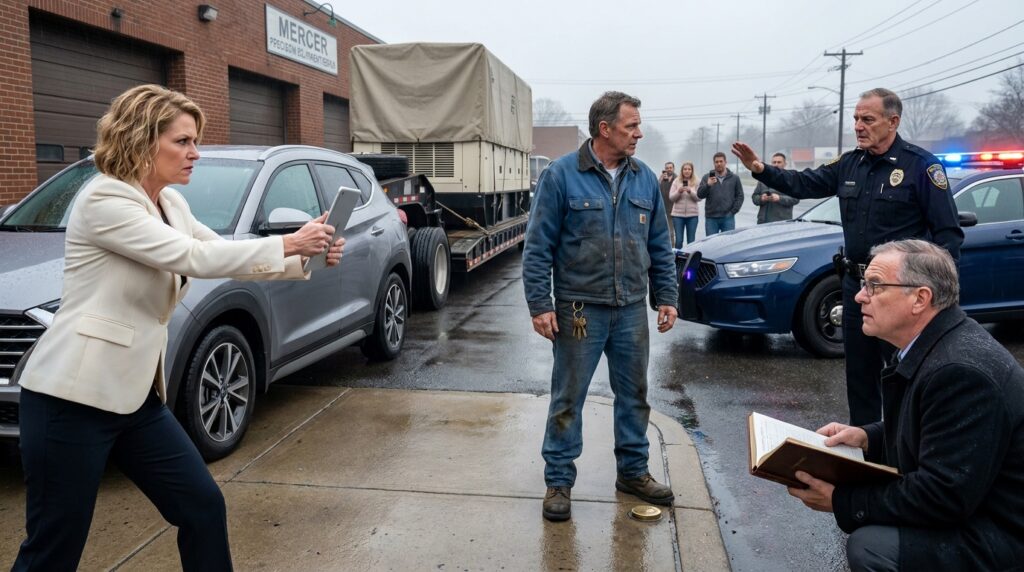
Across the two-lane asphalt, two heavy orange plastic barrels sat in the drainage ditch directly opposite Derrick’s driveway apron. They hadn’t been there when he turned the shop lights on at five. Tied between the barrels was a vinyl banner printed in glossy blue block letters: Crestview Corridor Improvement Zone — Commercial Vehicle Reroute Ahead.
It didn’t block the road completely, but it choked the entrance to Mercer Precision Equipment Repair down to a single narrow angle. A standard pickup could swing in fine, but a forty-foot lowboy trailer hauling an agricultural combine or a municipal backup generator wouldn’t be able to make the turning radius without mounting the curb or clipping the barrels.
“She put those up before dawn,” Jake said, setting his wrench on the bench with a sharp metallic clink. “Tom Martinez over at the hardware store told me she posted on the town group page last night. Called your place a ‘structural liability hazard.’ Said the heavy machinery coming in and out was cracking the sub-surface drainage pipes under the sidewalk.”
Derrick unfolded the letter. The text was three pages of dense legalese, quoting board ordinances that hadn’t existed six months ago. But it wasn’t the threat of a lawsuit that caught his attention; it was the payment instructions on page three. All checks were to be made payable to the Crestview Corridor Beautification Fund, care of a post office box in the neighboring county seat, rather than the town clerk’s official escrow office.
He reached for his brass key ring, hooking it to his belt. “She’s pushing hard for someone who claims she’s just enforcing neighborhood paint colors.”
“She’s got two board members riding in her back seat,” Jake warned, stepping toward the open door. “And her nephew’s riding patrol in the deputy cruiser three nights a week. You go pulling those barrels out of the ditch yourself, Chad Cromwell will have a misdemeanor obstruction charge written before your boots hit the gravel.”
“I’m not touching the barrels,” Derrick said. He folded the letter precisely along its original creases, tucking it inside his blue canvas jacket, right next to his father’s old pocket ledger. “Not until I see what the county recorder has filed under that six-digit parcel code.”
“Derrick,” Jake said softly, his hand resting on the heavy steel door frame. “The Martinez brothers pulled out last month because they couldn’t afford the legal retainers to fight six bogus citations a week. She bled their margin dry before they even got a hearing date.”
Derrick looked at the floorboards near the threshold, where the dark stain of fifty years of spilled gear oil had soaked deep into the grain of the white oak planks. “My father didn’t leave me a mortgage, Jake. He left me this floor. And paper doesn’t move oak.”
He walked out into the cool morning air. Across the road, behind the tinted glass of her second-floor office above the new boutique coffee shop, a single slat in the window blinds tilted downward. The sun caught the glint of a camera lens pointing down at his driveway apron. Derrick didn’t look up. He climbed into the cab of his Ford work truck, the diesel engine coughing once before settling into a slow, rhythmic shake that rattled the brass keys hanging from the ignition.
He pulled out onto Old Post Road, forcing the truck’s heavy front tires to swing wide around the orange barrels, leaving two deep, wet tracks in the road dust directly across the imaginary line Evelyn Pryce had drawn.