
CHAPTER 5: EVICTION OF AUTHORITY AND PUBLIC RECKONING
“Ma’am, you have thirty seconds to step into your vehicle and clear this fire lane,” Officer Lawson said, his tone dropping all remaining warmth, replaced by the precise, unyielding cadence of a sworn officer issuing a formal order. “If that crossover engine isn’t running and moving backward in thirty seconds, I am calling municipal dispatch, requesting a city traffic unit for a fire lane citation, and dispatching a flatbed tow truck to impound this car at your personal expense.”
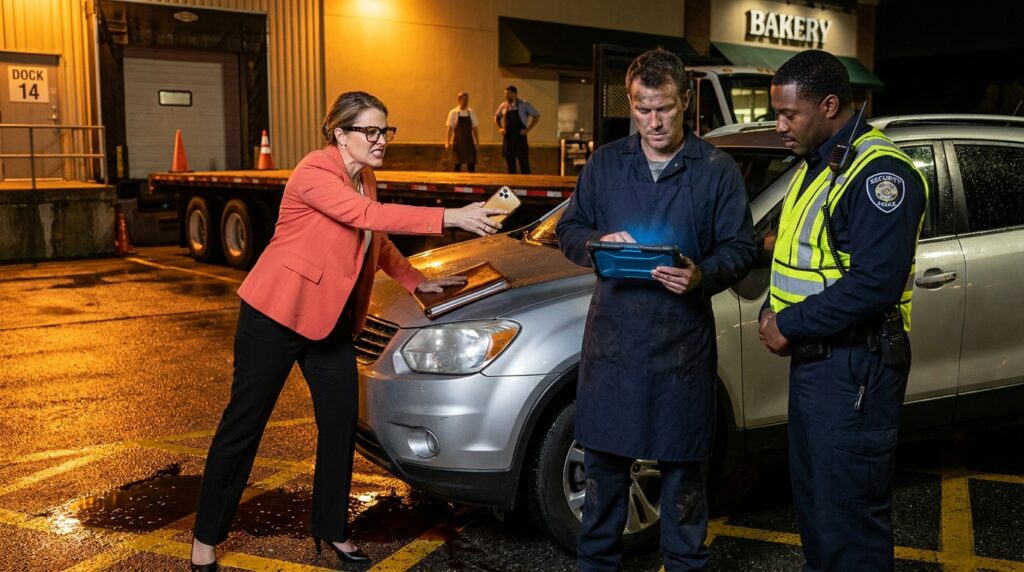
Deborah’s chest heaved under her coral blazer. She looked from Lawson’s stern, unblinking face to the glowing tablet still resting firmly in Marcus’s hands. The blue light illuminated her unratified binder, casting a cold, artificial glare over the crisp gold foil seal she had personally pressed into the page just five hours ago.
“You can’t tow me,” she whispered, her voice wavering, the arrogant rasp cracking under the sheer weight of public exposure. “I am the vice-chair of this merchant body. I have administrative proxy—”
“You have a vehicle parked unlawfully across a designated emergency transport route, blocking a deeded municipal easement,” Lawson cut her off, reaching down to unclip the mic from his shoulder strap. “Fifteen seconds, Deborah. And if I have to call city police, I will hand them this video log showing you intentionally staging an obstruction in a fire lane. That moves this from a parking dispute into criminal nuisance and reckless endangerment.”
Down at the end of the alley, near the bakery porch, one of the night-shift workers let out a loud, ringing whistle. “Move the car, lady!” he called out, his voice echoing off the brick walls. “We’ve got flour shipments coming in at four! Clear the dock!”
Ray leaned his entire upper body out of the eighteen-wheeler’s cab, crossing his heavy arms over the door. “Clock’s ticking, Vice-Chair. I’d hate to see a nice crossover get hoisted up on a sling.”
Deborah looked around the alleyway. The shadows had tightened around her. There were no board members present to support her authority, no corporate representatives from National Retail Partners to shield her, and no legal loopholes left in her leather binder. The cold, unyielding reality of city deed filings, digital camera logs, and impartial enforcement had stripped away her self-appointed title, leaving her standing alone under the harsh halogen dock lights in an oil-stained alleyway.
She didn’t speak another word. Her face burning a deep, blotchy crimson, she snatched her binder off the hood of her car, shoved her gold-cased phone into her pocket, and scrambled into the driver’s seat. She slammed the door so hard the side mirror vibrated. The crossover’s engine roared to life, its tires screeching against the damp asphalt as she threw the vehicle into reverse, backing out down the narrow service corridor in an awkward, erratic zig-zag before speeding away into the dark boulevard beyond.
The alley went dead quiet for two seconds, save for the steady, deep pulse of the diesel engine.
“Alright, Ray,” Marcus called out, stepping up onto the concrete lip of the dock and unlatching the heavy steel bay door. “Back her in.”
The eighteen-wheeler’s air brakes released with a loud, satisfying hiss. Ray guided the massive flatbed smoothly through the yellow guide lines, aligning the trailer’s rubber bumpers perfectly against Dock 14 with a dull, solid thud.
Officer Lawson walked up to the edge of the dock, resting one hand on the steel ladder rail. He looked up at Marcus, offering a single, curt nod. “I’ll be filing a formal incident report with the plaza management group tomorrow morning, Marcus. Including the footage of that fire lane blockade. I don’t think you’ll be seeing any more association binders at midnight.”
“Thanks, Greg,” Marcus said, his voice quiet, steady, and grounded. “I appreciate you looking at the actual paper.”
Lawson turned and walked back to his patrol car, shutting off his roof lights as he pulled out to complete his rounds.
By 12:45 a.m., Tasha had the forklift hums echoing inside the warehouse as the first pallet of green-board slid off the flatbed. Marcus stood at the edge of the bay, holding his tablet, watching the heavy drywall boards settle neatly into Space 14. He reached down and wiped a streak of chalky white dust off the corner of the glass screen, covering the corporate metadata line he had logged for his attorney’s morning call.
His father had built Holloway Building Supply on honest labor, legal clarity, and unyielding boundaries. No fake binder, no corporate maneuver, and no self-appointed authority was going to take that away.