CHAPTER 4: LIVE FOOTAGE AND DOCK PERMIT EXPOSURE
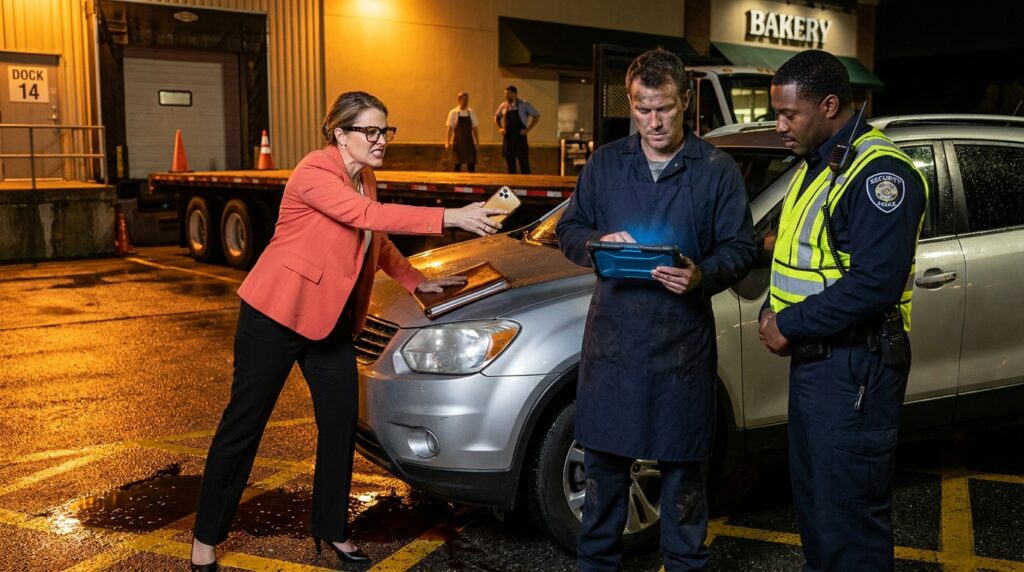
Officer Lawson took two steps forward, his boots crunching softly on the loose gravel near the base of the dock ladder. He didn’t look at Deborah, whose smartphone camera followed his every movement like a tracking visor. Instead, his gaze fixed on the bright screen of the industrial tablet Marcus held in his hands.
Marcus tapped the glass. The screen split into two distinct panes. On the left side, a scanned PDF document displayed the crisp, deep-blue emblem of the County Register of Deeds. Across the center ran the bold heading: Permanent Commercial Freight Easement & Unrestricted Dock Grant: Parcel 14-B.
“Read section four, Greg,” Marcus said, holding the screen steady as the cold night wind stirred the apron ties around his waist. “City council ordinance 94-822, filed when Westgate Plaza was developed thirty years ago. Space 14 is designated as an open municipal freight corridor twenty-four hours a day, seven days a week. It’s written directly into the master land-use deed.”
Lawson leaned in, his flashlight beam angling downward so the glare wouldn’t hit the screen. His eyes moved across the digital lines of text, tracking the recorded seal and the municipal clerk’s verification stamp. “A private merchants association can’t overwrite a deeded city easement,” Lawson murmured, his voice dropping into the quiet authority of a man reading a hard legal boundary. “Not without a public city council zoning vote.”
“It’s an emergency board directive!” Deborah interrupted, her heels clicking as she took three aggressive strides toward the dock. She didn’t look at the tablet; she pointed her gold-cased phone directly at Marcus’s face, her finger trembling slightly on the casing. “You’re showing him ancient history, Marcus! The association holds administrative control over common-area maintenance and traffic flow! You are intentionally misleading an officer of the peace!”
“Then look at the right side of the screen, Greg,” Marcus said without raising his voice.
He swiped his thumb across the screen, expanding the right-hand window into a full-screen, high-definition video playback feed. The top left corner displayed the crisp green digital timestamp from earlier that evening: 23:22:14. The camera angle looked down from the high-resolution dome camera mounted directly underneath Dock 14’s steel overhang, casting a wide-angle view across the entire service alleyway.
In the video, the alley was completely empty. The warning cones Marcus had placed near the lane mouth sat untouched in the amber light. At exactly 23:24, the video showed Deborah’s silver crossover turning sharply off the main boulevard, its tires clipping the curb as it accelerated into the narrow corridor. There was no truck in the frame. There was no noise.
The video captured her car coming to a sudden, sideways halt across the painted yellow fire lane. The footage clearly showed her turning off her engine, turning her headlights onto high beam, and sitting in the driver’s seat for eighteen minutes with her leather binder resting on the dashboard, waiting in ambush before Ray’s eighteen-wheeler had even turned into the plaza entrance.
“She didn’t react to a noise complaint, Greg,” Marcus said, his eyes locking onto Deborah’s tight, pale face. “She came down here twenty minutes before the delivery arrived, parked across a marked fire lane, and set up an intentional obstruction.”
Lawson stared at the video loop as Deborah’s car repeatedly swerved into the alley in crystal-clear night-vision clarity. He zoomed in on the red paint underneath her rear wheels, then tapped the metadata tab at the bottom of the screen. Beneath the timestamp, a small digital flag showed an incoming document link—a pending lease transfer query from the plaza’s master leasing office, marked with Deborah’s personal corporate real estate email address.
Marcus caught the line of text in the fraction of a second before the screen refreshed, his mind instantly registering the corporate domain name. It wasn’t an association address. It belonged to National Retail Partners—the commercial broker attempting to acquire the entire block for a regional pharmacy chain.
A sharp, cold realization settled in Marcus’s throat. The fake amendment binder wasn’t just an aggressive board member flexing arbitrary authority over a quiet tenant. It was a calculated paper trail created to trigger a default clause in his lease option before the quarterly renewal deadline next week.
Deborah saw Lawson’s expression shift. She saw the quiet, unyielding focus in the guard’s eyes as he backed away from her car, his hand moving away from his notepad and settling firmly onto his belt.
“That video is altered!” Deborah shouted, her voice breaking slightly into a high, frantic pitch that echoed off the cold brick walls. “He runs the shop’s local network! He can manipulate digital timestamps! Officer Lawson, I demand that you confiscate that device as evidence of illegal surveillance and order that truck off the premises immediately!”
“Deborah,” Lawson said, turning his entire body toward her, his voice devoid of any remaining hesitation. “You need to step back from that vehicle right now.”
Deborah froze, her phone still raised, but her arm visibly shaking against the cold night air.
“This camera feed is backed up to an off-site cloud server, Deborah,” Marcus said, his voice flat and unreadable. “And every frame of it is already logged.”
The setback hit Deborah like a physical blow, shattering her legal pretense in front of every witness in the alley, but as she took a sharp breath to double down on her threat, a low rumble from the mouth of the alley signaled that the conflict was far from over.