CHAPTER 1: THE MIDNIGHT BLOCKADE
The hiss of air brakes bled through the heavy steel door of Dock 14, carrying the low, rhythmic shudder of an idling diesel engine. Marcus Holloway didn’t rush. He pulled his dark navy apron tight against his waist, checking the digital clock on the warehouse wall—11:42 p.m. Outside, the night air tasted of damp asphalt, highway exhaust, and the faint, bitter edge of cooling brake dust.
He stepped onto the concrete dock platform, his boots leaving faint white smudges of drywall dust on the dark painted lip. Down in the narrow service corridor behind the Westgate Commercial Center, forty-two pallets of moisture-resistant wallboard waited on the back of Ray’s flatbed trailer. If those pallets weren’t staged inside the dry bay before 1:00 a.m., the morning shift contractors for the downtown build would be standing around burning fifty dollars an hour on Marcus’s dime.
“Back it in slow, Ray!” Marcus called out, pointing his industrial flashlight toward the painted yellow guide lines on the asphalt. “You’ve got three feet on the driver’s side curb!”
The eighteen-wheeler’s reverse lights flickered on, casting a harsh white glare down the alley. Then came the screech of tires.
A silver compact crossover swerved past the orange warning cones Marcus had set up at the mouth of the alley. It didn’t slow down. The crossover accelerated into the tight gap between the turning trailer and the cinderblock wall, slamming its brakes sideways across the driving lane with a violent crunch of rubber on gravel.
The nose of the crossover pinched the truck’s turning radius, missing the giant trailer’s rear bumper by less than eighteen inches. The truck driver slammed on his brakes, the entire rig shaking as the air lines screamed in protest.
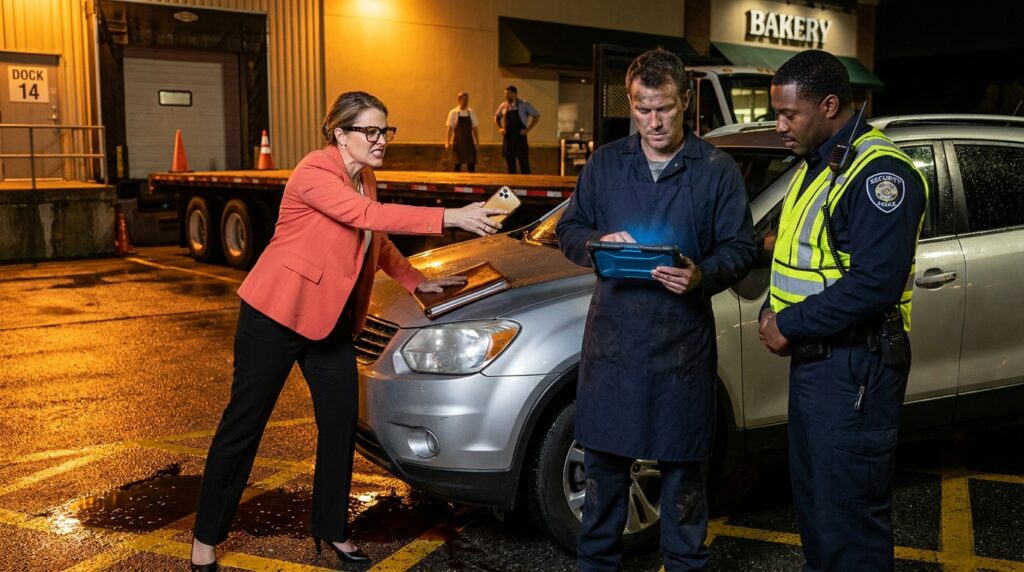
The crossover’s driver-side door swung open, and the high-beam headlights remained locked on high, blinding Marcus on the dock. Deborah Sallow stepped into the white glare. Her bright coral blazer was sharply pressed despite the midnight hour, her oversized tortoiseshell glasses catching the harsh reflection of the dock lights. In her right hand, she clutched a gold-cased smartphone raised like a weapon, its video flash strobing rhythmically; in her left, she pinned a thick, leather-bound binder against her ribs.
“Shut that engine down right now!” Deborah’s voice sliced through the diesel rumble, sharp, shrill, and carrying the unyielding weight of an absolute directive. “Cut the power, driver! I am recording this vehicle, its license plate, and its registration tags!”
Marcus didn’t yell back. He stood at the edge of the bay, feeling the cold steel railing under his palm, his mind instantly running through the spatial perimeters. She had positioned her car directly across the yellow-hatched fire lane—a spatial bottleneck designed to trap the freight rig against the bay.
“Deborah,” Marcus said, keeping his tone flat, even, and deliberate. “You’re standing in a blind spot. Step back onto the sidewalk.”
“Do not speak to me about safety, Marcus!” She marched up the low concrete ramp, her heels clicking aggressively on the rough surface until she was standing five feet from his dock edge, pointing her phone directly at his chest. “This commercial corridor is governed by Section 8 Quiet Hours past 10:00 p.m. You are in direct violation of the Westgate Merchants Association bylaws. I am issuing an immediate six-hundred-dollar nuisance penalty to your business, and if this unauthorized freight vehicle is not off plaza property in three minutes, I am having private security impound the rig!”
Marcus looked past her, into the dark cab where Ray was leaning out the window, his arm crossed over the door, staring down in disbelief. Behind Deborah’s crossover, near the back porch of the 24-hour bakery, two night-shift workers in flour-dusted aprons stepped into the alley, their own phones quietly rising into the light.
Marcus reached into his apron pocket, his calloused fingers settling on the cold, rubberized casing of his store tablet. He didn’t pull it out yet. He calculated the distance, the time, and the legal weight of the paper she held.
“The dock permit is posted on the wall behind you, Deborah,” Marcus said softly. “Move your car out of the turn radius before someone gets hurt.”
Deborah smiled—a tight, cold twitch of her lips that carried no warmth. “That permit means nothing. I signed the updated quiet-hours directive myself three hours ago.”