
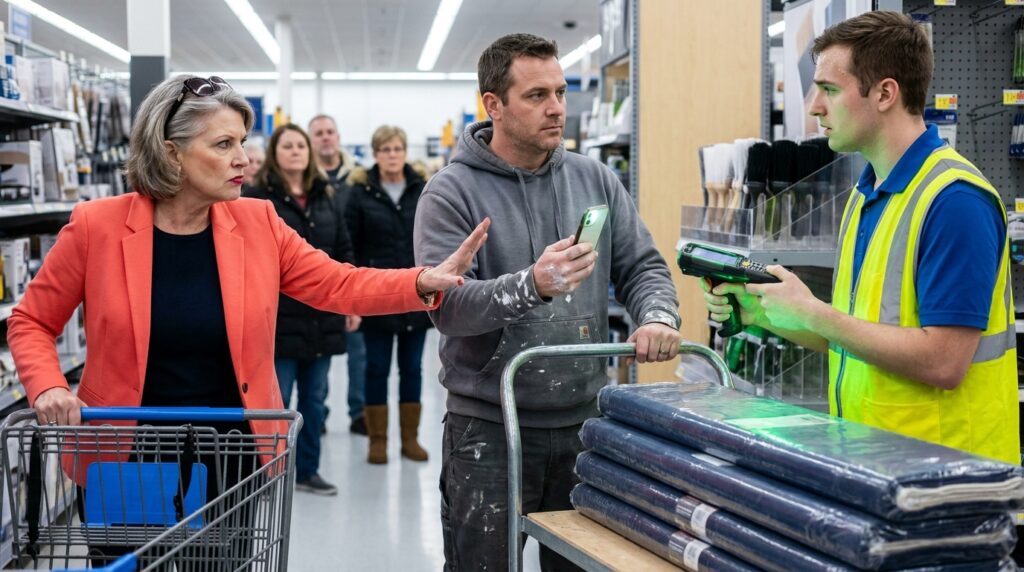
CHAPTER 1: THE METALLIC BARRICADE IN AISLE FOUR
The rubber wheels of the flatbed cart squeaked softly against the waxed floor, a low, rhythmic pulse beneath the ambient roar of Saturday morning retail. Apex Home & Goods smelled of citrus floor cleaner, dry timber, and unboxed polyester. Marcus Cole kept his hands rested flat on the galvanized steel handlebar, his knuckles dusted with dried titanium white paint from the mural primer he’d mixed before dawn. His thumb rested half an inch above the cold glass screen of his smartphone, dark in his palm.
He was three feet from the high-traffic arterial aisle when the metallic crash cut through the air.
Brenda Sallow didn’t ease her shopping cart into the lane; she rammed it sideways into the end-cap display of acrylic brushes. The metal frame groaned against the cardboard header, locking the swivel wheels between Marcus’s front bumper and the display column. She didn’t look at the fabric stacked on his cart first. She looked directly at his eyes, her dark sunglasses resting like a black crown atop her structured, silvering hair.
“You didn’t take those from the back-room discount bin,” Brenda announced, her voice pitched with practiced projection, the kind that transformed open public spaces into improvised courtrooms. Three shoppers near the ribbon display froze mid-reach. “Those aren’t marked for individual sale, and I saw you bypass the floor associate. Put them back, or I’m calling store security myself.”
Marcus didn’t pull back his cart. He didn’t shift his stance. The cold weight of the paint-stained cuffs around his wrists kept him grounded—a physical anchor to the four months he’d spent scraping by after commercial rent took his print shop. He looked at the tailored edge of her coral blazer, crisp and unwrinkled, holding the rigid geometry of a woman who viewed the town of Oakridge as a series of properties awaiting her inspection.
“The aisle is blocked, Brenda,” Marcus said. His voice was low, devoid of air, flat enough that it didn’t echo.
“It’s blocked for a reason,” she said, stepping around the handle of her cart, her heavy leather handbag wedged against her hip like a heraldic shield. She pulled her phone from an outer pocket with a swift, snapping motion of her wrist. “You think because the store is busy on a weekend, people don’t notice when specialty stock moves out the back? I know how this inventory works. That canvas is reserved for the seasonal floor markdown.”
Across the main walkway, a mother holding a toddler turned her cart around, positioning herself at the edge of the confrontation. Farther down aisle three, two high school floor associates in blue aprons paused mid-scan, their hands hovering over cardboard boxes of glue sticks.
Marcus calculated the geometry of the room in silence. The overhead lighting bounced off Brenda’s oversized sunglasses, hiding her eyes, but he didn’t need to see them. He remembered those same sunglasses resting on the oak conference table at the public library two months ago, right next to her proposed schedule of user fees designed to price out neighborhood art groups. He had cast the tie-breaking vote against her.
She raised her phone, the lens pointed straight at his face. The red recording indicator wasn’t flashing yet, but her finger hovered over the glass screen with deliberate theatrics.
“I’m asking you one last time,” Brenda said, her chin lifting as her tone took on the clipped cadence of a formal deposition. “Turn the flatbed around and leave the stock for store personnel. Or do we wait right here until security walks you out?”
Marcus looked down at his own screen. A faint amber light flickered on the ceiling directly above them—the green status ring of the store’s high-definition dome camera, blinking steadily as it recorded the intersection of aisles four and five. He didn’t lift his phone. He simply unlocked the display, letting the bright white light illuminate the blue-and-white header of the store app.
“Call them,” Marcus said.