
CHAPTER 1: THE DIESEL AND THE BRASS MARKER
The diesel engine of the heavy flatbed tow truck rattled the loose brickwork of the alley, sending a thin shiver of vibration through the soles of Derek Callahan’s work boots. Exhaust fumes, thick with unburned fuel, clung to the damp morning air, mingling with the scent of roasted espresso and proofing yeast wafting from Maya Lin’s bakery kitchen across the narrow lane.
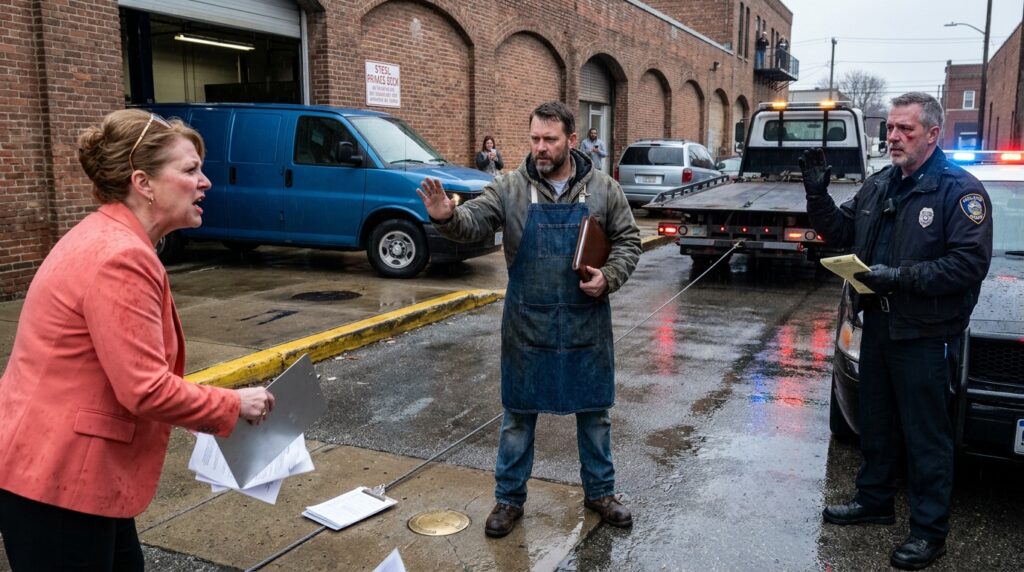
Derek stood on the concrete apron of his roll-up bay door, his hands resting flat against the oil-stained timber of his worktable. His denim apron was stiff with dried wood glue and fine mahogany dust, the leather straps biting slightly into his shoulders. Ten feet out on the cracked asphalt, Patricia Albright stood with her heels wedged into a seam between two paving stones. She wore a tailored coral blazer that looked absurd against the soot-streaked brick, her gold-rimmed sunglasses reflecting the dull gray light of the alley. Her manicured fingers tapped a rapid, impatient rhythm against the edge of a heavy aluminum clipboard.
Behind her, the metallic silver metallic tail of her luxury SUV sat dead across the yellow hash marks painted on the pavement—completely pinning a blue commercial delivery van against Derek’s loading frame. Inside the van sat forty thousand dollars’ worth of hand-wired vacuum tube amplifiers and custom cabinets, waiting for an inspection that was now thirty minutes overdue.
“I gave you fair warning, Callahan,” Patsy said, her voice carrying that sharp, practiced projection honed over years of chairing suburban committee meetings. She didn’t look at him; her eyes remained fixed on the tow truck operator as he pulled a thick steel cable toward the van’s front axle. “The Oak Street Merchant Association does not permit unapproved industrial staging in this passage. You are in violation of section four of the commercial access code.”
Walt, the tow driver, wiped a grease-blackened palm across his canvas trousers and hesitated, the heavy steel hook dangling between his knees. He looked at the bold red-and-black sign mounted on Derek’s brick wall—PRIVATE COMMERCIAL DOCK. NO ASSOCIATION JURISDICTION—and then down at the double-yellow curb line.
“Lady,” Walt grunted, his voice rasping from decades of roadside calls. “You said this was an abandoned vehicle blocking an official city fire lane. This looks like a private bay pad.”
“It is an association-managed common element,” Patsy snapped, her clipboard swinging toward Derek’s open door. “His landlord signed the master deed twenty years ago. The paper is on file in my husband’s office. Hook the vehicle.”
Derek didn’t step down into the alley. He reached into the front pocket of his apron, his thumb catching on a scrap of 120-grit sandpaper before pulling out his phone. His knuckles were permanently stained with dark walnut dye, the skin around his nails dry and cracked from turpentine. With three methodical taps on the screen, he pulled up a live four-camera split screen feeding directly from the high-definition lenses mounted under his roof eaves, displaying a real-time overlay of the city survey lines. Under his arm, he held a thick, string-tied legal folder containing the certified county lease deed, stamped with the raised seal of the Franklin County Recorder.
“Mrs. Albright,” Derek said softly, his voice low and flat from years of corporate conference rooms where loud voices were always the first sign of weakness. “My lease was certified three months ago. The property line extends twenty-four inches past that yellow curb. You are standing on private leased asphalt, and that van is legally loading.”
Patsy turned her head slowly, her lip curling just enough to reveal a sliver of white teeth. “Your paper means nothing here, Mr. Callahan. This alley belongs to the merchants who built this district, not an unemployed corporate manager playing with speakers.”
Walt looked between the two of them, his arm tightening around the steel cable. He stepped back toward his rig, his eyes catching the glint of a polished brass survey disk embedded directly into the concrete at Derek’s feet—a mark weathered by sixty years of iron wheels and salt, but sitting firm beneath the grease.
From the back door of the bakery, Maya Lin stepped out into the alley, wiping her flour-dusted hands on a gray rag, her phone already held steady in her right hand.