
CHAPTER 6: The Dusty Archives
The air inside the county records annex smelled of old glue, damp cotton, and the sharp, chemical tang of ozone drifting off the microfiche printers. Fluorescent tubes hummed overhead with a steady, high-pitched whine that seemed to bore straight into Clara’s temples. She didn’t wait for the clerk behind the high laminate counter to finish stamping a stack of yellow slips; she slid the heavy, blue-backed condemnation notice across the scarred surface.
“I need the original plat maps and the water easement ledger for Section Twelve,” Clara said, her voice cutting cleanly through the ambient chatter of the office. “Specifically the 1954 boundary transfers involving the south acre.”
The clerk, a young man with wire-rimmed glasses and a badge that read D. Miller, didn’t look up immediately. He dragged a dry stamp pad across a wooden block, pressed it down with a rhythmic thwack, and finally raised his eyes. When he saw the blue notice resting on the wood, his expression shifted from casual boredom to tight, professional neutrality. He pushed his glasses up his nose, sliding the notice back an inch without touching the text.
“That file’s restricted under active municipal review, Ms. Henderson,” Miller said, his tone flattened by routine. “Any queries regarding the southern vector have to go through the petitioner’s legal counsel.”
“The petitioner is standing on my patio trying to steal my perimeter,” Clara leaned forward, resting both palms flat on the cold laminate. Her voice didn’t rise; it dropped into that low, dangerous register that demanded attention. “I don’t need counsel to look at public domain records that have been open since the Eisenhower administration. Give me the box, Miller.”
The clerk hesitated, his fingers drumming a slow, nervous tattoo against the edge of his desk. He glanced toward the back office where the supervisor’s frosted-glass door remained firmly shut. For three seconds, the hum of the fluorescent lights was the only sound in the room. Then, with a dry sigh, Miller pulled a brass key from his pocket, turned around, and unlocked a low rolling cabinet behind him.
He slid out a shallow, metal-reinforced cardboard box stamped with a faded red label: Series 4-B: Irrigation & Drainage Easements, 1950–1965.
Clara pulled the box toward her, popping the metal clasps with a sharp snap. Inside lay a dense pack of onion-skin paper and carbon-copied receipts, yellowed at the edges and smelling of decades of neglect. She flipped past the standard land-grant certificates until her thumb caught on a heavy, folded vellum sheet pinned beneath a rusted paperclip.
It was the original 1954 covenant signed by her grandfather and Mark’s uncle. But written across the bottom margin in neat, modern ink—initialed by a county zoning officer just three weeks ago—was an addendum she hadn’t authorized: Easement void upon structural failure of primary catchment.
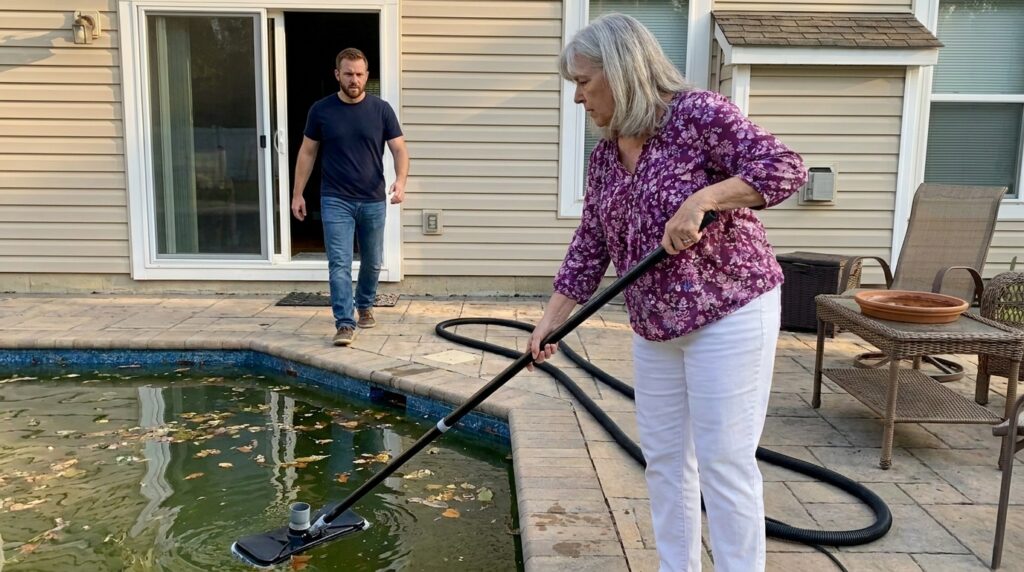
Someone had rewritten the conditions of the water right while she was busy trying to keep the leaves out of an empty swimming pool.