
CHAPTER 5: SOCIAL REVERSAL AND AFTERMATH
The paper slip felt thin between Marcus’s thumb and forefinger—five inches of thermal paper, warm from the pocket of his jacket, bearing the clean, indelible black ink of a transaction closed at 10:14 PM.
He didn’t fold it. He slid it back into his inner breast pocket, right next to the three-inch framing nail and the gray pine dust that clung to his lining.
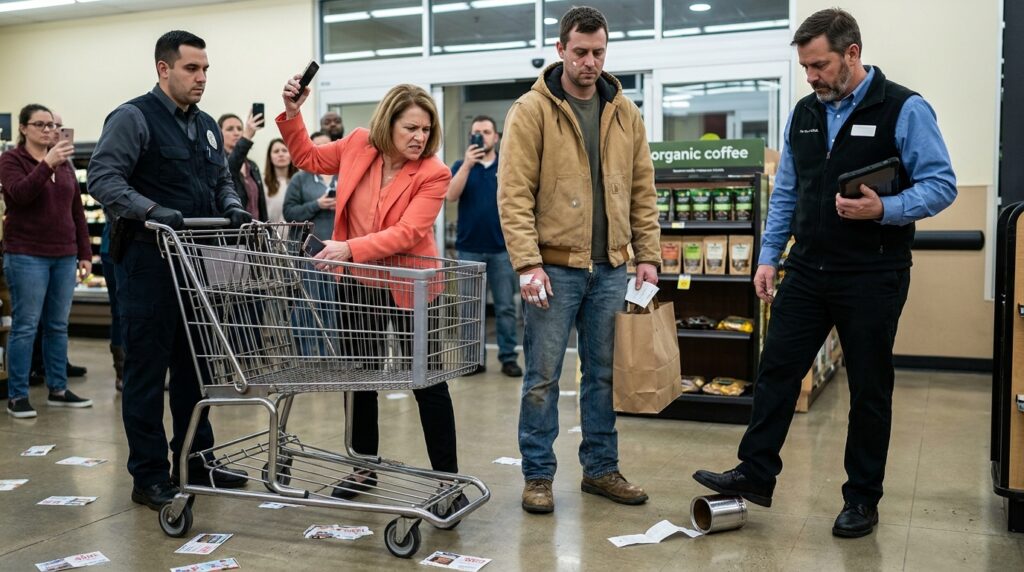
Behind him, Victoria didn’t move. The loss-prevention officer had stepped smoothly into the gap between her coral blazer and the aisle exit, his arms folded loosely across his dark uniform vest. At her feet, the silver tin of dark roast lay on its side, the overhead fluorescent lights glaring off its un-scanned metal lid.
“I want her name noted for the trespass report,” Mercer was saying into his earpiece, his voice flat and clinical as he tapped the tablet screen. “Store system lockout for all regional locations. Effective immediately.”
“You can’t lock me out!” Victoria’s voice rose, a thin, cracking sound that lacked the resonant projection it had carried five minutes ago. She reached down to grab her handbag, her manicured fingers trembling so hard she fumbled the leather strap twice before pulling it over her shoulder. “My family has lived in this township for forty years! I know the regional general manager!”
Nobody answered her. The cashier at Lane Two pulled a register divider bar across the belt with a sharp, heavy clack. The young mother holding the toddler turned her back completely, adjusting her child’s blanket as she walked toward the self-checkout terminals. A elderly man in a flannel coat stepped right past Victoria’s stalled cart, giving her a wide two-foot berth as if her stainless-steel frame were a hazardous road spill marked with orange cones.
Marcus shifted his grip on the brown paper bag. His boots made a dry, scuffing sound against the polished vinyl floor as he stepped through the opening between the coffee display and the register divider.
When he passed Victoria, she didn’t look at him. Her eyes were fixed on the floor, her teeth pressed hard into her lower lip as her face flushed a blotchy, dark red under the harsh overhead tubes. Her smartphone, still clutched in her right hand, had gone completely black.
Marcus didn’t say a word. He didn’t offer a parting jab, and he didn’t raise his chin in triumph. He simply walked past her, the coarse paper of his grocery sack rustling against his canvas sleeve.
The automatic glass doors sensed his approach and slid open with a soft hydraulic hiss.
A rush of cold, damp October air hit him square in the face, cutting through the thick, artificial smell of floor wax and roasted coffee beans. The parking lot was quiet, bathed in the sterile orange glow of high-pressure sodium lamps. Rain had fallen an hour earlier, leaving the asphalt black and reflective, mirroring the tall light poles like long streaks of rust on water.
He walked down the concrete ramp toward his rusty Ford pickup, his work boots leaving damp, dusty prints on the wet pavement.
In the quiet of the lot, forty yards from the store entrance, the low hum of the highway three miles south carried through the night air. He reached his truck, pulled the heavy driver-side door open with a metallic latch-click, and placed the brown paper bag carefully on the worn vinyl bench seat.
He didn’t get in immediately. He stood in the doorframe, resting his forearm on the top edge of the cab, and took a long, slow breath. The cold air burned his lungs, clean and sharp, clearing out the lingering taste of stale store air and fluorescent heat.
He pulled his phone from his pocket. The screen lit up: one unread text message from the neighbor down the road.
Lily’s fever dropped to a hundred point one. She’s awake and asking for her juice.
Marcus typed back a single word: Coming.
He slid into the driver’s seat, pulled the heavy door shut until the latch caught with a solid, iron thud, and turned the key in the ignition. The old V8 engine rumbled to life, the exhaust vibrating through the floorboards under his boots. As he backed out of the parking space, his headlights swept across the glass front of the supermarket.
Through the tall windows, he could see Mercer standing near the customer service desk, holding a clipboard, while the loss-prevention officer escorted Victoria toward the side office. Her coral blazer looked small now under the vast, cavernous rafters of the store, stripped of its stance, its noise, and its fake authority.
Marcus turned the truck toward the exit lane, the tires hummed against the wet asphalt as he accelerated onto the quiet, dark township road.
Some people needed a microphone, a title, and a crowd to feel tall. All he had needed was five inches of paper, a quiet tongue, and the truth resting in his coat pocket.