
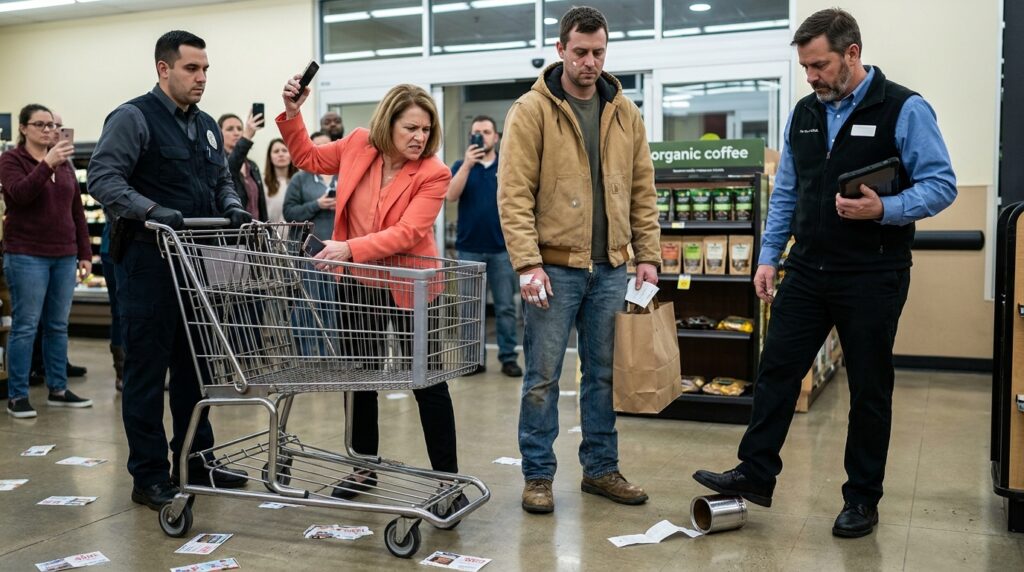
CHAPTER 1: THE PUBLIC OBSTRUCTION
The fluorescent tubes in Aisle Seven hummed with a low, metallic vibration that rattled the base of Marcus Holloway’s teeth. It was 10:12 PM. The air inside the supermarket smelled of commercial floor wax, crushed cardboard, and stale coffee syrup. In his right hand, the brown paper bag felt heavy—a bottle of liquid fever reducer, two cans of ginger ale, and a single loaf of white bread resting against his palm.
He didn’t move. He couldn’t.
Victoria Vance-Bramwell had parked her heavy, stainless-steel shopping cart laterally across the exit gap, sealing the narrow passage between the organic coffee display and the register lane. Her coral blazer stood out against the pale vinyl floor like fresh blood on clean concrete. A heavy gold-plated necklace rested against her collarbone, catching the sterile white light every time she shifted her weight.
“He didn’t pay for that bag,” she announced, her phone raised like a drawn weapon, its lens reflecting the harsh overhead fluorescents of Aisle Seven. “I watched him bypass the main register. Hand over the merchandise, sir, or security locks those sliding doors.”
Marcus kept his posture rigid. His work boots, caked with dry plaster and yellow pine dust from a twelve-hour framing job in Southfield, stayed anchored to the scuffed floor tile. Underneath his fingernails, fine gray dust sat packed into the skin. He looked down at the hand holding her phone. Her knuckles were tight, her manicured thumb resting near the record button.
Behind him, the soft clack-clack of a cashier pulling register drawers shut stopped dead.
“My daughter is sick at home, ma’am,” Marcus said. His voice was low, flat, and stripped of speed. “The receipt is in my pocket, and I’m walking out those doors.”
“You aren’t walking anywhere,” Victoria said. Her voice carried the practiced, shrill projection of someone used to running town hall zoning boards. She stepped forward, her leather flat tapping sharply against the tile, bringing her within two feet of his chest. “I saw you at the back of the store. You stuffed that medicine into your coat before you even got close to the kiosks. You think because you put on a dirty work jacket you can just walk out of this store without paying like the rest of us?”
To her right, a young mother holding a crying toddler stepped back, her eyes darting between Marcus’s stained canvas jacket and Victoria’s posture. Two aisles over, a night-shift stock clerk holding a box cutter slowly lowered his arms.
Marcus felt the cold air from the sliding doors draft against the back of his neck every time a departing customer triggered the motion sensor twenty feet away. He didn’t reach for his coat zipper. He didn’t drop the bag. He slowly lowered his gaze to the point where Victoria’s coral sleeve met her wrist.
In her left hand, tucked behind her phone, she held a folded store circular—its paper crumpled along the margin where her fingers pinched it tight. Underneath his jacket, tucked against his ribcage, his phone vibrated once. It was the neighbor watching Lily, asking if he was on his way with the drops.
“Step away from the cart,” Marcus said softly.
“Touch that cart and I call the township sheriff for physical assault,” Victoria snapped, leaning her body weight against the handlebar. “I have your face on video. I have your jacket. You’re not the first one to try this on my watch.”
Marcus reached slowly into his right coat pocket. His fingers brushed past a rusty three-inch framing nail, a handful of sawdust, and closed around the sharp, thin edge of a curled slip of thermal paper.
He pulled it out two inches—just enough for the black ink timestamp to catch the light—and kept his eyes locked on hers.