
CHAPTER 3: THE MANAGERS ARRIVAL
“Terminal zero-eight isn’t an asset protection desk, sir,” Vance said, his thumb flicking against the side casing of the scanner. “That’s the customer service counter at the front of the store.”
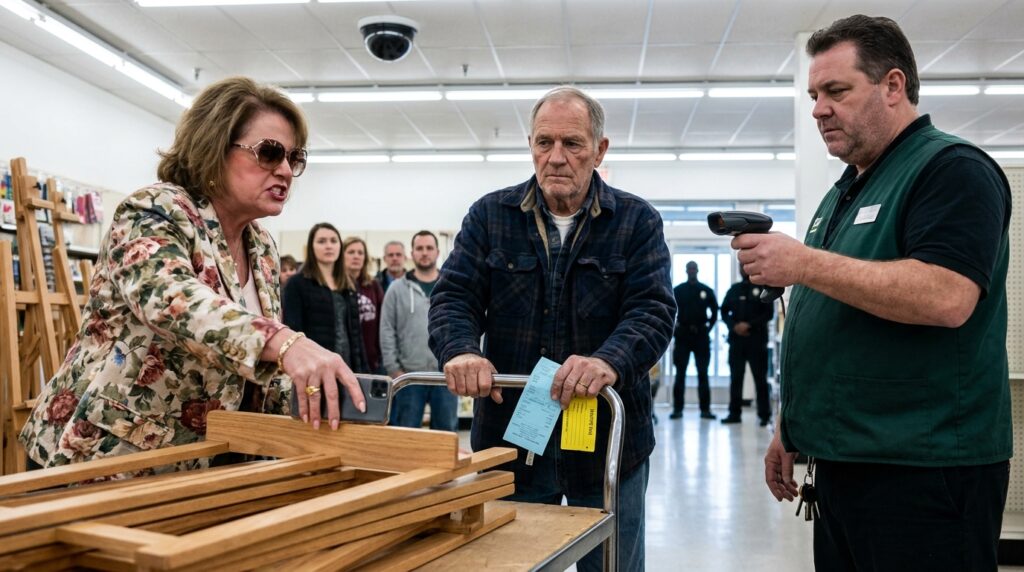
Brenda smiled, a tight, thin stretching of red lipstick that didn’t reach her eyes. She lowered her smartphone by an inch, resting it flat against the lapel of her blazer like a folded badge. “Which is precisely where our committee secretary logged our priority hold forty minutes ago. David, this man is simply manufacturing delays because he knows he took stock that wasn’t tagged for public purchase.”
Marcus didn’t break eye contact with Vance. “Terminal zero-eight is the supervisor console. Ask yourself why an administrative lock was entered six minutes ago while I was already standing here with the cart.”
Vance’s collar looked tighter now. Sweat had formed a thin sheen across his forehead under the harsh 400-watt halides overhead. He looked down at the LCD screen, then past Marcus toward the main aisle, where three more shoppers had halted their carts near the seasonal framing end-cap. The hum of the store—the distant beep of register scanners, the rhythmic thud of a fabric bolt being unwound—seemed to drop an octave, swallowed by the narrow corridor.
“I don’t have to account for backend system latency to you,” Vance said, his voice dropping into a rehearsed corporate tone designed to shut down aisle disputes. “The scanner reads an active lock. Until that lock is cleared by the shift manager, this flatbed cannot clear the threshold. That is store policy.”
“David,” Brenda said, stepping closer until her shoulder brushed against the velvet fitting-room curtain. Her voice took on an intimate, conspiratorial weight. “We have twenty-two volunteers arriving at the parish hall in one hour. If this stock isn’t in my SUV in ten minutes, I will call regional operations. You know how much the Heritage Gala brings into this branch every November.”
Marcus slowly lifted his left hand from the handle. He didn’t reach for Brenda. He reached into the inner breast pocket of his navy flannel jacket, his movements slow, measured, and completely visible.
Brenda flinched backward anyway, her phone flaring up again as she raised the screen. “David! What is he doing?”
Marcus produced a folded piece of paper—a standard thermal store receipt, six inches long, printed on light blue paper. He didn’t unfold it completely. He turned it so the top header faced Vance, revealing the dark ink stamp of a digital order confirmation code alongside a bold black barcode.
“Order number 4882,” Marcus said evenly. “Processed through the mobile app at 8:12 AM. Picked, verified, and staged in this lane by Tim at 1:15 PM. Paid in full using a Visa debit card ending in 4091.”
Vance stared at the blue slip. For a second, his scanner hovered in mid-air, the red laser line flickering against the floor linoleum like a dying pulse. “Tim staged it?”
“Tim staged it,” Marcus affirmed. “He placed those four oak easels on this flatbed, slapped the yellow thermal routing tag on the side frame, and told me my order was ready in the framing clearance lane.”
Brenda’s jaw tightened. The smug certainty on her face faltered for the fraction of a second before her posture hardened into pure aggression. “Tim is a nineteen-year-old floor associate who doesn’t understand department holds! He made a mistake. He pulled from our reserved gala inventory instead of the general warehouse floor!”
“Tim pulled from the warehouse,” Marcus replied, his voice dropping into that quiet, impenetrable register that made the surrounding space feel smaller. “Because the floor stock was empty. And your committee never placed an order.”
Brenda let out a sharp, high-pitched gasp. “How dare you! I have been coordinating with this store for six years—”
“Scan the receipt, David,” Marcus interrupted. He didn’t raise his voice, but the command cut clean through her indignation. “Scan the customer order barcode on this paper, then compare the SKU numbers to the tag on the cart.”
Vance hesitated, his eyes darting between Brenda’s furious glare and the steady blue paper in Marcus’s hand. The pressure in the aisle was palpable now—a dozen pairs of eyes locked onto the three of them. Vance lifted the terminal, pointed the glass window at the blue paper, and pulled the trigger.
A loud, clear, single BEEP echoed down the corridor.
The LCD screen flickered from amber to green. ORDER #4882 — MATCH CONFIRMED. But beneath the green banner, a second line popped up in bright red text: HOLD OVERRIDE REQUIRED: LOCATION CONFLICT — ITEM RESERVED UNDER B. HOLLINGS (UNPAID HOLD).
Vance stared at the display, his mouth slightly open. “Wait… it’s the exact same order number.”
Brenda didn’t blink. She stepped straight up to Vance, her eyes gleaming with cold triumph. “That’s right. Our committee placed a phone hold on that exact order package when we saw the inventory count drop this morning. The system held it under my name. He paid for a reservation that was already locked by us!”
Marcus looked at the green screen, then at the silver marker scribbled on the clip-on badge hanging off the framing desk keyboard five feet away: SUP_08. The decoy was complete. The system showed a legitimate hold conflict, placing Marcus in the position of a customer who had bought a disputed, locked item.
“You see?” Brenda declared to the crowd, turning her back on Marcus as if the matter were settled. “He bought a system error. The easels belong to the gala hold. David, take the cart.”
Vance cleared his throat, adjusting his grip on the flatbed handle. “Sir… I’m sorry. The system shows an unpaid administrative hold placed under Mrs. Hollings’s name before your pickup was finalized. I have to lock this cart.”
Marcus didn’t let go of the bar. He looked up at the dome mirror overhead one more time, then back at Vance. “Then let’s look at the camera log.”