
CHAPTER 2: THE PAPER LAWSUIT
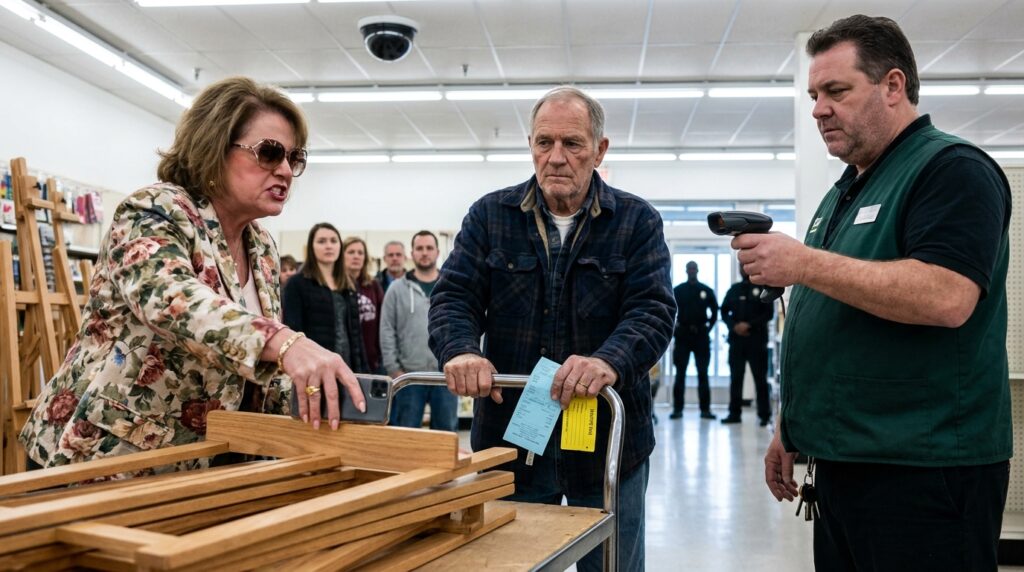
“Step back from the cart, please, sir,” David Vance said. His voice was too thin for his frame, strained by four hours of Saturday retail rush. He held his handheld inventory terminal like a shield, his thumb hovering over the rubberized scan trigger. “Ma’am, lower the phone.”
Brenda didn’t lower it. She adjusted her grip on the gold ring stand, keeping the camera angled straight at Marcus’s jaw. “I will record until this aisle is clear, David. I’ve spoken with the store manager twice this month about designated space for the Heritage Gala. This man has physically seized our staging flatbed, and he’s refusing to surrender community property.”
Marcus didn’t move his hand from the cold steel bar. “Scan the barcode on the side rail,” he repeated. His voice remained anchored, low and dry, untouched by the rising chorus of whispers from the main aisle. “The yellow thermal sticker.”
Vance exhaled through his nose, a sharp, irritated hiss, and stepped between them. He clicked the laser trigger. The red line flashed once across the crinkled thermal paper affixed to the wood frame, emitting a flat, negative double-beep.
On the small LCD screen of Vance’s handheld, a bright amber box began to blink.
ERR-409: SYSTEM HOLD ACTIVE — DEPT 04 (EVENT RESERVED).
Brenda let out a triumphant breath, her shoulders settling back into her floral blazer with absolute satisfaction. “There it is,” she said, her voice ringing out toward the dozen shoppers now hovering near the end-cap of acrylic paints. “Do you see? It’s locked in the system. He took an item off a restricted hold.”
Vance squinted at the screen, tapping the glass with a thumbnail. “That’s… strange,” he muttered under his breath, more to himself than to the crowd. “This stock was cleared for staging at one o’clock. But the system shows an administrative lock applied four minutes ago.”
Marcus watched the manager’s face. He saw the subtle shift in Vance’s posture—the tightening of his shoulders as his mind weighed the options. On one side stood a retired man in a worn work jacket with no social leverage; on the other stood a prominent town socialite threatening corporate complaints and public scandal. The path of least resistance was glaringly obvious.
“Sir,” Vance said, his tone shifting from neutral to procedural, turning his body slightly to screen Marcus from the main walkway. “The terminal shows an active department hold on these SKU numbers. If there’s an administrative lock on the order, I can’t let this flatbed clear the staging zone. I’ll have to ask you to step out of the clearance lane while I take this back to the receiving desk.”
“The order is paid for,” Marcus said quietly.
“The system says otherwise right now, sir,” Vance countered, his voice hardening as he tried to take control of the space. “It’s flagged as reserved floor stock for an active store account. If you paid online, the transaction might have failed at the gateway or been flagged for a manual review. Either way, until the lock is cleared by a supervisor, this cart remains store property.”
Brenda took a step forward, the heel of her shoe clicking sharply against the linoleum. “You hear him? It’s store property. Hand over the handle.” She reached out, her long, manicured nails extending toward the grip of the flatbed right next to Marcus’s calloused fingers. “You’re trespassing on a reserved order zone, and if you don’t step back right now, I’m having David call the police department.”
A murmur rippled through the onlookers. A mother holding a toddler pulled her child back a step, her eyes wide with the sudden escalation of the word police. Two aisle employees in green aprons halted their stocking carts ten feet away, exchange nervous glances.
Marcus didn’t let go of the handle. Instead, his fingers tightened around the steel until the knuckles turned white beneath the weathered skin. He didn’t look at Brenda’s reaching hand. He looked directly into Vance’s eyes.
“Who applied the administrative lock?” Marcus asked.
Vance blinked, momentarily thrown off balance by the directness of the question. “What?”
“An administrative lock requires an employee ID and a terminal timestamp,” Marcus said, his tone as precise as a field manual. “You said it was locked four minutes ago. I’ve been standing in this aisle for six minutes. Nobody touched this cart except me, and nobody scanned that tag until you walked up.”
Vance looked down at the blinking screen. The amber box was still pulsing: ERR-409. Beneath it, a small line of subtext scrolled across the low-resolution screen: MODIFIED BY: USER_SUP_08 (REMOTE ENTRY).
“Look, sir,” Vance said, his face flushing red under the harsh overhead fluorescent tubes. “I don’t know who routed the lock through the backend, but the handheld doesn’t lie. I have to enforce the system status. If I let you push a flagged cart out to the parking lot, it registers as an unverified exit at the front registers. The alarms will trip, and asset protection will be involved.”
“Good,” Marcus said, his voice dropping another octave, settling into an immovable baseline that seemed to quiet the surrounding noise of the store. “Call asset protection.”
Brenda scoffed loudly, lowering her phone just an inch. “Don’t be ridiculous! You’re wasting everyone’s time! David, resolve this now. Take the cart.”
“Call them,” Marcus repeated, his unblinking gaze locked onto Vance. “And tell them to bring the log from terminal zero-eight.”