
CHAPTER 3: The Ledger of Small Invasions
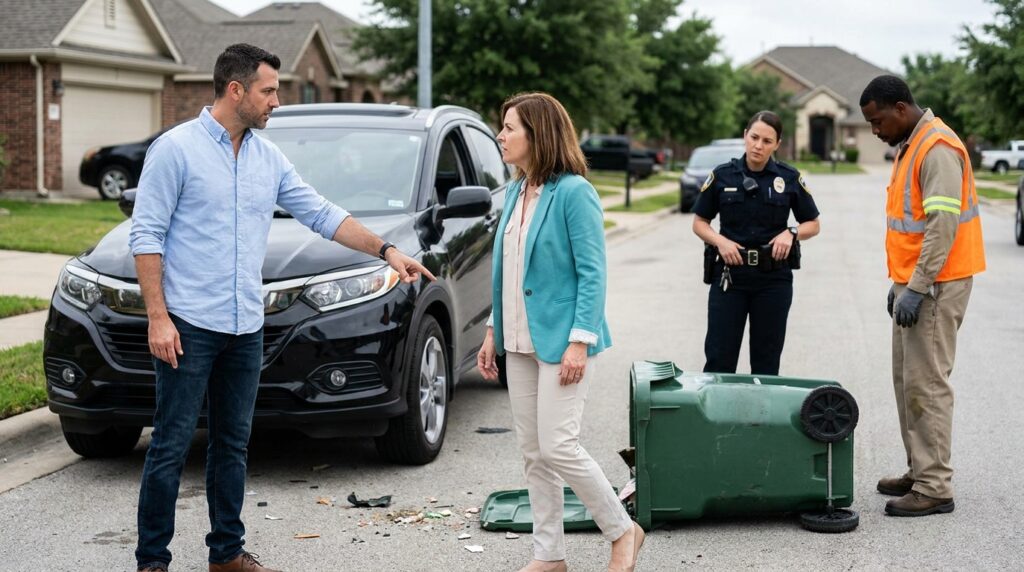
The silence that followed Gomez’s technical breakdown didn’t feel like a reprieve; it felt like the temporary calm before a pressure vessel blew its gaskets. Arthur’s right thumb kept twitching against the seam of his trousers, but Clara wasn’t looking at him anymore. Her mind slipped backward, through the dry heat of the morning, straight into the archive of small, abrasive friction that had defined the street for the past three seasons.
It never started with a shouting match. In a neighborhood built on retired mortgages and manicured lawns, war was waged by administrative proxy.
Two months ago, it had been an anonymous neon-orange sticker plastered across the windshield of Clara’s work van, warning of a forty-eight-hour street-storage violation while it was parked legally during a routine transmission drop. Three weeks prior to that, a series of stakes had appeared along the outer perimeter of her lawn, driven four inches deep into the municipal strip with handwritten notes attached by rubber bands—Easement Clearance Required: 18 Inches Minimum. The handwriting was neat, slightly cramped, leaning heavily to the right, matching the exact penmanship found on the faux-violation notices stuffed into every mail slot between numbers 42 and 58.
Arthur hadn’t just appeared at the curb this morning out of nowhere; he had engineered the stage. He was the self-appointed custodian of a street that hadn’t elected him to anything since the homeowners’ association dissolved its active charter back during the county tax reassessment of two years prior.
Clara shifted her weight, feeling the faint grit of rust under her boot heel. She remembered the afternoon she caught him kneeling by her side-yard fence line, a small yellow folding ruler extended against her timber posts, measuring the gap between her property line and the county gas main. When she stepped out onto the porch with a mug of black coffee, he hadn’t flinched or scrambled away. He had simply stood up, dusted the dry dirt from his knees with two sharp slaps of his palms, and told her that her fence post was three-eighths of an inch over the invisible grid, and that these things “tend to compound over time if left uncorrected.”
That was the architecture of his control. It wasn’t about the trash bin. The shattered green plastic lying by the storm drain was just the physical manifestation of a man whose world was shrinking by fractions of an inch every single day.
Officer Reyes didn’t break her gaze from Gomez’s tablet. The digital screen cast a pale, cold square of light against the badge pinned to her chest. “Mr. Vance,” Reyes said, her voice dropping into that register that officers reserved for people they were about to write redundant paperwork for. “This timestamp logs the container position at 04:15 this morning. Long before the municipal collection crews rolled through, and long before Miss Hayes stepped out of her property.”
Arthur’s throat worked once, a dry, visible swallow that pulled the skin tight across his collarbone. “The digital logs can be manipulated,” he snapped, though the volume had dropped from a broadcast roar to a thin, defensive rattle. “Everyone knows those tablet apps sync manually. That driver has a history with the block association. They’re covering for each other.”
Gomez didn’t blink. He didn’t even look up from the screen. He simply tilted the heavy-duty device five degrees to the left, exposing a secondary data stream—a high-resolution asset tracking log synced directly to the sanitation department’s central dispatch server three towns over.
Clara watched Arthur’s eyes track the movement of the blue light. Beneath the aggressive posture of the light-blue button-down, there was a profound, frantic hollowness. It was the look of a man who had spent thousands of dollars on security cameras, perimeter alarms, and printed warning letters, only to realize that the pavement didn’t care whose name was on the tax deed.
The micro-mystery sat right there in plain sight, half-hidden on the floor mat of the black SUV idling behind him: a crumpled yellow municipal warning pad identical to the ones that had been terrorizing mailboxes for months, resting beside a grease-stained receipt from an industrial hardware supply store three counties away—dated two days prior, for a heavy steel-reinforced demolition mallet.
Clara didn’t point it out. Not yet. Let the officer do the work of turning the screw.