
CHAPTER 2: The Logic of the Gutter
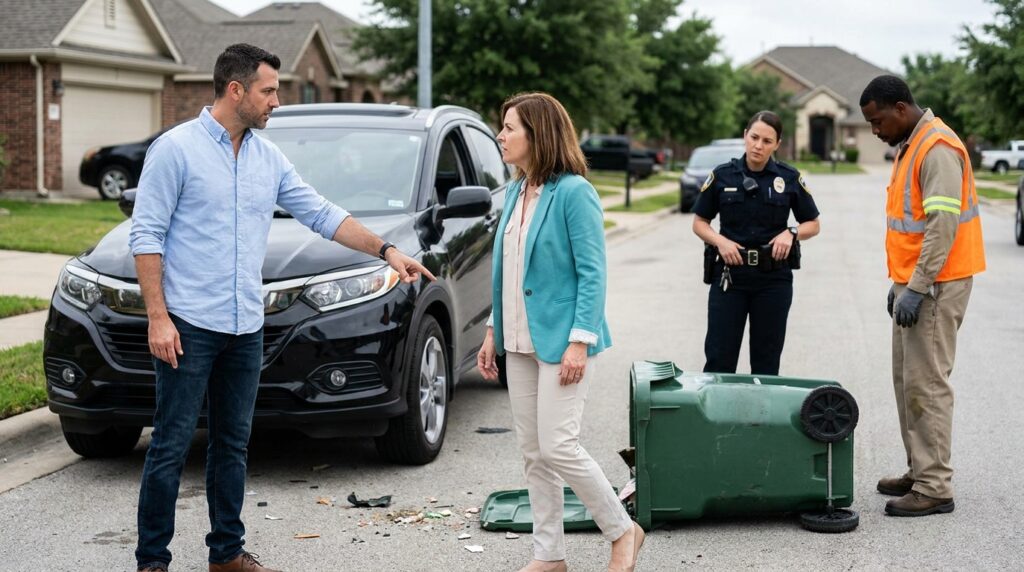
The crisp double-chirp of the Ford Interceptor’s door locks cut through Arthur’s windup like a butcher’s cleaver. He didn’t drop his pointing hand, but the rigid extension of his index finger lost half an inch of its altitude as the low rumble of the municipal cruiser settled against the tarmac.
Clara didn’t look at the cruiser. She kept her eyes locked on the space between Arthur’s collarbones, watching the dark stain of sweat pulse against the pale blue fabric of his shirt. In the Sovereign Protector’s arithmetic, looking away from an aggressor was the equivalent of offering a flank to a bayonet. Every step Arthur took toward her over the past three months had been a calculated probe—testing the municipal easement, parking his heavy SUV half-treaded over her gravel apron, leaving grey plastic bags of dog waste right on the seam where her property met the county right-of-way.
“Officer,” Arthur barked, spinning half-around before the cruiser’s door had even fully settled, his voice sliding into that oily, aggrieved register designed to summon state power to a personal grievance. “Over here. We have a complete destruction of public infrastructure, and the resident is refusing identification.”
Clara shifted her weight, feeling the coarse gravel grind beneath her boot heel. The sensory texture of the street was always heavy with iron and old dust, but today it tasted bitter—like dry copper on the back of the tongue.
The sanitation worker, whose nametag read Gomez in faded blue stitching over his breast pocket, hadn’t moved from his crouch beside the green wheeled bin. His heavy-duty tablet remained active, casting a faint blue glow against the orange fabric of his vest. He didn’t call out. He simply reached down with a gloved thumb and smeared a streak of greasy black soot away from the fractured corner of the bin’s plastic rim.
“Arthur,” Clara said, her voice dropping an octave, steady as a plumb line. “Put your arm down. You’re blocking the drainage lane.”
“Don’t you tell me what to block,” Arthur snapped, his head whipping back toward her, his features tight with the frantic, brittle energy of a man who realized his performance was losing its audience. “That’s municipal property you smashed up during your morning contractor haul. I saw the trailer here yesterday. I saw the debris.”
“You didn’t see a trailer,” Clara said evenly. “You saw an empty delivery van that left forty-eight hours ago.”
“Liar,” Arthur spat, taking another aggressive half-step forward. His boot heel caught a stray fragment of the shattered bin, sending a sharp clack-skitter across the hot asphalt.
From behind them, the heavy tread of rubber soles on pavement announced the officer’s approach. Officer Reyes didn’t run, and she didn’t draw her weight into a tactical crouch; she walked with the heavy, unhurried cadence of someone who had spent ten years listening to suburban property disputes over broken sprinklers and disputed mulch lines. Her dark uniform was pressed flat, her duty belt silent except for the low, rhythmic chime of a radio clip shifting against her hip.
“Alright,” Reyes said, her voice a low, neutral hum that instantly drained the theatrical volume from the air. “Let’s back the line up three feet. What’s the obstruction?”
Arthur pivoted instantly, his body language shifting from belligerent landlord to righteous taxpayer. He thrust his arm out again, sweeping toward Clara with a theatrical flourish. “She broke the container, Officer. Smashed it right against the storm drain during an unauthorized load-out. Look at the plastic stress marks—fresh breaks. She thinks her property line extends into the county gutter.”
Clara watched Reyes’s eyes. They didn’t go to Arthur’s pointing finger. They didn’t even go to Clara’s turquoise blazer. They dropped straight down, past Arthur’s belt line, tracking the trajectory of the grey debris pinned against the concrete by the heat.
Gomez stood up slowly from his crouch, his orange vest rustling like dry corn husks. He didn’t look at Arthur at all. He held his tablet out toward the approaching officer, the screen displaying a timestamped, geo-tagged photograph of the bin’s exact orientation before the morning routes even rolled.
“Officer,” Gomez said, his voice flat and dry as desert sand. “That bin didn’t get hit from the driveway side. The axle housing is sheared inward from the street. Whatever cracked this thing didn’t fall out of a yard. It was backed into by a high-clearance frame with a misaligned dual exhaust.”
Arthur’s mouth closed with an abrupt, dry snap. The skin around his eyes went grey, the rudery of his flush draining away into something pinched and thin.
Clara didn’t smile. She just kept her weight centered on her left foot, watching the micro-shiver in Arthur’s right thumb—the tiny, involuntary twitch of a man whose ledger had just stopped balancing.