
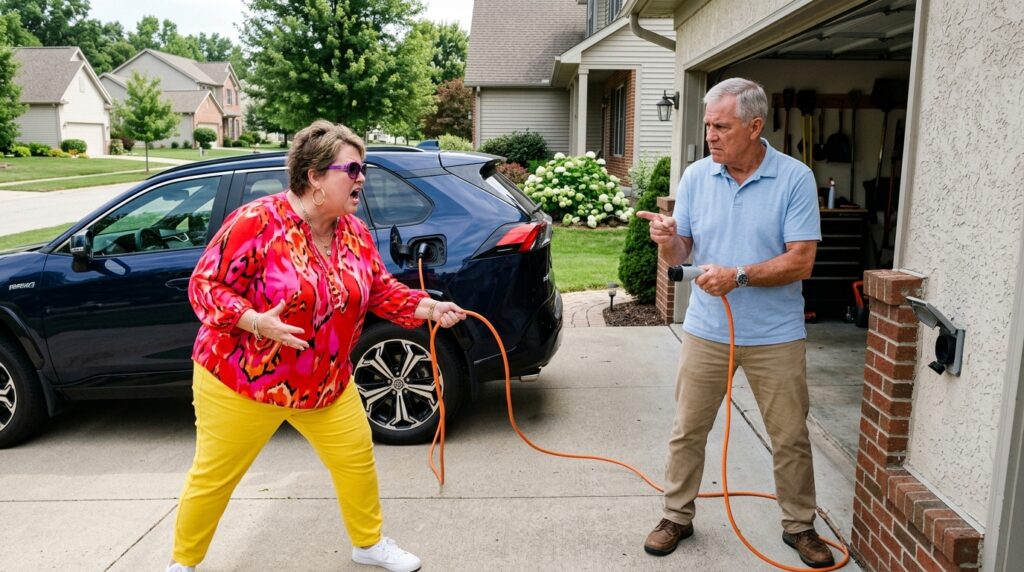
Chapter 3: Karen Changes the Story
Karen returned two days later.
This time, she didn’t bring the charging cable.
She came on foot.
Daniel was trimming a hedge when he saw her approaching.
She stopped at the edge of his driveway.
“You’ve been telling people I stole from you.”
Daniel lowered the hedge trimmer.
“I told Susan what happened.”
“You made it sound like I committed some crime.”
“I said you used our electricity without permission.”
Karen crossed her arms.
“You’re making this much bigger than it is.”
Daniel didn’t respond immediately.
That irritated her more than an argument would have.
“I offered to pay you,” she continued.
“You didn’t.”
“I was going to.”
“When?”
Karen stared at him.
She didn’t have an answer.
Daniel set the trimmer down.
“I checked the camera.”
Her expression changed.
Not dramatically.
Just enough.
Her shoulders stiffened.
Daniel told her he had footage of her connecting the charger on multiple occasions.
Karen immediately shifted tactics.
“You were spying on me?”
“The camera covers my driveway.”
“You shouldn’t be recording people.”
“It records my property.”
Karen shook her head.
“This neighborhood has become ridiculous.”
Daniel remained calm.
He didn’t raise his voice.
He didn’t call her names.
He simply stated what he knew.
“You used our outlet without permission. You did it repeatedly. You did it when we weren’t home. And after I caught you, you told me it wasn’t a big deal.”
Karen’s lips tightened.
“Because it isn’t.”
Daniel looked at her.
“For you, maybe.”
That ended the conversation.
Karen turned and walked away.
But she wasn’t finished.
By the next evening, several neighbors had heard a different version.
According to Karen, Daniel had “humiliated” her over an insignificant electrical bill.
Someone said Daniel was becoming unreasonable.
Someone else said Karen had been “borrowing” electricity because her own charger had stopped working.
The story moved through the neighborhood the way these things often do: faster than facts.
Daniel refused to chase rumors.
He kept his records.
He also called the utility company and asked whether they could inspect the meter for unusual usage.
They couldn’t tell him who had used the electricity, of course.
But they could confirm consumption patterns.
The technician explained that the house had shown several unusual spikes during periods when Daniel’s household normally used very little power.
Daniel didn’t celebrate.
The confirmation didn’t make him feel victorious.
It made him sad.
Because the situation had become bigger than two neighbors arguing beside a garage.
It had become a question of trust.
Then something unexpected happened.
Daniel received a message from another neighbor, an older woman named Linda.
She asked if they could talk privately.
When Linda arrived, she hesitated before speaking.
“I don’t want to get involved,” she said.
Daniel waited.
“But I think you should know something.”
She told him Karen had once asked to use her outdoor outlet too.
Linda had refused.
A week later, she noticed her electrical bill was unusually high.
She couldn’t prove Karen had been responsible.
So she had never accused her.
Daniel thanked her.
He didn’t make any accusation either.
But now there was a pattern.
And patterns demanded more careful attention than a single confrontation.