Chapter 4: The Folder With His Name
The folder contained forty-three photographs.
Daniel’s truck appeared in nearly all of them.
But there was something else.
Several photographs showed his driveway from across the street.
Others showed his garage door.
One captured him leaving early in the morning.
Another showed Emily arriving with Daniel’s grandson, Caleb.
Daniel stopped scrolling.
That was no longer about an old truck.
Someone had been watching his home.
He called Emily.
She arrived twenty minutes later.
They sat at the kitchen table while Daniel showed her the photographs.
Emily became quiet.
“Dad, why would she do this?”
“I don’t know.”
“Has she ever said anything to you about me?”
Daniel shook his head.
But then he remembered something.
Two weeks earlier, Karen had asked him whether he was planning to sell his house.
He had thought it was ordinary neighborhood conversation.
Now it felt different.
The following morning, Daniel asked Melissa for the account information.
She couldn’t disclose everything, but she confirmed that the complaint account had been created using an email address connected to Karen’s HOA committee account.
That didn’t prove everything.
But it explained enough to make the board take the matter seriously.
Karen was called in for another meeting.
This time, she arrived without her folder.
She claimed she had only been trying to protect property values.
She said the truck made the neighborhood look neglected.
She said residents had complained.
But when asked to identify those residents, she couldn’t.
When asked why she had personally photographed Daniel’s property, she said she was “keeping records.”
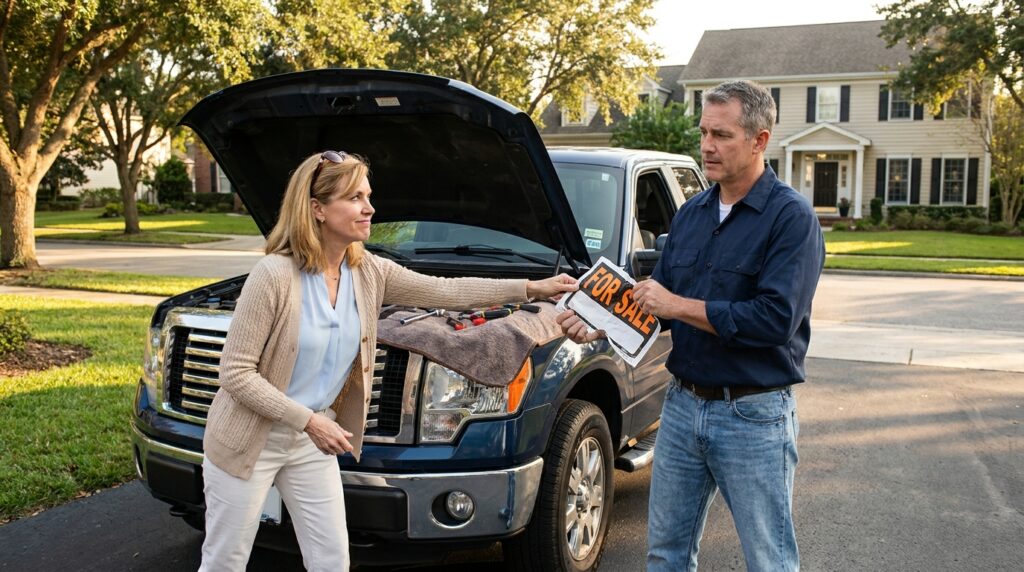
When asked why she had placed a “FOR SALE” sign on a vehicle she did not own, she had no answer.
Then Daniel asked one question.
“Why did you write dates on my windshield?”
Karen looked at him.
“I didn’t.”
Daniel placed the photographs of the stickers on the table.
Her expression changed.
The board president leaned forward.
Karen finally admitted she had marked the dates.
But she insisted there was nothing wrong with it.
“I needed to know how long the truck was sitting there.”
Daniel looked at the photographs again.
“You could have asked me.”
Karen’s answer was quiet.
“I knew you’d say you were fixing it.”
That sentence changed the room.
Because it meant she already knew the truth.
She hadn’t misunderstood the truck.
She had chosen to ignore it.
And now the board had to decide what to do with that information.