
CHAPTER 5: THE COLLAPSE
The word “tow” hung in the thick midday heat, heavy and unyielding as a slab of iron dropped onto the pavement.
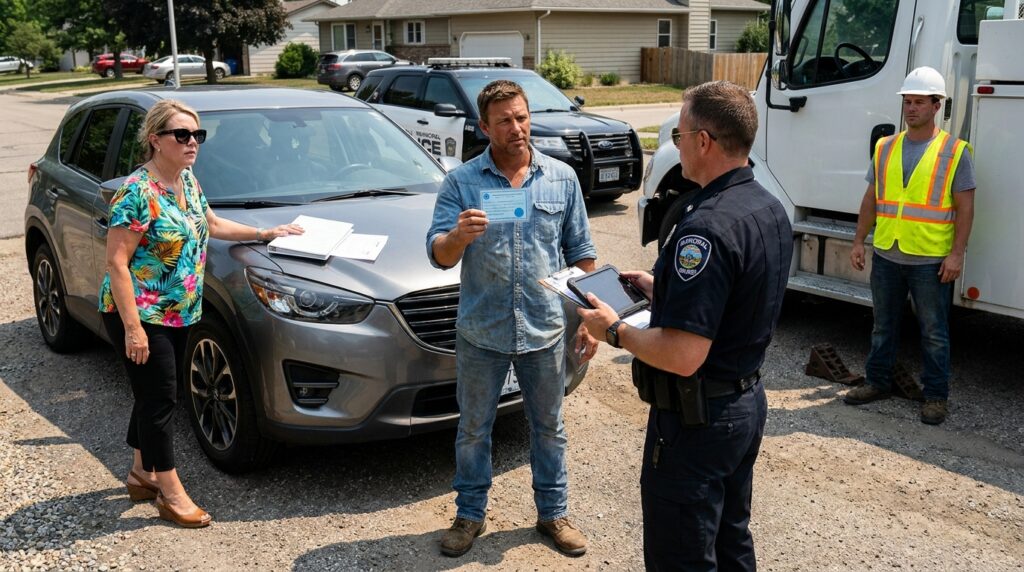
For a second that stretched until the rumble of the idling utility engine seemed to shake the very dust in the air, Evelyn Harper didn’t move. Her jaw stayed locked, her eyes wide behind the dark lenses of her glasses, staring at Officer Campbell as if waiting for him to break into a smile, to admit it was a mistake, to validate the twenty-five years of self-appointed dominion she had built over Bayview Drive.
Campbell didn’t smile. He unclipped his citation book from his belt, the heavy leather snapping with a sharp, dry crack that sounded like a gunshot across the quiet street. He unclipped a heavy black pen, laid the form against his metal clipboard, and looked directly at her over his glasses.
“I am opening the citation log, Mrs. Harper,” Campbell said, his voice dropping into a flat, steady rhythm. “The obstruction fine is three hundred dollars, non-negotiable. The county dispatch for a commercial flatbed will add two hundred and eighty dollars for the hook fee, plus forty dollars a day for storage at the impound yard.”
Evelyn’s breath hitched. A dark, ugly flush spread up her neck, staining her pale skin above the tropical print of her blouse. Her gaze flicked away from the officer, darting across the street to where old man Miller stood by his hedge, to where Mrs. Gable stood on her driveway, to the landscaping crew who had stopped work entirely to watch from the curb.
Every single pair of eyes on Bayview Drive was pinned to her. The neighbours who had paid her fifty-dollar “lawn compliance fees,” the residents who had quietly painted their mailboxes the exact shade of brown she demanded to avoid her harassment, the newcomers she had intimidated—they were all watching the illusion crumble into the dry gravel.
She looked down at her hands. The white binder, its spine broken, hung loosely from her fingers. The yellow corner of her tax delinquency notice was still sticking out from her blouse pocket, exposed, useless, and pathetic under the relentless glare of the sun.
“This isn’t over,” she whispered, though her voice lacked the sharp, biting edge it had carried five minutes ago. It sounded thin, dry, and brittle, like old leaves being crushed under a boot.
“It is for today, ma’am,” Campbell replied, his pen hovering over the paper. “Vehicle key in the ignition, or tow dispatch?”
Evelyn didn’t answer. She turned on her heel, her leather wedge shoes grinding harshly against the gravel, and pulled open the door of her silver crossover. She practically collapsed into the driver’s seat, her shoulders hunched forward as if the weight of thirty years of lies had suddenly settled squarely on her spine.
The engine turned over with a rough, metallic cough. She slammed the transmission into reverse, the tires spinning on the loose gravel, kicking up a small cloud of grey dust before she straightened the wheel and backed the crossover sixty feet down the street, right into her own driveway. The heavy garage door rattled violently as she drove inside, and before the rear bumper had even cleared the sensor, the automatic door mechanism groaned, descending to slam against the concrete threshold with a dull, hollow thud that echoed off the surrounding houses.
The street went deathly quiet.
Officer Campbell clipped his pen back into his pocket, tore the unwritten citation strip off his board, and turned to Marcus. He handed back the laminated permit, his thumb brushing the crisp, raised blue seal.
“You’re clear to proceed with your work, Mr. Vance,” Campbell said softly, a subtle, almost unnoticeable nod of respect passing between them. “If she comes out here again to interfere with a city-permitted job, call dispatch directly. It won’t be a warning next time.”
“Thank you, Officer,” Marcus said, taking the document.
Haro didn’t waste a second. He spat one last time into the dirt, waved his hand toward the cab, and yelled to his crew, “Alright, drop the stabilizers! We’re on the clock!”
The heavy steel jacks of the utility truck lowered with a deep, hydraulic hiss, biting firmly into the asphalt of the curb apron. The crew moved with practiced efficiency, setting up their safety perimeters and uncoiling the heavy electrical lines.
Across the street, old man Miller picked up his hedge shears, gave Marcus a slow, deliberate nod of approval, and went back to his bushes. Mrs. Gable turned and walked back up her driveway, her shoulders relaxed, her stride lighter than it had been in years.
Marcus stood by his mailbox, holding his permit, watching the heavy diesel rig work safely on the space that belonged to everyone. The air was still hot, smelling of dry pine and exhaust, but as he looked down the long, sun-bleached stretch of Bayview Drive, the air felt clearer, lighter, and finally free.