
CHAPTER 4: THE PUBLIC REVIEW
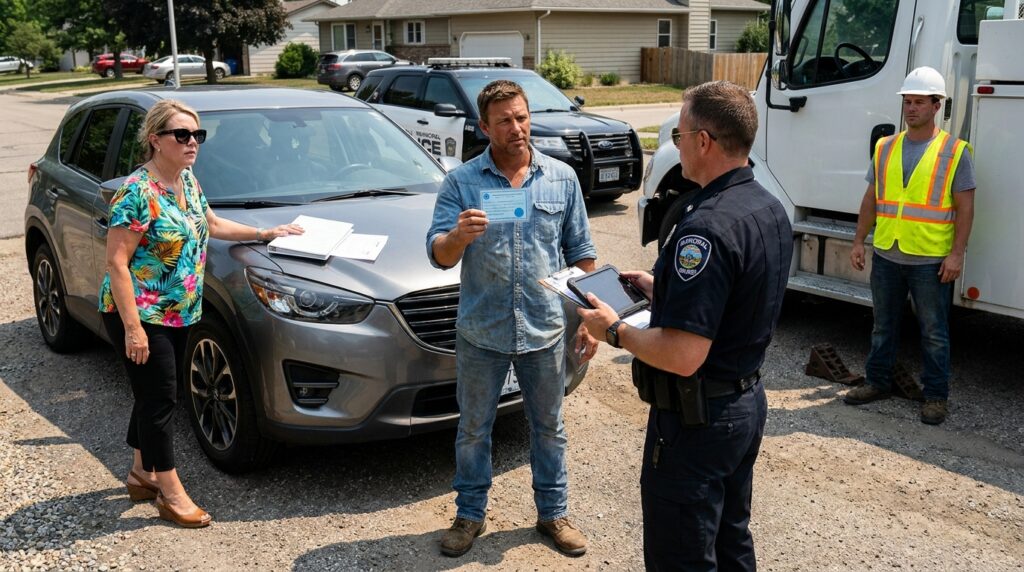
The white municipal cruiser rolled over the curb apron, its tires crunching heavily into the sun-baked gravel before coming to a stop behind Evelyn’s angled crossover. The doors creaked on dry hinges as Officer D. Campbell stepped out, his dark uniform crisp despite the oppressive August humidity. His eyes, narrowed behind aviator glasses, swept the scene in a single, practiced arc—taking in the idling utility rig, the orange cones, the cluster of watching neighbors, and Evelyn standing rigidly against the truck’s front grille.
“Officer! Thank God you’re here,” Evelyn called out, stepping away from the grille with her chin held high, her tropical blouse snapping softly in the hot exhaust breeze. She clutched her broken binder against her chest like a shield. “We have an unauthorized commercial intrusion blocking our residential access, and this homeowner refuses to comply with block safety regulations.”
Officer Campbell didn’t answer right away. He adjusted his duty belt, the heavy leather creaking under the weight of his radio and equipment pouch. His boots made a rhythmic, heavy thud against the hot pavement as he walked past her crossover, taking in the tire angles and the way her rear bumper jutted four feet into the public driving lane.
“Who called dispatch?” Campbell asked, his voice a low, gravelly baritone that carried no warmth and no bias.
“I did,” Marcus said, stepping off the grass. “Marcus Vance, owner of 412. I have a permitted utility drop scheduled for today. The vehicle blocking the right-of-way belongs to Mrs. Harper.”
“He’s operating on a fraudulent permit!” Evelyn interjected, her voice rising an octave as she thrust a hand toward her binder. “The Bayview Block Committee has an established 1988 easement covenant on this apron. Private green space preservation overrides basic utility access!”
Campbell turned his head slowly, looking at Evelyn over the top of his dark lenses. “Ma’am. Are you an officer of a registered municipal Homeowners Association?”
“I am the administrator of the Bayview Block Committee,” she declared, drawing herself up. “We have enforced the road standards on this street for twenty-five years.”
Marcus stepped forward, handing Campbell the laminated sheet. The embossed blue seal caught the harsh glare of the midday sun, shining like polished bronze. “City Department of Transportation permit number 88-41-A. Issued two weeks ago. Approved for full utility access from seven-thirty AM to three PM today.”
Campbell took the document in his gloved hands. He didn’t just glance at it; he held it up to the light, feeling the tactile ridge of the raised municipal seal with his thumb. Then he unclipped a heavy, ruggedized tablet from his belt harness, tapping the screen with rapid, practiced movements.
For two minutes, the only sound on Bayview Drive was the steady, heavy thrum of the utility truck’s diesel engine and the dry rustle of pine needles along the ditch. Across the street, old man Miller had crossed his lawn, standing right at the edge of the curb with his shears hanging loose, watching intently. Behind him, Mrs. Gable had walked all the way down her driveway, joined by two workers from the landscaping crew down the block.
Marcus watched Officer Campbell’s face. The officer’s eyes scanned the tablet screen, moving past the city access map to the municipal registry database. A subtle shift occurred around Campbell’s mouth—a tightening of the jaw that signaled the moment a official truth locked into place.
“Mrs. Harper,” Campbell said, his voice flat as slate as he looked up from his screen. “I’m pulling the municipal GIS plot for Bayview Drive right now.”
Evelyn’s hands tightened on the broken binder until her knuckles turned chalk-white. “My covenant paper is in this binder. Signed by the original developer—”
“There is no registered covenant on this parcel,” Campbell interrupted cleanly. “And there is no record of a ‘Bayview Block Committee’ in the county clerk’s office, the secretary of state’s business index, or the city tax registry. This street is a public thoroughfare owned and maintained entirely by the City of Oakridge.”
The silence that followed was heavy and suffocating. Evelyn stared at the officer, her mouth opening slightly, but no sound came out.
“The permit in my hand is completely valid,” Campbell continued, turning the tablet screen slightly so Marcus and Evelyn could both see the bright green verification indicator beside the GPS boundary lines. “And your vehicle is currently parked in direct violation of Municipal Code 410-B: Unlawful Obstruction of a Permitted Work Zone.”
“You… you don’t understand,” Evelyn stammered, her composure cracking like dry mud. Her eyes flicked frantically toward the gathering crowd of neighbors, who were watching in complete, unblinking stillness. “We paid for the road sealing! We maintain the aesthetic integrity! You can’t just let a heavy commercial rig—”
“Ma’am,” Campbell said, his voice dropping into the cold, sharp register of immediate legal authority. “I am going to ask you once. Enter your vehicle and remove it from the permitted zone.”
Evelyn didn’t move. She stood frozen on the hot asphalt, her fingers digging into the vinyl of her binder, the secret of her fake authority laid completely bare under the blinding summer light.
Marcus didn’t gloat. He simply stood beside his mailbox, feeling the quiet, heavy weight of the moment settle over Bayview Drive.
“If you refuse,” Campbell added, his hand resting casually near his radio strap, “I will issue an immediate three-hundred-dollar obstruction citation, and I will dispatch a heavy-duty tow unit to clear this apron at your expense.”