CHAPTER 1: THE CURB LINE
“You move two inches closer to that curb, and I’m having this rig impounded before the sun hits the fence posts,” Evelyn said, her voice dropping into the flat, dangerous quiet of a woman who had spent twenty years running this street without a challenge.
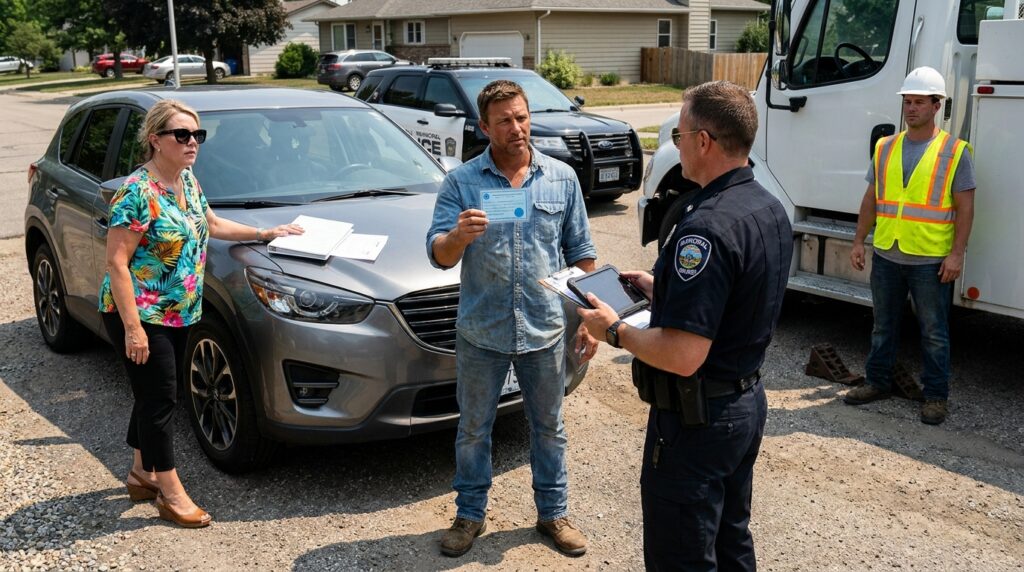
The heavy diesel engine of the utility truck thrummed beneath the heat, shaking the dry air between the houses. Marcus Vance stood at the edge of his gravel driveway, his boots planted on the cracked asphalt where his property met the public street. The heat of the August sun beat down on his neck, smelling of sun-baked pine needles and exhaust. In his right hand, the stiff plastic edge of a laminated city right-of-way permit dug into his palm.
Across the hood of her dark silver crossover—parked squarely across the mouth of his access apron at a sharp, aggressive forty-five-degree angle—Evelyn Harper didn’t flinch. Her oversized black sunglasses reflected the bright glare of the sky, hiding her eyes, but her jaw was set tight. Under her arm, she clutched a thick, faded white binder, its spine bulging with unlaminated home-printed “notices” and hand-typed lists of neighborhood regulations she had spent two decades enforcing with the cold discipline of a tax collector.
“This is a public thoroughfare, Evelyn,” Marcus said, keeping his voice low, steady, and stripped of heat. “The city department of transportation cleared the drop two weeks ago. The contractors are here to work.”
“The city doesn’t pave this asphalt after heavy machinery grinds the topcoat into gravel,” Evelyn snapped, stepping away from her driver’s side door. The bright tropical print of her blouse stood out against the sun-bleached gray of the pavement. She tapped a manicured nail against the vinyl cover of her binder. “The Bayview Block Committee voted three years ago that any commercial chassis over four tons pays a five-hundred-dollar road preservation deposit to the street fund before a tire touches the curb. You didn’t submit the form. You didn’t pay the fee.”
Behind Marcus, the lead contractor, a broad-shouldered man in a sweat-stained high-visibility vest, leaned out of the truck cabin. He didn’t turn off the ignition. He just looked at Marcus, his brow furrowed under his hard hat, waiting to see if this was going to be a thirty-minute job or a three-hour screaming match that ended with his rig sitting idle on company time.
Across the street, old man Miller paused on his front porch, a pair of hedge shears hanging slack in his hands. Two doors down, a front curtain twitched, then pulled back. The neighborhood was watching. They knew how this went. For six years, anyone who wanted to pour a patio, cut a tree branch, or park a trailer had paid Evelyn’s “administrative fees” or faced endless complaints, fake citations, and code enforcement calls until they broke.
Marcus didn’t raise his voice. He didn’t look at the neighbors. He stepped forward until he was three feet from the front bumper of Evelyn’s crossover, holding out the laminated sheet so the blue, embossed municipal seal caught the glare of the noon light.
“There is no street fund, Evelyn,” Marcus said smoothly, his eyes locking onto the dark lenses of her glasses. “And you don’t own the asphalt.”
Evelyn reached into her binder, pulling out a folded piece of yellowed paper, her fingers trembling slightly with cold rage. “You think you’re the first person to try reading city ordinances to me, Vance? Look at this.” She slapped the paper against the hood of her car. “1988 easement covenant. This apron is private community access.”
Marcus didn’t reach for the paper. Instead, his thumb slid over the edge of his own document, feeling the raised seal, knowing the exact line where her authority ended and the law began.