CHAPTER 3: THE BROKEN LEDGER
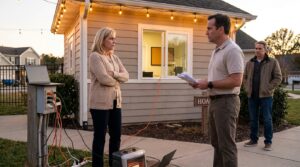
The morning air smelled of cold wet iron and diesel fumes. At 6:15 AM, forty-five minutes before Inspector Hewitt’s scheduled arrival, the streetlights along Laurel Crossing flickered and shut down, plunging the cul-de-sac into a flat gray pre-dawn light.
Nora didn’t wait on her porch. She walked down the driveway, her boots crunching on the gravel path that ran parallel to her framed timber layout. In her right hand she carried a galvanized steel clip clipboard containing three documents: the certified county site plan, the notarized easement affidavit, and a high-resolution printout of the 11:43 PM camera frame showing Brenda’s hand on the rebar stake.
Across the street, at the central community mailbox cluster—a bank of sixteen aluminum lockers anchored into a concrete pad—a shadow moved.
It was Brenda. She wasn’t setting up cones this time. She stood by the open master distribution box, her heavy floral coat buttoned to the collar, her white visor pulled low over her brow. Beside her on the concrete pad rested her thick white binder, left unzipped, its plastic dividers flapping slightly in the sharp morning breeze.
Nora adjusted her stride. She didn’t head toward Brenda’s driveway; she walked straight toward the mailbox cluster, the galvanized clipboard resting against her thigh.
“The carrier doesn’t run until eleven, Brenda,” Nora said as her boots hit the curb opposite the mail pad.
Brenda didn’t flinch. She was holding a stack of blue-and-white window envelopes—official HOA assessment notices. She didn’t look up as she slid one into Mr. Miller’s slot, then another into Sarah Jenkins’s box.
“Board business isn’t limited to postal hours, Nora,” Brenda said. Her voice was raspy, thin, as if she hadn’t slept. “Emergency assessment delivery. Section 8, Clause C. The board retains the right to hand-deliver notice when a property owner creates an unmitigated nuisance.”
Nora stepped onto the concrete pad. The space between them closed to three feet.
“You’re distributing fines for my driveway,” Nora said flatly.
“I am distributing an emergency drainage levy,” Brenda corrected, her gloved fingers jamming another envelope into box fourteen. “Three hundred dollars per household to cover potential structural mitigation if your unpermitted excavation compromises the cul-de-sac line.”
“There is no cul-de-sac line under my lawn,” Nora said. She raised her clipboard, laying it flat on top of the aluminum mailbox bank. “The municipal main runs down the center of the asphalt. Here. Section 2, Page 4 of the county public works index.”
Brenda finally turned her head. Her eyes were bloodshot, the skin beneath them bruised with exhaustion. She looked at the paper on the clipboard, then at Nora’s eyes.
“County papers don’t overwrite neighborhood solvency,” Brenda spat, her voice dropping into a harsh whisper. “You think you’re clever with your cameras and your phone calls? If the drainage fails, the insurance carrier drops Laurel Crossing. If the carrier drops us, property values fall fifteen percent across the entire zip code. I am protecting this street from people who don’t understand what it costs to stay whole.”
“You’re not protecting the street,” Nora said softly. “You’re collecting money.”
“It goes into the reserve account!” Brenda snapped, her hand slapping against the side of her open binder.
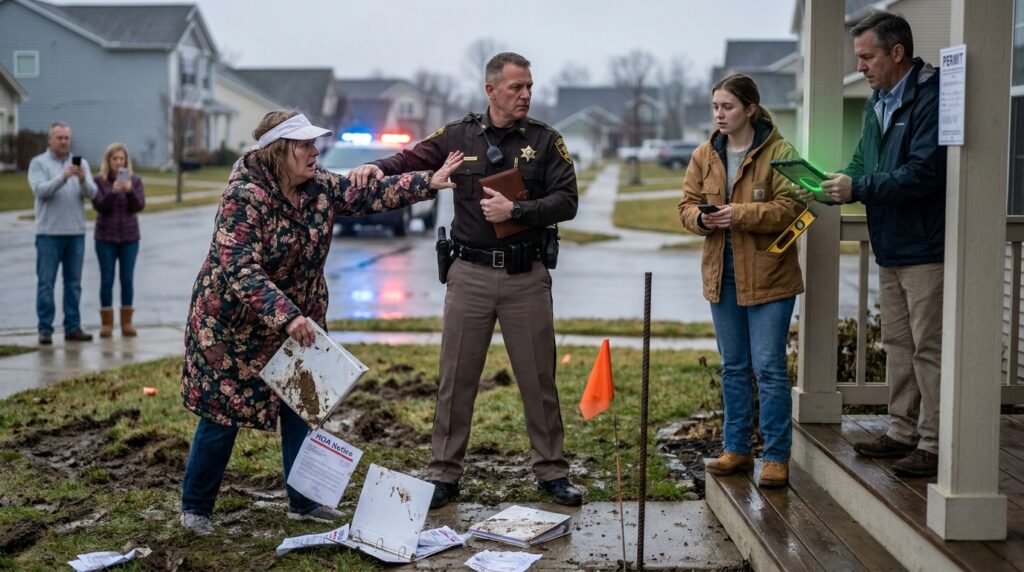
The force of her palm hit the binder’s unzipped spine. The thick plastic cover flipped backward, and a heavy, green cloth-bound ledger—not an HOA binder, but an old ledger book with frayed canvas edges—slid off the concrete base and hit the damp asphalt with a heavy, hollow thud.
The book burst open on impact.
A dozen loose papers scattered across the wet street: bank deposit slips from First National, hand-written carbon receipts, and pink duplicate pages.
Brenda made a sharp, panicked sound in her throat and dropped to her knees, her hands scrambling across the wet pavement to grab the loose sheets.
Nora didn’t jump forward, but her eyes locked on the paper nearest her boot. It was an carbon receipt dated four months back, made out to Miller, House 38. Amount: $450.00. Paid in cash. For: Unapproved tree trimming compliance.
Beside it lay a First National deposit slip. The account name at the top wasn’t Laurel Crossing HOA Reserve Fund.
It read: Clery, Brenda M. – Personal Checking.
Nora reached down and picked up a second slip before Brenda’s gloved hand could reach it.
“Give me that!” Brenda shrieked, her voice cracking as she lunged upward from the pavement, her visor slipping sideways across her forehead.
Nora stepped back smoothly, keeping the paper out of reach. She looked at the printed numbers. It was a deposit record from three weeks ago: $1,200 in cash, deposited directly into the personal checking account, accompanied by a handwritten note on the back in Brenda’s precise script: Jenkins / Gable compliance settlements.
The physical decoy secret was bare, laid out across the wet asphalt between them. Brenda wasn’t just an overzealous neighborhood marshal defending property values; she was running an unrecorded, private extortion racket, converting bogus HOA violation threats into direct personal cash income to cover her own spiraling debts.
“This isn’t an HOA ledger,” Nora said, her voice dropping into a stone-cold register that cut through the wind. “These are cash receipts. You’ve been fining the seniors on this street and depositing the money directly into your own account.”
Brenda stood up, her chest heaving, clutching the green cloth ledger against her stomach like a wounded animal. Her face had gone completely white, her jaw trembling.
“Mr. Miller doesn’t know how to file county variances,” Brenda stuttered, her eyes darting frantically toward the dark windows of the surrounding houses. “I handle his filings! I take a management fee! It’s administrative compensation!”
“There is no management fee in the HOA charter, Brenda,” Nora said, holding the deposit slip firmly between her thumb and forefinger. “This is fraud.”
Brenda took a slow step toward Nora, her voice dropping into a desperate, dangerous hiss. “You hand that back to me right now, Nora. You hand it back, or I swear to God I will have your driveway paved over before noon. I have the board signatures!”
“You don’t have the board,” Nora said quietly.
Down at the end of the cul-de-sac, two headlights turned onto Laurel Crossing. A white County Code Enforcement SUV came to a stop at the curb, its roof lights flashing silently in the gray light, followed immediately by a marked Sheriff’s Department patrol cruiser.
Nora didn’t look away from Brenda’s face as the car doors opened in the distance.
“Inspector Hewitt is here, Brenda,” Nora whispered. “And I’m handing him this deposit slip.”
Brenda didn’t run. She stood frozen on the concrete pad, her knuckles white against the green canvas ledger, her eyes wide with a frantic, animal terror as Deputy Albright stepped off the curb and began walking toward the mailboxes.